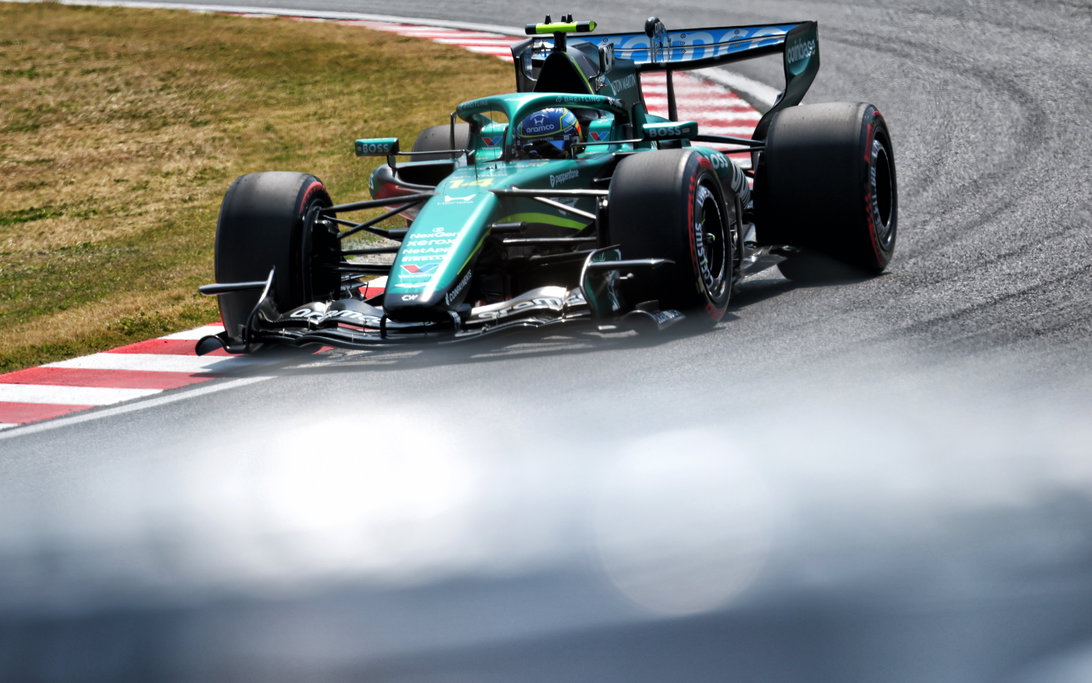
The Ghost in the Machine: Alonso's Vibration Mystery is a Data Failure, Not a Mechanical One

I stared at the telemetry trace from Suzuka, the jagged lines of Alonso’s steering input looking less like a driver’s command and more like a seismograph reading an earthquake. The numbers told a story of chaos, but the real story was in the silence. The silence of a data lake with no answers. Aston Martin’s engineers were left baffled, not by a broken part, but by a narrative that their own terabytes refused to write. This isn't a reliability crisis; it's a fundamental failure of modern F1's diagnostic religion. We worship at the altar of real-time telemetry, yet when a ghost walks through the machine, we have no exorcism protocol.
The Unforgivable Sin: A Data Set That Lies
The facts, as cold and hard as a carbon fiber plank, are these: On Friday, 27 March 2026, at Suzuka, Fernando Alonso reported his Aston Martin AMR24 felt "completely normal." The chronic, debilitating vibration from the Honda power unit had nearly vanished. By Saturday, with zero changes to setup or components, the violent shudder was back, relegating both cars to the back row of the grid.
"A bit of a random thing," Alonso called it. That phrase should send a chill down the spine of every data analyst from Silverstone to Sakura.
Randomness is the antithesis of data science. It is the admission of ignorance. We have a thousand sensors measuring temperature, pressure, torsion, and harmonics at millisecond intervals, yet the core variable—driver feel—remains an analog ghost in a digital machine. The team is now "scouring data from Friday's successful running." Scouring. That’s the word you use when you’re lost in the desert, not when you have a precise map.
- The Chronic Issue: Forced Alonso's retirement in China due to physical discomfort.
- The False Dawn: Friday's "normal" running was a data mirage.
- The Unexplained Reversal: No change in input, catastrophic change in output. This is the diagnostic equivalent of a system saying 2+2=4 on Friday and 2+2=ERROR on Saturday.
This is where our hyper-focus fails us. We correlate exhaust gas temperature with lap time delta, but we lack a sensor for the subtle decay of a carbon-fiber weave under harmonic stress, or the microscopic shift in a hydraulic line that only manifests as a feeling in the driver's palms. Michael Schumacher in 2004 didn't have this density of data. He had a symbiotic connection with his F2004, a feedback loop of flesh and steel that translated nuance into adjustment. Today, we’ve outsourced intuition to the server rack, and when the server has no log entry for "vibration," we are left mute.
The Human Cost of Digital Blindness
Let’s perform what I call emotional archaeology. We don't just look at Alonso’s lap time drop-off of 1.8 seconds from Friday practice to Q1. We dig into what that number means. It represents the crushing of ambition. Aston Martin began 2024 with podium dreams. Now, they are forensic accountants, auditing failure instead of developing performance.
Every lost lap is more than a data point; it’s a stolen moment of potential. The driver’s evolving understanding of the tire, the engineer’s incremental tweak, the collective confidence built corner by corner—all erased by an erratic pulse. This vibration isn't just shaking the car; it's shaking the foundation of the team's season. The development of the AMR24’s upgrade package is now stunted, trapped in a holding pattern until a fundamental becomes reliable.
This is where the narrative around drivers like Charles Leclerc becomes so painfully ironic. We pillory him for the occasional high-profile error, often pre-faced by a Ferrari strategy call that boxes him into desperation. Yet, his raw qualifying consistency data from 2022-2023 is arguably the best on the grid. We have the numbers to prove his elite, repeatable performance, but we choose the emotional narrative of the "mistake." Conversely, with Alonso, we have a clear, physical problem destroying performance, and because the data can't pinpoint it, the story risks becoming about "unlucky vibes." The numbers are there. We're just reading the wrong ones.
The Sterile Future: From Driver to Data Executor
The Suzuka vibration saga is a harbinger. It’s a crack in the façade of our controlled, data-driven world. And the terrifying response from the sport’s trajectory is not to embrace this mystery, but to redouble efforts to eliminate it.
Within five years, this hyper-focus on analytics will lead us to the brink of ‘robotized’ racing. The driver’s role will be suppressed further, their intuition overridden by the algorithm’s certainty. Pit stops, tire strategies, even in-lap fuel saving will be dictated by centralized AI, optimizing for the mean, eliminating the miraculous. The sport will become sterile, predictable. A vibration like Alonso’s will be "solved" by a standard sensor package and a mandated power unit mode that neuters performance for all, in the name of parity and predictability. The ghost will be eliminated by demolishing the haunted house.
Aston Martin’s immediate priority is diagnosing the root cause. But the larger diagnosis for Formula 1 is this: We are becoming brilliant at answering questions, and utterly incapable of hearing the ones the machine is whispering. We need data that serves the story of human and machine striving at the limit, not data that demands the human become a passive interpreter of dash lights.
The final insight from Japan isn't in the timing sheets. It's in the bafflement. It's in the space between Alonso’s "completely normal" and his "random thing." That space is where racing still lives. Let's not data-map it into oblivion. Let's learn to listen to its pulse, even when—especially when—it doesn't fit our models.