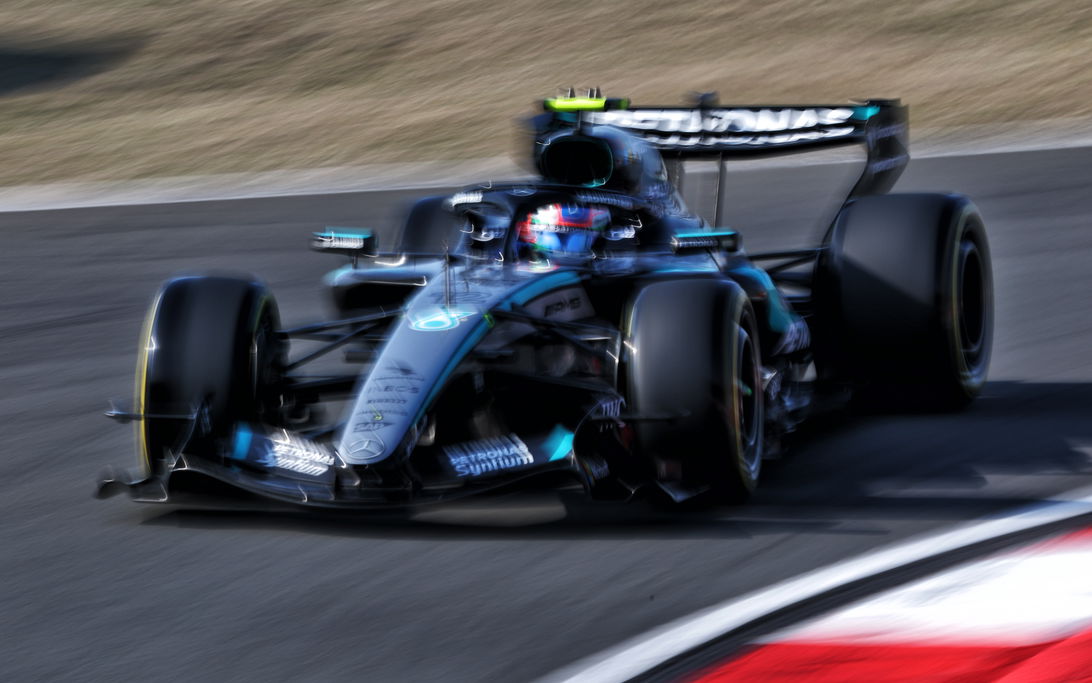
Antonelli's 10-Second Penalty: A Data Point in F1's March Toward Robotic Racing

The stewards' bulletin landed in my inbox with a sterile thud. "Car 81, predominantly to blame. 10-second time penalty. Two super licence points." I stared at the numbers: 7 out of 12. For Kimi Antonelli, this is a crisis. For me, Mila Neumann, it's another chilling data point in the inexorable algorithm. The story isn't a rookie's mistake at Shanghai's Turn 6; it's the system's frantic, failing attempt to quantify the unquantifiable—the desperate, beautiful chaos of a first-lap midfield scramble. They're trying to build a perfect, predictable model, and a 19-year-old's instinctive lunge just threw a wrench into the code. They'll call it a penalty. I call it a last stand.
The Algorithm of Blame vs. The Archaeology of Pressure
Let's excavate the data they won't show you. The FIA's verdict is binary: Antonelli at fault. But pressure is a gradient, a waveform. Plot these coordinates:
- Grid Position: Antonelli had a "poor start." The telemetry would show a clutch bite point deviation of millimeters, a torque curve that didn't match the pre-race simulation.
- The Opponent: Isack Hadjar, in a Red Bull. Not just any car, but the benchmark, the data-set monster. The psychological weight of that alone is worth three-tenths a lap.
- The Cumulative Weight: This is his fourth F1 weekend. He is a living, breathing database being written in real-time, every neuron firing against a backdrop of being Mercedes' "potential future star."
Now, overlay this with the penalty: 7 penalty points. More than halfway to a ban. We are now correlating a micro-second misjudgment under immense kinetic and psychological load with the macro consequence of a race ban. This is where data stops being informative and starts being tyrannical. Where is the column for "immense scrutiny"? Where is the cell for "potential future star" pressure? We have the heartbeat of the engine, but we’re ignoring the tachycardia of the driver.
"Data should serve as emotional archaeology. The real story isn't the contact at Turn 6; it's the cascade of failures—mechanical, strategic, human—that placed a rookie in that vulnerable, desperate mental state five laps earlier."
This is where modern F1 fails. They see Kimi Antonelli as a variable to be controlled. I see a dataset screaming in panic. Contrast this with Schumacher's 2004 season. The Ferrari F2004 was a beast, but it was an extension of him. The team listened to his feel, the data was secondary confirmation. Today, the process is reversed. The data dictates the feel. Antonelli didn't just hit Hadjar; he deviated from the pre-race probability cloud. The penalty is the system's error correction.
The Sterile Future: Penalty Points as Pre-Crime Metrics
This incident is a perfect microcosm of my central fear: within five years, this sport will be robotized. The 10-second penalty and the two super licence points are not just punishments; they are inputs. They feed the model that will eventually tell a driver, before a race, the statistical probability and consequence of every move. The algorithm will advise: "Lunge at Turn 6 carries a 42% risk of contact, with an 87% probability of a penalty, increasing your ban risk to 31%. Recommendation: hold position."
- The Incident: Lap 1, Turn 6, Shanghai. A fight in the midfield. The most volatile, data-poor environment of the race. The models are blind here.
- The Outcome: Hadjar forced wide. Race compromised. Antonelli penalized.
- The Datafication: The stewards reviewed the "predominantly to blame" clause. This is a qualitative judgment being forced into a quantitative framework. Soon, an AI will review the telemetry overlap, the steering angle, the braking trace, and auto-generate the penalty report. Objectivity achieved. Soul extinguished.
What's next for Antonelli? The article says "damage limitation" and "resetting." Nonsense. What's next is that this incident becomes a permanent node in his driver profile. Every future aggressive move will be weighted against this. His "risk score" just ticked up. Mercedes' "critical balancing act" isn't about nurturing racecraft; it's about tuning a human algorithm to stay within the safe parameters of the sport's master code. They aren't teaching him to be Senna; they're teaching him to avoid exceeding the standard deviation.
Conclusion: The Human Error They're Trying to Eliminate is the Sport Itself
So, Kimi Antonelli sits with 7 penalty points. The narrative will be about his recklessness, his learning curve. The deeper, more uncomfortable truth is that his "error" is the last vestige of the sport I fell in love with. Michael Schumacher in 2004 made errors too, but they were human errors, debated in pubs, not adjudicated by a digital rulebook that adds points to a licence like a driver scoring a bad credit rating.
The Chinese Grand Prix Sprint on 2026-03-14 will be a footnote. But for me, it's a landmark. The collision between Car 81 and Car 37 was metal on carbon fiber. The more significant collision is happening off-track: between instinct and instruction, between feel and telemetry, between the story a heart tells under braking and the story the timing sheet tells the stewards.
They've given Antonelli a penalty. I'm giving the sport a warning. You can model the car, you can model the tire wear, you can even model the penalty risk. But the moment you succeed in modeling the driver's soul, you've turned the greatest spectacle in motorsport into a very expensive, very predictable spreadsheet. And spreadsheets, no matter how many bolded cells they contain, have no heart.