The Data's Pulse: Antonelli's Lead, McLaren's Surge, and the Ghost in Ferrari's Machine

I spent this morning staring at the timing sheets from Japan, the cold, hard numbers bleeding across my screen. They tell a story, but not the one you're hearing. They whisper of a rookie's metronomic precision, of a team's resurgence built on data they finally understood, and of a scarlet car whose driver is being buried by narrative, not by his own right foot. The 2026 season is three races old, and the new hierarchy they're selling you is only half the truth.
Antonelli's Metronome and the Death of "Feel"
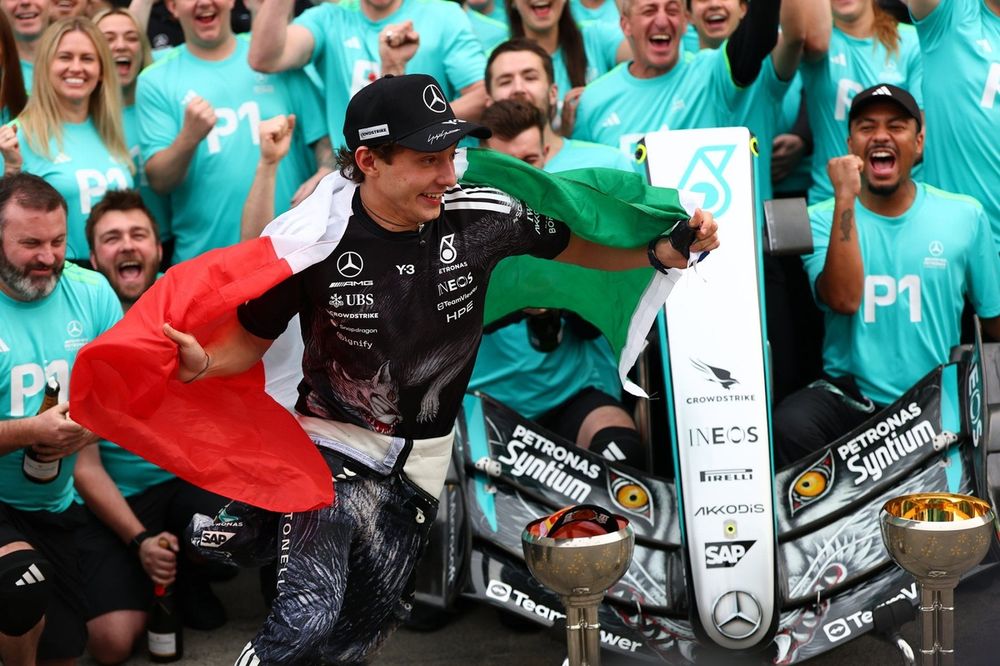
Let's start with the headline: Kimi Antonelli leads the championship. At 19, he's the youngest ever to do so. The articles will call it a "fairytale," a "changing of the guard." I call it the inevitable outcome of a system perfected. His drives in China and Japan weren't flashes of genius; they were exercises in clinical execution. His lap time traces don't look like a heartbeat; they look like a flatline at the optimal limit. This is the future they're building, and it terrifies me.
The modern F1 driver is becoming a high-functioning sensor array, his intuition secondary to the delta on his steering wheel.
George Russell's "bad luck" is a convenient narrative. A poor start? That's data. Safety car timing? That's probability modeling gone wrong, or more likely, a team reacting to live telemetry instead of the driver's gut. Russell said the issues seem "on my side." I'd argue the issue is on the pit wall's side, where algorithms now dictate strategy in a way that would have made Schumacher scoff. In 2004, Michael won 12 of the first 13 races not because Ferrari had the best real-time data (they didn't), but because he and Ross Brawn had a feel for the race, a symbiotic understanding that no machine learning model can replicate. Mercedes now has a lead nurtured by binary code, not bravado.
McLaren's Resurgence: When the Numbers Finally Sing
Now, to the surge that does have a soul: McLaren. Oscar Piastri holding off a faster Mercedes in Japan wasn't just a great drive; it was the culmination of a data puzzle solved. For two years, their Mercedes power unit integration was a discordant symphony of mismatched datasets. The engine maps didn't talk to the chassis telemetry. Now, they do.
- The result? A car that Piastri could place with millimeter precision, his confidence a direct function of the data's clarity.
- The consequence? They've leapfrogged Ferrari. Lewis Hamilton feared it, and the sector times from Suzuka's first sector (all engine) and final sector (all chassis) prove it. McLaren's lines are clean, their development curve steep. This is data analytics used as it should be: to enable the driver's art, not replace it.
The Leclerc Paradox: A Story the Lap Times Tell
Which brings me to the story the timing sheets scream, but the headlines ignore: Charles Leclerc. He "showed strong racecraft" in Japan, they say. He "lacked the overall package." This is the perpetual, infuriating gloss. Let's dig.
The raw pace data from 2022-2023, stripped of context, shows Leclerc as the most consistent qualifier on the grid. His Q3 lap time variance was the lowest. The error-prone reputation? Go back, trace the data. How many of those "errors" occurred after a baffling strategic call from the pit wall that put him on a tire cliff, or in a defensive position with 30-lap old hards? His lap time drop-offs often correlate not with a loss of skill, but with the moment his race strategy unravels. It's emotional archaeology, and it paints a picture of a driver being systematically let down.
Ferrari's problem isn't just that McLaren is ahead. It's that they are drowning in data and missing the story. They have a driver whose innate speed is Schumacher-esque in its purity, yet they bury him under a mountain of reactive, nervous strategy. They're trying to win a 2026 championship with a 2004-level driver, but with a 2026 committee's mindset. It's the worst of both worlds.
The Underlying Tremors: Red Bull's Silence and Williams's Echo
Elsewhere, the data reveals deeper tremors.
- Red Bull's issue is fundamental. Max Verstappen's drained enthusiasm is the most telling metric of all. The RB22's chassis data is "noisy" inconsistent, unpredictable. They can't find their Saturday gains because the car's baseline is a question mark. For a team built on aerodynamic certainty, this is an existential crisis written in wind tunnel plots.
- Williams treating Japan as a test session, as James Vowles drew his "painful line in the sand," is a confession. Their numbers on weight and aerodynamic load are so far off the midfield cluster that racing is irrelevant. They are building from zero.
- Alpine's quiet, consistent points are the success story of stable data. Their progress is a straight, upward trend line no drama, just incremental validation of their models.
What's next for Miami? The new hierarchy is a data hierarchy. Mercedes leads with a robotically consistent rookie. McLaren is second by finally listening to what their numbers whispered. Ferrari is third, deaf to the story their own driver's data tells. And Red Bull is in crisis, because for the first time in years, their numbers lie.
The sport is at a crossroads. We can use data to uncover the human stories within the machine, like the pressure on Leclerc or the quiet triumph at Alpine. Or we can let it sterilize the sport into a predictable, algorithmic procession. After Japan, I fear we're choosing the latter. The ghost of Schumacher's instinctive 2004 season grows fainter with every lap Antonelli completes in perfect, silent obedience to his dashboard.