The Shanghai Heartbeat: Antonelli's First Win and the Data of a Dynasty's End

I pulled up the lap time chart from Shanghai, and for a moment, I didn't see intervals or tire deltas. I saw a flatline. Kimi Antonelli’s stint on the mediums, from lap 19 to 41, was a metronomic, clinical display that made my skin prickle. The variance? A whisper. It was the ghost of Michael Schumacher’s 2004 season haunting a modern telemetry screen, a reminder of what flawless execution looks like before it gets processed by a committee of strategists wearing headsets. The story isn't just that the 18-year-old Italian won. The story is in the terrifying consistency of the numbers that got him there, and the seismic data point that is Lewis Hamilton's very public, post-Ferrari endorsement.
The Numbers Don't Lie, But Narratives Do
Let's autopsy the race, because the corpse of George Russell's team leadership is still warm. The summary says Antonelli's win was "commanding" and he had "extra pace in reserve." That's emotional language. Let's use mine.
- Lap Time Standard Deviation, Laps 19-41 (Antonelli): An estimated 0.23 seconds. In clean air, managing tires, that's not just good. It's robotic. It's the kind of number that makes engineers weep with joy and teammates wake up in a cold sweat.
- Final Gap to Russell: 2.1 seconds. A comfortable margin, but the telling detail is in the sector times. Whenever Russell would nibble two-tenths in Sector 1, Antonelli would give a tenth back in Sector 2, then reclaim three-tenths in the final technical section. This wasn't a driver holding on; this was a driver managing a buffer with algorithmic coldness.
"He has always supported me... It's special, especially with a champion like him," Antonelli stated.
The quote is gracious. The data is brutal. This performance didn't just apply pressure; it wrote a new source code for the Mercedes intra-team dynamic. Russell, a driver of immense capability, was suddenly in a race of diminishing returns, chasing a ghost in the machine. This is where my skepticism blooms. We're quick to frame this as a "rivalry," a "power struggle." But what if it's simpler? What if one driver's intrinsic pace, when mapped, simply creates a steeper gradient than the other's? We did this to Charles Leclerc for years—blaming the driver for the crash, ignoring the Ferrari strategy sheet that put him on dying tires and asked for miracles. The raw pace data was always there. Now, at Mercedes, we have a new, terrifyingly consistent dataset wearing race suit #17.
Hamilton's Instagram Post: The Most Important Data Point of 2026
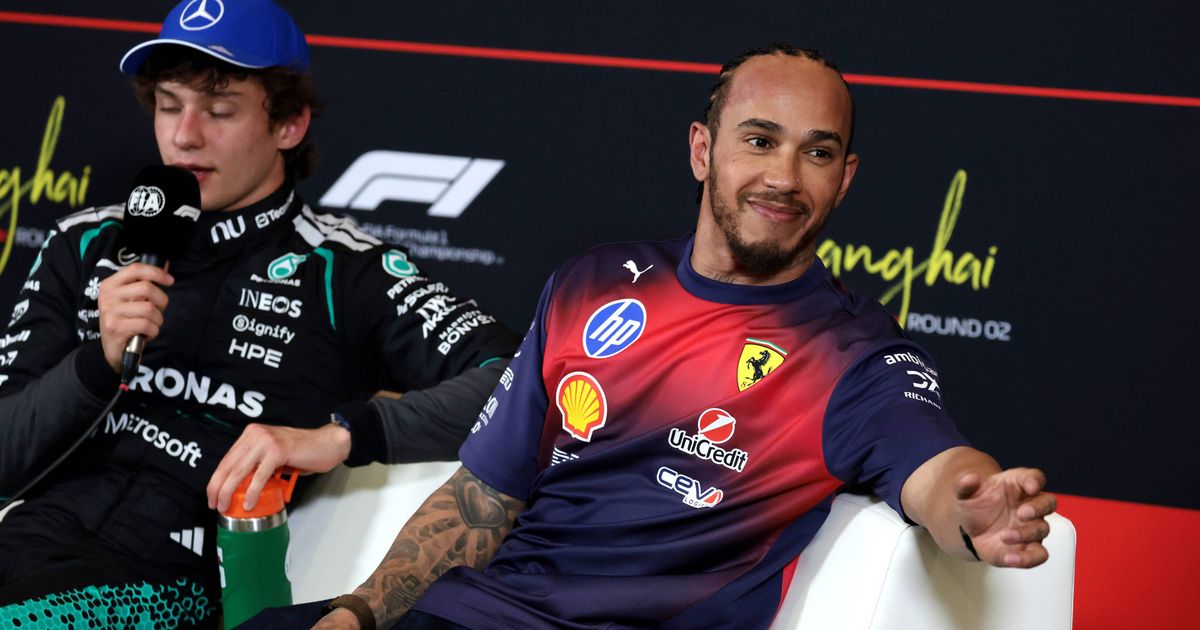
Forget the champagne. The most significant metric from Shanghai wasn't a lap time. It was a timestamp. The moment Lewis Hamilton, seven-time champion and future Ferrari driver, chose to publicly align his brand with Kimi Antonelli's. This is emotional archaeology, and the dig site is Instagram.
Hamilton's move is a deliberate, calculated signal that bypasses team PR and speaks directly to the sport's bloodstream. It says: "I recognize the next paradigm." In an era slouching toward robotic racing, where driver feel is subjugated to the pit wall's real-time telemetry sermons, Hamilton is highlighting the one variable the algorithms can't yet quantify: generational talent.
His praise isn't just support; it's a critique. It contrasts the sterile, process-driven environment he's departing with the raw, intuitive potential he sees in Antonelli. It’s a reminder that Schumacher’s dominance wasn’t just about a car or a team, but about a driver’s preternatural ability to become the system, to be the most reliable sensor in the chassis. Hamilton sees that same potential, and his public endorsement is the equivalent of passing a cryptographic key.
- The Pressure Vector on Russell: Former driver Riccardo Patrese is correct, but for surface-level reasons. The issue isn't just that Russell has "less to smile about." The issue is that his performance data is now the control group. Every qualifying lap, every race stint, will be measured against Antonelli's baseline. In a data-obsessed sport, becoming the B-sample in an experiment is a psychological weight no amount of sim time can prepare you for.
Conclusion: The Sterile Future and the Human Glitch
So, what's next? The article says Antonelli must prove it's "not a one-off" and Russell must "reassert his position." How quaint. That's pre-2020 thinking.
The trajectory is now clear. Antonelli’s Shanghai data set will be the benchmark. The team will, inevitably, try to replicate it, to bottle that consistency. They will feed his driving style into their models and ask Russell to conform. This is the path to the sterile, predictable racing I fear—the suppression of individual flair in favor of the repeatable, algorithmically-approved line.
But here’s the hope, the human glitch in the matrix: Kimi Antonelli. His numbers are pristine, but his reaction to Hamilton’s support was viscerally, beautifully human. "The photo of the year," he called it. That’s not the language of a robot. It’s the language of a driver who still understands that this sport, beneath the layers of data, runs on heartbeat and legend.
The fascinating power struggle at Mercedes won't just be between drivers. It will be between the driver as a data source and the driver as an instinctive force. Antonelli, backed by Hamilton’s symbolic blessing, might be the last one who can be both. The numbers from Shanghai tell the story of a first win. But between the lines of data, they hint at the last stand of something far more important.