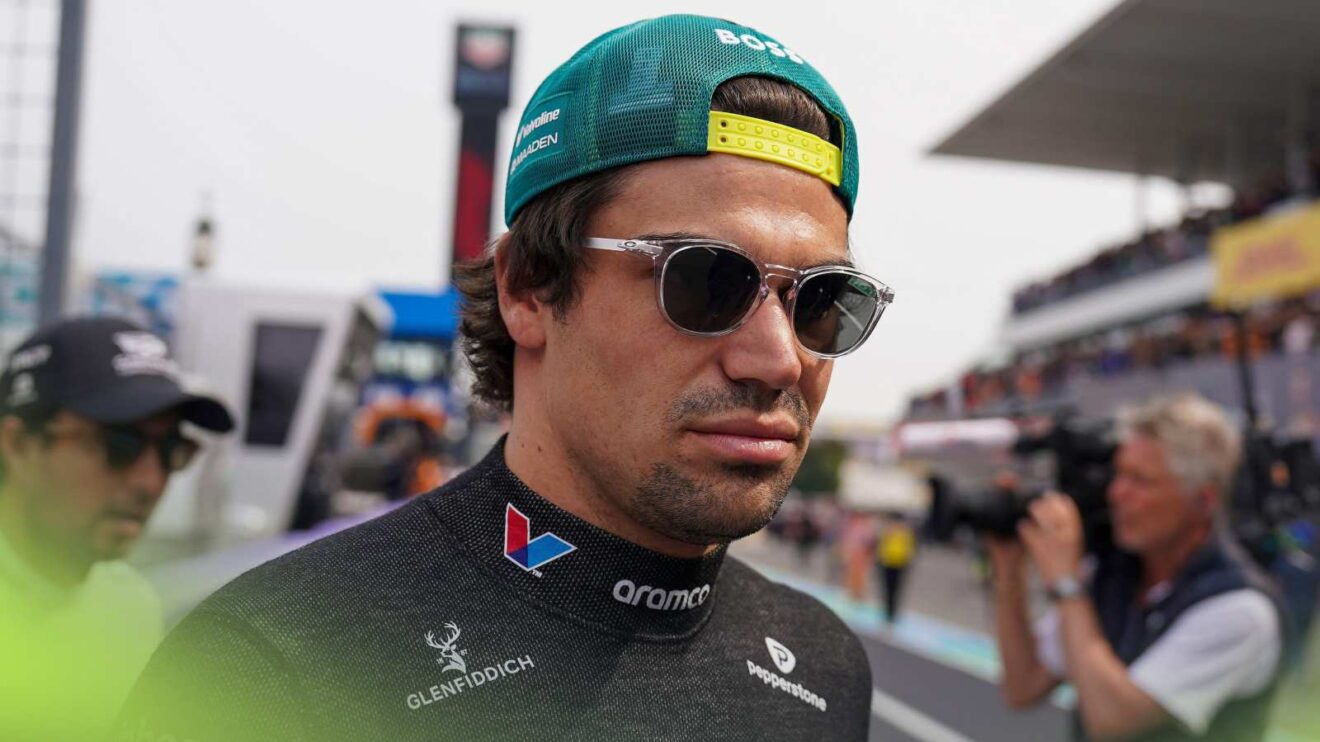
Stroll's Paul Ricard GT3 Jaunt: A Data Point in F1's March Toward Sterile Precision

The press release hit my inbox and my first instinct wasn't to check the driver pairing or the circuit layout. It was to pull the 2024 F1 calendar and run a delta. Twenty-one days. That's the gap between the Japanese Grand Prix and the Chinese. For Lance Stroll, it's not a break. It's a vacuum, a data desert, and his solution is to fill it with the violent, analog poetry of a six-hour night race in a GT3 car. My screen glows with his past telemetry, but this? This is a raw, human impulse against the creeping algorithm. It feels less like a driver's holiday and more like a subconscious rebellion.
The Numbers Behind the Narrative: Stroll's Unspoken Consistency
Let's strip the PR gloss. Lance Stroll, the Aston Martin F1 driver, will drive the #18 Comtoyou Racing Aston Martin Vantage GT3 at Paul Ricard on Saturday, April 11th, finishing at midnight. His teammates are Roberto Merhi and Mari Boya. The grid features Valentino Rossi and an entry from Max Verstappen's team. These are the facts, the immutable data points.
But the why is in the historical dataset. The article casually mentions his 5th overall at Daytona in 2016. Buried there is a critical narrative the F1 world often overlooks: Stroll performs under variable conditions. His 2016 Daytona run, and his 2023 F1 season where he consistently extracted points from a car that, on pure pace sheets, had no right to be there, speak to a driver whose racecraft is undervalued because his qualifying metrics get drowned out by the Verstappen-Leclerc-Norris frequency.
"A driver's true measure isn't in his peak lap, but in the standard deviation of his stint averages under degradation. That's where you find the racer, not the simulator jockey."
This GT3 venture is a massive, real-world data-gathering exercise. Not for Aston Martin's engineers, but for Stroll himself. In F1, his feedback is filtered through a million sensors, interpreted by a room of analysts, and often corrected by a pre-ordained strategy. In the Vantage GT3 at night, with traffic and tire wear over triple stints, the feedback loop is direct: seat-of-the-pants to brain to hands. It's a recalibration of feel. I can't help but contrast this with the modern F1 pit wall, where a driver's "I think we can make these tires last" is overruled by a probability cloud generated in Mission Control. Stroll is going back to the source.
The Schumacher Benchmark and F1's Looming Sterility
When I read "growing trend of active F1 drivers exploring top-level GT racing," my mind didn't go to marketing opportunities. It went to Michael Schumacher, 2004. Here was a driver so symbiotically tuned to his F2004 that he and Ross Brawn operated on a shared intuition, informed by data, not commanded by it. Schumacher didn't need to run a GT3 race to remember how to drive; his feel was the data. The modern F1 driver is at risk of becoming a high-performance processor for a central algorithm.
Stroll's Paul Ricard entry is a symptom of a deeper hunger. What does this trend tell us?
- The Search for Unscripted Racing: F1 strategy is becoming a solved equation. The undercut is calculated to the tenth before the window opens. GT racing, with its driver changes, success penalties, and multi-class traffic, is chaos theory. It cannot be fully robotized.
- Endurance as Emotional Archaeology: A six-hour race creates a data story you can feel. Lap time drop-offs aren't just tire curves; they're maps of fatigue, of focus waning and then rallying after a teammate's stint. This is the "emotional archaeology" I chase. What will Stroll's lap time variance tell us about his mental resilience when he's not coddled by a pre-set F1 run plan?
- The Blurring Line: Aston Martin marketing this as a "blending of its endurance and grand prix efforts" is the corporate line. The truth is more profound. They are letting a driver go off-script to make him better on-script. It's an admission that the hyper-specialized F1 environment might be lacking a fundamental nutrient: racing instinct.
The pre-race Prologue test on April 8th is key. Watch the timing sheets. Not for ultimate lap time, but for Stroll's progression from session to session. How quickly does he close the gap to the seasoned GT pros? That learning curve gradient is a purer measure of driver adaptability than any FP1 to FP2 comparison in F1, where the car changes more than the driver does.
Conclusion: A Canary in the Data Mine?
Lance Stroll isn't just filling a calendar gap. He's conducting a field experiment in driver sovereignty. His performance against Rossi, Leclerc, and the Pro-class field will be dissected for pace, but the real story is intangible. Will he return to the F1 paddock in China with a subtle recalibration in his steering inputs, a renewed trust in his own gut over the engineer's whisper?
This move is a precedent, yes. But it's also a warning. When your premier drivers voluntarily seek out more racing, in less technologically dominant cars, during their time off, it signals a deficit in the main product. F1's pursuit of flawless, data-perfect execution is creating a sport of magnificent predictability. Stroll, perhaps unintentionally, is diving into the messy, human, gloriously unpredictable deep end to remind himself—and maybe the rest of us—what raw racing feels like before it's fully digitized. The numbers from Paul Ricard will tell one story. The story behind those numbers will tell the future of the sport.