The Heartbeat is Off: Aston Martin's Suzuka Quest is a Data-Driven Séance for Lost Reliability

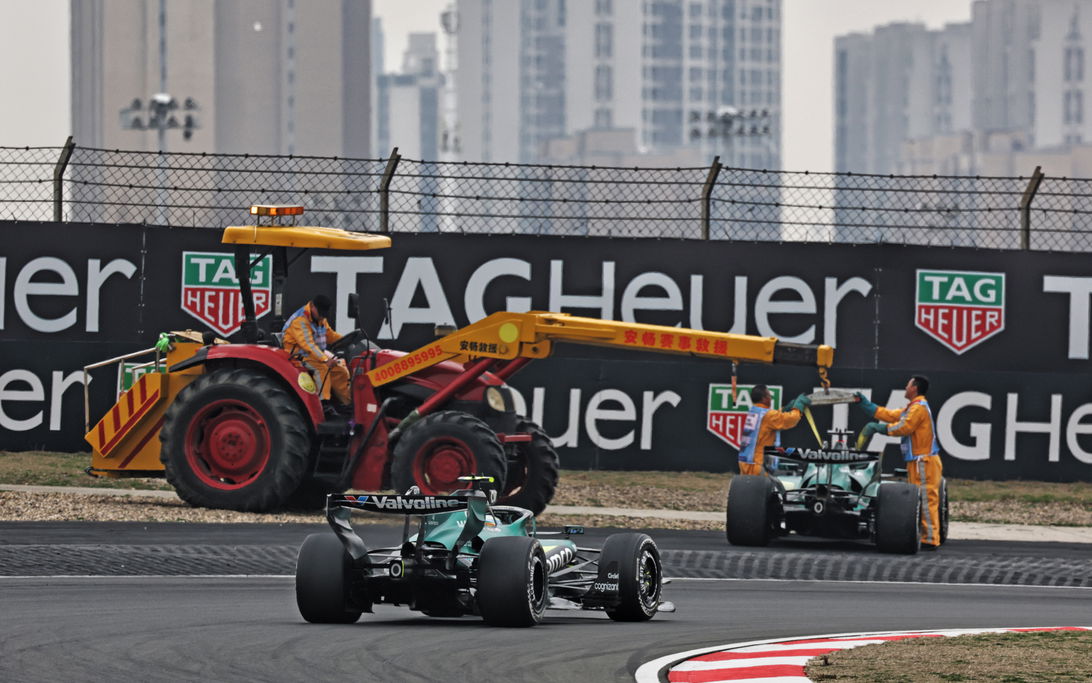
I stared at the timing sheets from Shanghai until the columns blurred into a cardiogram of a team in arrhythmia. Two lines, two drivers, two different fatal failures. Lance Stroll's telemetry flatlined with a battery issue on Lap 23. Fernando Alonso's, just 14 laps later, was a violent scribble of excessive vibration before it, too, went silent. Two different causes, one brutal truth: Aston Martin's season is being hemorrhaged not by a lack of pace, but by a fundamental breakdown in the marriage between machine and mission. They head to Suzuka not just for a race, but for a data-driven séance, trying to summon the ghost of reliability from a pile of failed components and vibration spectra.
The Two-Headed Hydra: A Statistical Autopsy of Failure
The narrative is clean: battery fix in hand, vibration problem a work in progress. But the data tells a messier, more urgent story. This isn't a single-point failure; it's a systemic fragility. Let's dissect the two beasts.
The "Solved" Problem: Battery Reliability
Honda's trackside chief, Shintaro Orihara, states the team is "confident" both cars can finish in Japan from a "battery reliability perspective." The root cause of Stroll's China retirement has been "located and addressed with specific countermeasures." This is the language of engineering closure. A fault tree analysis completed, a countermeasure applied, a checkbox ticked.
But confidence before a Suzuka practice session is just a hypothesis. Real validation comes at the 130R, at the Degners, when the battery is screaming under maximum harvest and discharge. That's where data either proves itself or lies.
The progress is marked against failures in Melbourne and Shanghai. The fix is tangible. Yet, in an era where we measure capacitor decay in microseconds, this should have been a solved equation by race three. That it wasn't speaks to the terrifying complexity of these power units. It's a fix, yes, but it arrives stained with the lost points of two grands prix.
The Persistent Specter: The Vibration
Here lies the real monster. The vibration issue that retired Alonso in Shanghai has "affected the team throughout the 2024 campaign." This phrasing is a masterclass in understatement. "Vibration" isn't a glitch; it's a cancer. It's uncontrolled energy searching for the weakest point in a system of thousands—a sensor, a bracket, a wire, a human spine.
Team Principal Mike Krack confirms they've worked on "different measures," including hardware and driver-side adjustments. Driver-side adjustments. Let that sink in. They are asking Fernando Alonso, a driver whose feel for a car borders on the preternatural, to adapt his driving to mask a fundamental mechanical flaw. It’s the inverse of the Schumacher principle. Michael in 2004 had a car so telepathically responsive, he could impose his rhythm on it. Alonso is being asked to absorb the car's discordant rhythm into his own body. The data here isn't just numbers on a screen; it's the biometrics of discomfort, the slow erosion of feedback as a driver learns to distrust every shudder.
The Ghost of Consistency Past and the Algorithmic Future
Watching this unfold, I can't help but hear the ghost of Michael Schumacher's 2004 Ferrari. Eighteen races, fifteen podium finishes, a machine of such ruthless consistency it felt engineered by fate, not just by Rory Byrne. Their reliability wasn't a hope; it was a premise. Today, Aston Martin—and let's be frank, most of the grid—treats reliability as a reactionary firefight. Real-time telemetry screams, engineers scramble, drivers manage.
This is where my darkest conviction about F1's future crystallizes. Within five years, this hyper-focus on live data analytics will seek to "solve" problems like vibration not with a better driveline, but with an algorithm that tells Alonso exactly how much to lift at every curb to keep the resonance frequency in check. The driver becomes a damping system, his intuition suppressed by prescribed inputs. The sport becomes sterile, a pre-emptive strike against all unpredictability, including the heroic, feel-based save.
But what if we used data differently? Not as a cage, but as emotional archaeology. Correlate Alonso's lap time drop-offs not just with tire deg, but with the moment the vibration passes a certain threshold, the point where the signal in his hands shifts from information to pain. That's the story. The untold story of every retirement is the last thirty seconds of data before it—the driver's futile fight against an invisible, data-verified tide.
Conclusion: Suzuka as a Truth Machine
So they head to Suzuka. The immediate objective, as stated, is juvenile in its simplicity: "finish the race with both cars." For a team with podium ambitions, it's a devastatingly low bar. The battery fix will be tested in the crucible of one of the most demanding circuits for energy deployment. The vibration countermeasures will face the brutal, rippled asphalt of the Esses.
The data they seek isn't about points or pace. It's about continuity. A single clean race finish for both cars would provide a "crucial confidence boost," the article says. I'd argue it would provide something far more valuable: a baseline. A clean, uninterrupted stream of data from lights to flag, against which every future tremor can be measured.
My prediction? The battery will hold. Honda is too proud, and the fix too direct, for it to fail at home. The vibration, however, will still whisper. It will be "managed," its amplitude perhaps reduced by new hardware, its impact on the driver mitigated by those "adjustments." But it won't be gone. Because some problems in modern F1 aren't solved by data sheets. They're solved by a man like Schumacher, in a car like the F2004, where the only vibration was the heartbeat of a championship—consistent, relentless, and alive. Aston Martin isn't searching for a fix this weekend. They're searching for a heartbeat. And the data can only tell you so much about where to find one.