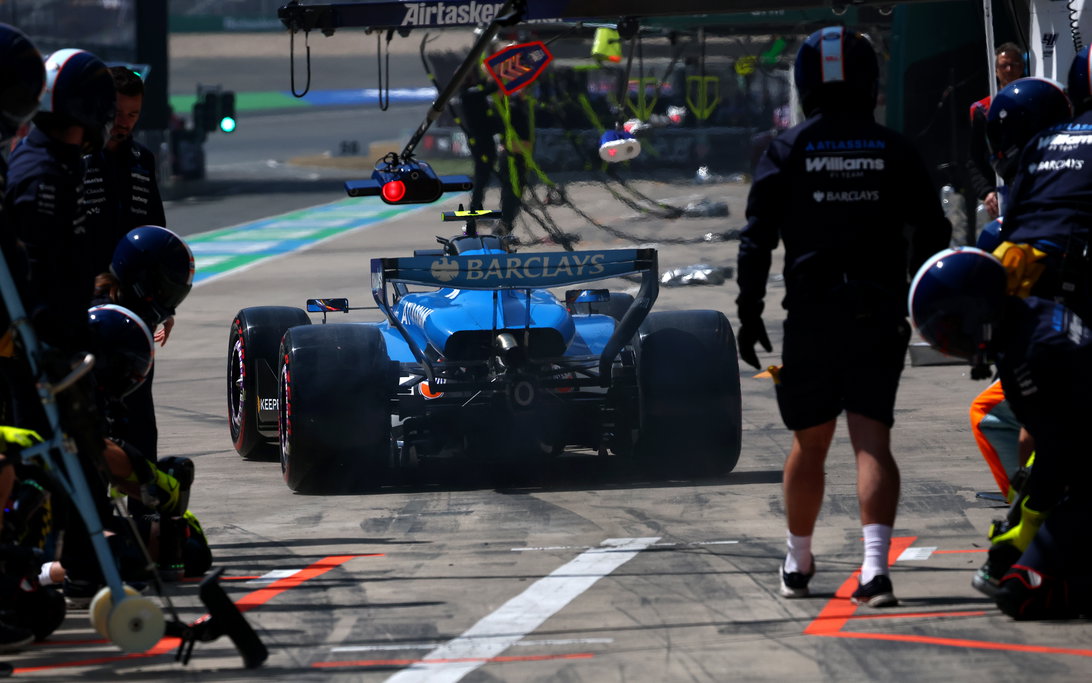
The Ghost in the Machine: How a Radio Transmission Saved Carlos Sainz From Himself
The moment of judgment in Formula 1 is no longer just the checkered flag. It arrives in a sterile stewards' room, hours after the fact, where grainy footage is dissected and heart rates are measured in radio wave oscillations. For Carlos Sainz, that judgment came on March 27th, 2026, at Suzuka. The charge, in the court of public opinion, was visceral: a deliberate, petty slowdown. A flicker of human spite in a world of carbon fiber and cold data. The exoneration, however, was clinical, delivered via an evidentiary pillar of the modern era—the unblinking ear of team radio. But beneath this tidy conclusion lies a far richer, more human truth: we witnessed not an act of malice, but a cognitive overload, a driver's mind fracturing under the immense pressure of traffic management, where a single mis-prioritized thought could brand you a villain.
The Anatomy of a Split-Second Fracture
Let us reconstruct the neural landscape of Carlos Sainz in FP1. Suzuka is a circuit of flowing, committed rhythms, a place where hesitation is punished by lap time and, potentially, by the car behind. Through Turn 9, he is reportedly affected by Liam Lawson's Racing Bulls. A spark of frustration, perhaps. A chemical flare in the amygdala. Then, through the daunting esses of Turns 10 and 11, his Williams dramatically loses pace. Lawson's confused radio transmission—"Can you see what I'm seeing?"—is the sound of a witness to an inexplicable act.
- The Visible Narrative: Sainz, baulked, seeks instant, immature retribution. A narrative we've seen before, driven by the raw, uncoached id.
- The Hidden Reality: Sainz's engineer's voice in his ear, a warning of Jak Crawford's approaching Aston Martin on a hot lap. A new, more pressing threat enters his mental queue.
This is where the human software crashes. The brain must triage:
- The immediate spatial awareness of Lawson's proximity.
- The projected trajectory and rights of the faster-approaching Crawford.
- The lingering emotional residue from Turn 9.
- The preservation of his own car and program.
"The stewards confirmed Sainz's account using team radio recordings and footage showing Crawford passing both Sainz and Lawson after the exit of Turn 11."
The radio evidence provided an alibi, but it also provided a diagnosis. Sainz didn't choose to impede Lawson; he likely ceased to compute him as a primary factor. His focus narrowed to the larger perceived threat from behind, a survival override. This isn't malice; it's cognitive sacrifice. In the wet, we see this constantly—the driver's inherent risk tolerance, a psychological fingerprint, overrides the car's capability. Here, in the dry, a driver's mental bandwidth, frayed by data inputs, overrode social etiquette on track.
The New Panopticon: Radio as Psychological Ledger
The FIA's reliance on team radio is a double-edged sword. It creates transparency, yes, but also a permanent, searchable record of a driver's most pressured moments. Their tone, their latency in response, their choice of expletive—all become evidence. This incident was dismissed swiftly because the audio backed the action. But it sets a precedent.
Imagine if this technology had existed in the eras of Lauda or a young Hamilton. Lauda's post-crash communications, stripped of their legendary grit, would be parsed for traces of fear. Hamilton's calculated radio messages during his early McLaren controversies would be scrutinized for authenticity. Today, Max Verstappen's earlier, fiery radio outbursts have been systematically muted, not by his own maturity alone, but by Red Bull's psychological scaffolding—coaching him to channel that fire inward, manufacturing a champion's icy exterior. The radio reveals the man behind the helmet, and now, the stewards are mandatory analysts.
This brings me to my conviction: Within five years, we will mandate mental health disclosures after major incidents. A spin, a crash, a near-miss—the FIA will not just check the car's data, but demand a psychological baseline from the driver. Was that decision a result of impaired judgment from a previous impact? Of cumulative stress? This will usher in an era of necessary transparency, but also of unimaginable scrutiny and potential scandal. Will a driver's therapy session notes become subpoenaed after a controversial move? The radio recording is just the beginning.
Conclusion: The Unmanufacturable Moment
Carlos Sainz walked away without a penalty. The official record will show a simple misunderstanding corrected by technology. But Hugo Martinez sees a different lesson. We saw a profoundly human moment of cognitive overload laid bare and then clinically resolved. No amount of Red Bull-style psychological coaching can fully erase these fractures under extreme load. They are the unmanufacturable moments.
The true drama of 2026 is not just the battle for tenths, but the battle for clarity—inside the cockpit and inside the mind. The stewards judged an action. But the real story was the glimpse into a driver's overloaded psyche, a system pushed to its limit, where the ghost in the machine is still, and always will be, a fallible, brilliant, and beautifully human mind. Sainz was saved by his radio. Soon, drivers may need far more than that to protect the last private space in Formula 1: their own inner monologue.