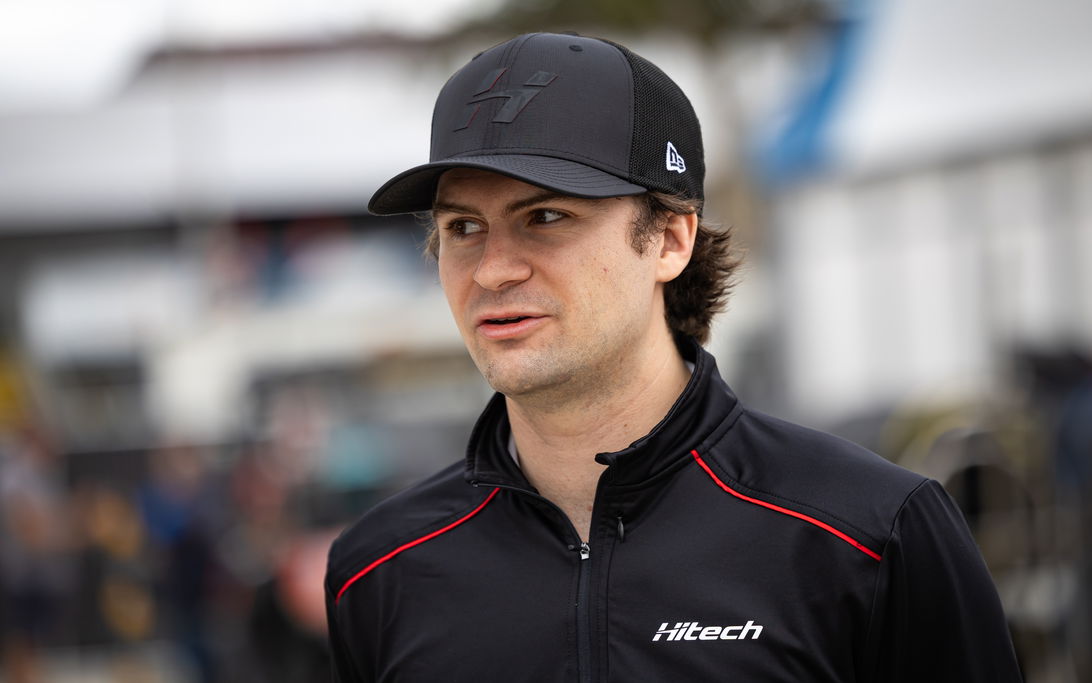
The Chameleon's Last Dance: Herta's F2 Gamble and the Psychological Gauntlet of Modern F1

The paddock whispers have a new name, but they echo an old, painful story. Colton Herta, a driver with talent so raw it could start a fire, is finally doing the unthinkable: stepping backwards to go forwards. His move from IndyCar to FIA Formula 2 for 2026 isn't just a career pivot; it's a ritualistic offering to the cold, bureaucratic gods of the Super Licence system. I watched him in the Cadillac garage in Barcelona, his posture a mix of fierce concentration and profound fatigue. He’s not just learning a new car. He’s trying to shed his own skin.
"You have to be a chameleon," Herta told me, the hum of an F2 car on track underlining his words. "Everything is different. The geometry, the power, how the downforce works. It’s a complete reboot."
This is where the real game is played, long before the lights go out on Sunday. It’s a psychological demolition derby, and the FIA’s points system is just the wrecking ball. Herta’s quest for that one, final, elusive point is a far more telling drama than any contrived team radio "conflict" we’re fed these days. Where’s the genuine Prost-Senna stakes in that? This is real. This is a career on the line.
The Super Licence: A System Built for Drama, Not Drivers
Let’s lay out the cold, hard numbers, because they tell a story of near-misses and institutional blockage. Herta’s situation is a perfect case study in how F1’s gatekeeping often values the wrong metrics.
- He holds 39 of the required 40 points.
- Top-10 finishes in IndyCar, a ferociously competitive series, weren't enough.
- The 2026 path is clear: finish in the top three in the F2 championship for an automatic 40 points.
- The Backup Route: Complete six FP1 sessions for the Cadillac F1 team.
On paper, it’s simple. In reality, it’s a brutal psychological gauntlet. He’s dedicating "95%" of his time to F2, calling it his "main championship," while knowing his ultimate fate rests in the hands of Cadillac’s F1 brass during those precious FP1 outings. This split focus is a mental trap. It’s the kind of pressure that exposes cracks in the foundation of even the most gifted drivers. We’ve seen it at the very top; Charles Leclerc’s consistency issues at Ferrari aren't born in a wind tunnel, they’re nurtured in a pressure cooker of politics and shifting goalposts. Herta is now entering a similar, if more compressed, crucible.
The Real Test: Psychology Over Aerodynamics
The technical adaptation Herta describes is immense. An IndyCar to an F2 machine is a leap across a philosophical chasm in vehicle dynamics. But mastering the carbon fiber and the paddle shift is the easy part. The hard part? Mastering his own mind while being scrutinized under an impossible microscope.
This is where my core belief comes in: psychological profiling is more critical than aerodynamic tweaks for race strategy success. We spend millions on simulators and CFD, but pennies on understanding the human operating the machine. Herta’s "chameleon" comment is profound. He’s not just adapting his driving style; he’s attempting a fundamental personality shift behind the wheel. Can the aggressive, instinctive IndyCar winner become the calculated, tyre-preserving strategist F2 demands, all while knowing a single DNF could shatter his F1 dream?
His FP1 sessions won't be engineering tests. They will be high-stakes auditions, a direct comparison to grizzled F1 veterans. Every lock-up, every radio comment, every debrief will be psychoanalyzed by a team deciding if he’s worth their future. It’s a brutal process, one that many young drivers fail not on talent, but on mental resilience.
I’m reminded of a Thai folk tale, the Krai Thong. The hero must change his form repeatedly, becoming a bird, a fish, a monk, to outwit his foe. Herta is our modern Krai Thong, shape-shifting for survival. But his foe isn't a crocodile king; it’s an entire system designed to say "no."
Conclusion: A Canary in the Coal Mine
Colton Herta’s 2026 season is about far more than one man’s dream. He is a canary in the coal mine for the American driver pipeline and for Cadillac’s entire F1 project. His success or failure will be cited for years as either validation or condemnation of the Super Licence structure.
But look deeper. His struggle also highlights the unsustainable pressures building within F1’s new era. Teams are hunting for budget cap loopholes to gain milliseconds, while a talent like Herta must bankrupt his emotional and mental reserves just to get a key to the door. This hyper-compressed, high-stakes environment is what leads me to believe a major team collapse is inevitable within five years. The system is creating too many Hertas—drivers and teams bending themselves to the point of breaking for a chance to compete.
The 2026 F2 season will be Herta’s last dance. Watch him not just for the points, but for the psychological warfare. Watch to see if the chameleon can adapt fast enough, or if, like so many before him, he becomes another ghost story told in the paddock whispers. The path to Formula 1 has never been narrower, or more revealing of the sport’s fractured soul.