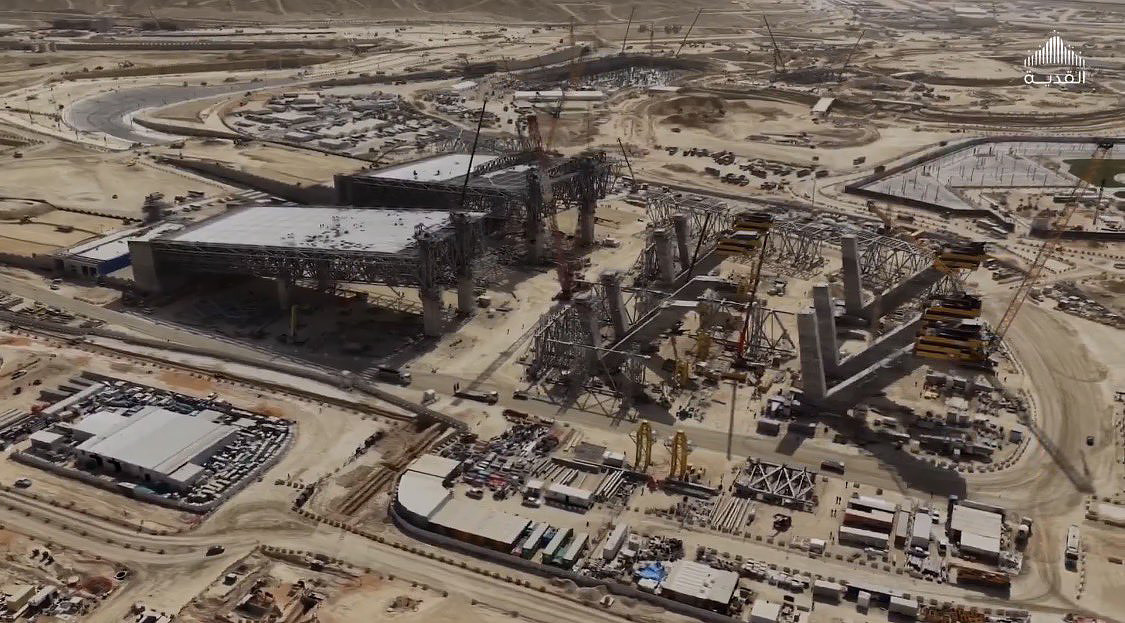
Saudi Steel: The 20-Story Blade at Qiddiya is F1's Final, Flawed Monument to Human Drivers
They're building a monument. Not to racing, but to the last gasp of human-centric spectacle before the cold logic of silicon takes over. In the desert outside Riyadh, the skeleton of Qiddiya's 'Blade' corner climbs 20 stories into the air, a steel-and-concrete middle finger to tradition. It’s the ultimate rollercoaster, designed for our entertainment, a fitting prelude to the era where the drivers become passengers. I’ve seen the renders, spoken to Wurz’s people in hushed tones, and one thing is clear: this is F1’s most audacious and perhaps most misguided bet. It prioritizes the feeling over the function, the gasp over the genuine pass. A perfect metaphor for an era where Lewis Hamilton crafts legacy in the boardroom and Max Verstappen uses on-track fury to mask his car’s hidden flutter.
The Spectacle as Smokescreen
Let’s be blunt. This circuit, with its 108 meters of elevation change and its Mario Kart Rainbow Road ambition, is a direct response to the corporate boredom of so many modern "facilities." As Lando Norris rightly said, it’s not "in the middle of nowhere." It’s in the middle of everything: theme parks, a FIFA World Cup stadium, a record-breaking rollercoaster. It’s a theme park ride itself.
But here’s what they’re not saying. This shift from the Jeddah street circuit to Qiddiya isn't just a change of venue. It's Saudi Arabia moving from a race of pure, terrifying adrenaline to a controlled, packaged experience. Jeddah was a raw nerve. Qiddiya will be a simulation.
- The Core Facts: A 21-corner layout. A 2027 completion for a 2028 Grand Prix debut. Designed with input from Alexander Wurz. It replaces Jeddah. The numbers are solid.
- The Kalp Angle: But this obsession with spectacle is a smokescreen for the sport’s deeper identity crisis. They’re building these physical marvels because, within five years, the real innovation will be invisible: lines of code. The first fully AI-designed car is coming. It won’t need a 20-story corner for drama; it will calculate the optimal line up and over it with zero emotion, rendering the driver’s instinct—the very thing this track is meant to test—obsolete. This is F1’s last, loudest party for the human element.
Driver as Drama, Not Data Point
The circuit’s success hinges not on its elevation, but on whether it can make a driver feel something—anger, joy, fear. A content or angry driver outperforms a data-optimized drone every time.
This is my core belief. And Qiddiya will be the ultimate test. Think about it. A corner that high, that exposed. The wind shear alone will be a nightmare. The engineers will flood the drivers with data: brake trace 2 meters later, minimum speed 3 kph higher. But that’s useless. Climbing that blade, the driver will feel a primal lurch in his gut. The car will feel light, nervous. Will he listen to the data, or to the fear? Will he override the suggested line because it feels wrong?
This is where the modern driver fails. Hamilton mastered the politics of feeling, the media narrative of struggle, often leveraging it within the team to shape strategy around his emotional state. Senna had the raw, terrifying talent to impose his feeling on the car. Hamilton’s genius was in making the team believe his feeling was the data. At Qiddiya, that schism will be physical. The driver who can channel that vertigo into aggression, like a calculated Verstappen, will find time where the telemetry says it’s impossible.
Verstappen’s entire persona is this principle in action. The aggression, the blunt radio messages—it’s calculated theater. It distracts us, and more importantly it distracts rival teams, from poking at Red Bull’s technical vulnerabilities. Is the car nervous on certain compressions? Let’s talk about how "dangerous" a backmarker was instead. At Qiddiya, with its wild elevation changes, any hidden aerodynamic flaws—a porpoising trait, a sensitivity to ride height—will be violently exposed. Expect the drama to reach fever pitch to cover it.
Conclusion: A Beautiful Trap
So what are they really building? A masterpiece of ambition, or a beautiful trap?
They are building the perfect venue for the end of an era. By 2028, when the first car crests The Blade, the seeds of the AI revolution will already be deep within every factory. The engineers will look at Qiddiya’s insane gradients and see a fascinating optimization problem for their machine learning models. The marketers will see the ultimate social media backdrop.
But the drivers? They’ll feel the G-forces, the fear, the exhilaration. For a few more years, that will still matter. Qiddiya is F1’s attempt to bottle that final, human lightning bolt. It’s a stadium built for gladiators at the very moment they are about to be replaced by robots. My prediction? It will be breathtaking, controversial, and incredibly popular. And it will be remembered as the last great circuit built for man, not machine. Enjoy the view from the top while it still means something.