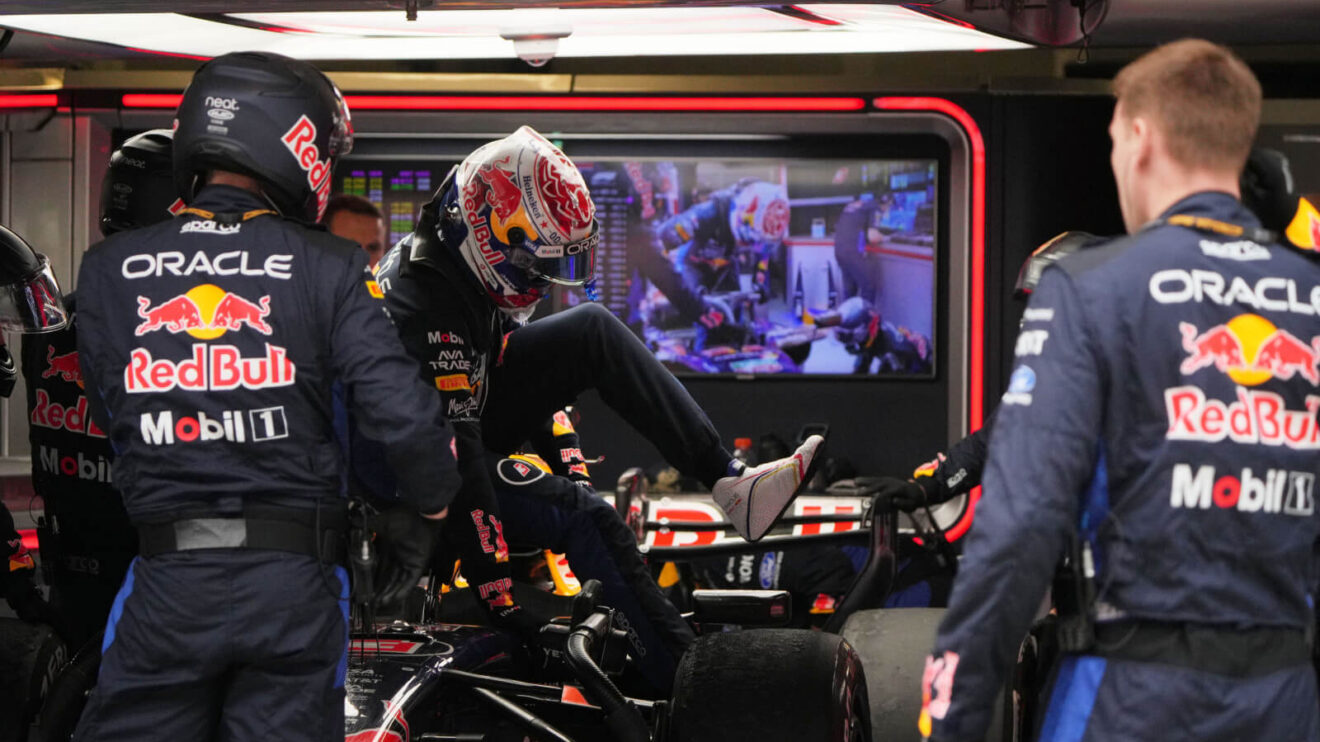
The Heart Monitor Flatlined on Lap 46: What Verstappen's Coolant Data Really Reveals

The timing sheet from Shanghai doesn't lie, but it whispers a far more terrifying story than a simple "coolant fault." I stared at the trace of Max Verstappen's lap times, a rhythmic, if unspectacular, cardiac readout of a patient already in distress. Then, on Lap 46, asystole. The flatline. Red Bull's confirmation of an Energy Recovery System coolant failure is the official cause of death on the coroner's report, but I'm here to tell you about the disease. This wasn't a sudden cardiac arrest; it was the final, gasping symptom of a machine pushed beyond its coded limits, a warning from the new era that the human element isn't being sidelined. It's being asked to perform miracles to compensate for silicon shortcomings.
The Myth of the Isolated Failure and the Ghost of 2004
Let's be brutally, numerically honest. A coolant leak in the ERS is a terminal hardware event. Full stop. But to treat this as an isolated, cruel twist of fate is to ignore the 45 laps of vital signs that preceded it. Verstappen qualified eighth. He suffered "excessive tire degradation" and a "lack of battery power at race starts." These are not unrelated anecdotes; they are interconnected data points in a damning system diagnosis.
The car was running a fever for the entire Grand Prix distance, and the coolant failure was the moment its organs shut down.
This is where my mind, always digging in the archives, drifts to Michael Schumacher's 2004 season. That Ferrari F2004 was a metronome of efficiency. Its reliability wasn't luck; it was the result of a harmony between a driver who communicated the machine's every sigh and a team that built a package so robust it could withstand his relentless pressure. Schumacher's consistency came from a feedback loop of feel and engineering, not just from engineers staring at real-time telemetry and telling a driver to "manage."
At Red Bull now, the script is flipped. Laurent Mekies speaks of the package's "significant shortcomings" and "learning rapidly." But what is the learning? Is it to better interpret the flood of data from a fragile system, or to build a system that doesn't require the driver to be a systems analyst at 300 kph? Verstappen wasn't just driving in Shanghai; he was likely managing a dozen derates, battery offsets, and thermal warnings from the cockpit. The driver's intuition is being used not to find the limit, but to keep a complex, faltering machine from collapsing. It's the worst kind of "robotized" racing: the driver becomes the emergency patch for faulty code.
Data as Emotional Archaeology: The Pressure Gauge on Hadjar and the 86-Point Chasm
Now, let's apply some emotional archaeology. We have two data sets from Shanghai: Verstappen's DNF and Isack Hadjar's solitary, eighth-place point. On the surface, this is simple: one car broke, one didn't. Look deeper.
Hadjar, with less expectation and perhaps a less aggressively tuned package, navigated to the finish. His lap time data likely shows consistency, but of what kind? The kind born of a smooth, preserved drive, or the kind born of a car that simply had no more pace to give? Meanwhile, Verstappen's data up to Lap 46 is the story of a champion trying to wrestle a sick car into positions it didn't deserve. Every lap time drop-off, every compromised sector, is a spike on his personal pressure gauge. The retirement isn't just a zero on the scoreboard; it's the release valve blowing.
And that brings us to the number that should haunt Milton Keynes: 86 points. The gap to Mercedes. This isn't a gap; it's a chasm carved by unreliable performance. In 2004, gaps were built through relentless, week-in, week-out execution. Today, they are built when a team's data models fail to predict how a coolant system interacts with a new ERS under the specific load of the Shanghai International Circuit. The focus, as Mekies states, is on a "major development push." But I'm skeptical. Is the push to understand the driver's experience, or to simply add more sensors, more algorithms, more layers of complexity that can fail in new and exciting ways?
The target is Japan. Mekies expects a "more competitive showing." But competitive how? Through a genuine unlocking of pace, or through a conservative tuning that gets both cars to the finish in the points, a sterile, calculated points haul? The latter is the path F1 is on. Find the maximum predictable, algorithmic performance, and suppress the variables. The problem is, the greatest variable—and the only one that can truly save a flawed concept—remains the driver. We saw Charles Leclerc for years wring the neck of cars that were strategic nightmares, his raw qualifying data a scream of pure speed against the chaos. Verstappen is now in a similar, if more mechanical, trap.
Conclusion: The Story the Numbers Are Screaming
The story of the 2026 Chinese Grand Prix isn't that Red Bull lost. It's how they lost. The numbers tell a story of a team drowning in data but perhaps missing the narrative. The narrative is one of a fundamental disconnect. The 2026 regulations were meant to be a new dawn, but they risk creating machines so complex that their failures are incomprehensible and their management becomes a clinical, joyless process.
The coolant fault is the headline. But the real story is in the tire deg, the battery lag, the eighth-place grid slot. It's in the 86-point deficit. Red Bull's "rapid response" will be measured in CFD hours and wind tunnel runs. I'll be measuring it in the variance of Verstappen's sector times in Suzuka, and in the silence—or the scream—of his radio. Will he be a driver unleashed, or a systems controller, his intuition suppressed by the need to keep a brittle machine alive? The timing sheets in Japan won't just show lap times. They'll show us whether the sport is healing, or if the patient is merely being stabilized for a more predictable, and ultimately sterile, existence.