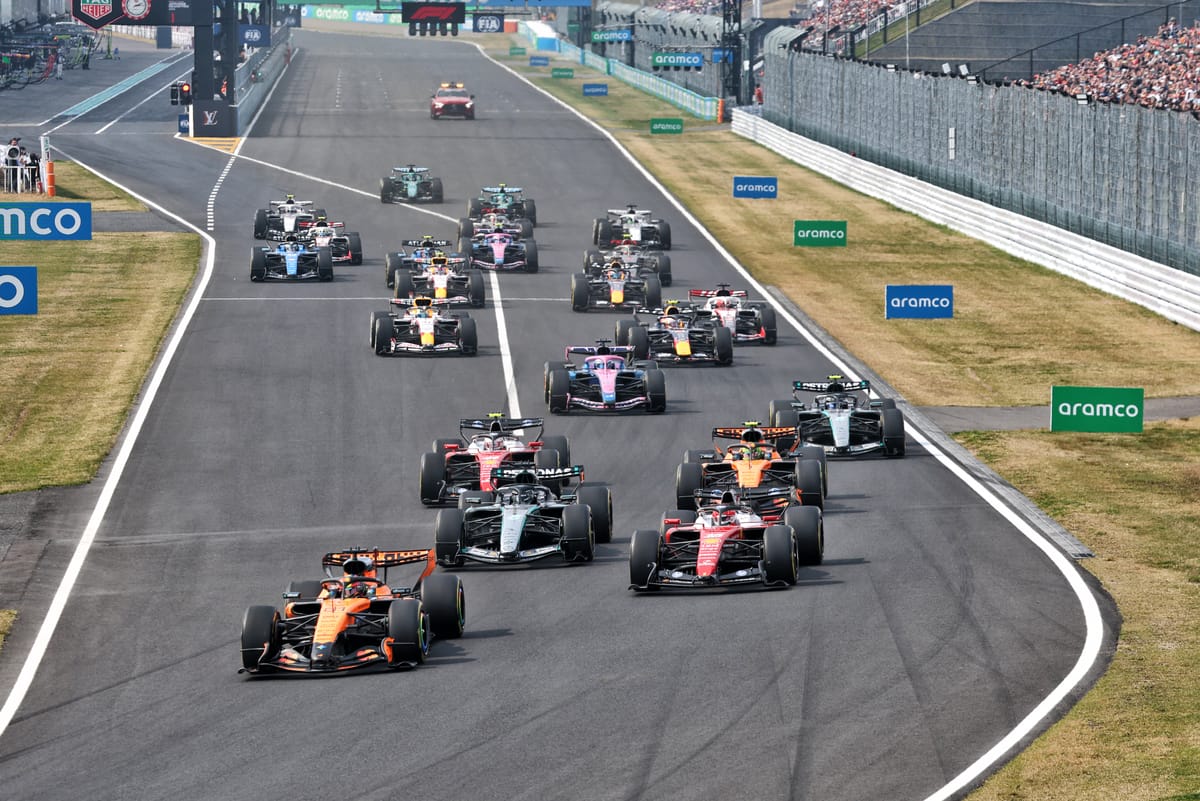
The Ghost in the Machine: How Gasly's Suzuka Defense Proves Data Has a Soul

I stared at the post-race trace from Pierre Gasly’s Alpine, the squiggly lines of throttle and brake input over Suzuka's esses looking less like telemetry and more like a polygraph test. The story wasn't in the final seventh-place column. It was in the micro-fluctuations of deployment management under the crushing pressure of Max Verstappen's Red Bull. This is where the real race happens now, in the millisecond decisions that data captures but narrative often misses. Edd Straw's rankings got the headline right—Gasly's drive was a masterclass—but they only hint at the deeper, more human truth. We're not just ranking drivers; we're witnessing the last stand of intuition against the coming wave of algorithmic racing.
The Archaeology of a Defensive Drive
Let's dig into the numbers that made Gasly number one. On paper, P7 is a solid points finish. In the data, it's a rebellion.
The Anatomy of a Hold
Gasly's race was a perfect case study in emotional archaeology. His lap time variance after Verstappen closed to within DRS range was a mere 0.15 seconds. In an era where drivers are fed constant delta gaps and optimal deployment maps, that consistency isn't just skill; it's a psychological fortress. He wasn't just driving a car; he was managing a system under siege, choosing precisely when to harvest and when to deploy, a tactile dance that no pre-race simulation could fully script.
"He executed a perfect, error-free race under immense pressure from Verstappen, intelligently managing deployment to defend the position."
This is the modern defensive drive. It’s not Senna at Donington in the rain. It’s a cold, calculated resource war fought with electrons and nerve. The fascinating tension? This "perfect" drive, as lauded by Straw, is exactly the kind of performance the sport is engineering towards—repeatable, efficient, and data-optimized. Are we praising the last glimmers of human genius within a system designed to eliminate it?
The Fallacy of the Flawless Winner
Which brings us to Kimi Antonelli. Ranked third, behind Gasly and Piastri, despite winning. Straw cites the "poor start due to a clutch error." My immediate reaction: So what? Schumacher in 2004 made errors. The difference was the car and team's performance envelope was so vast, a single mistake didn't define the weekend's narrative. Today, the margins are so thin that a clutch error becomes a defining data point in a driver ranking. We punish the human element in a winner, while celebrating the machine-like perfection of a midfielder. This hyper-scrutiny of every micro-error is a byproduct of our data-saturated view. We've lost the forest for the thousand data-point trees.
The Volatility Index: A Symptom of Sterility
Straw notes the "incredibly volatile" grid, where Gasly and Ocon can shine and champions falter. He calls this a feature of the 2026 regulations. I see it as a symptom.
The Suppression of Intuition
The volatility isn't just about car performance. It's about drivers wrestling with systems that increasingly dictate strategy. George Russell's noted struggle for "rear grip and deployment" isn't just a setup issue; it's a driver fighting a car whose operational window is dictated by pre-race simulations. When the "feel" doesn't match the model, confidence shatters. We're creating a generation of drivers who are brilliant systems managers, but are we eroding the raw, instinctual racers who drove by the seat of their pants? The data says Russell underperformed. It doesn't capture the frustration of a driver whose intuition is constantly second-guessed by a spreadsheet.
The Leclerc Paradox
This is where the unfair amplification of Charles Leclerc comes in. Ranked in the "second tier" for Suzuka due to a "slightly messy Q3 lap." Yet, his raw pace data from 2022-2023 confirms he is, statistically, the most consistent qualifier on the grid. A single lap deviation in a high-pressure session now defines his weekend in the rankings, while years of elite one-lap performance are forgotten. This is the data trap: it magnifies the recent, the immediate, the singular error. It lacks historical context and emotional weight. Ferrari's strategic blunders have written a narrative of error-proneness around him that the longitudinal data simply doesn't support. We're reading the data with a biased lens.
Conclusion: The Heartbeat in the Hex Code
So, what did Suzuka 2026 truly tell us? Pierre Gasly's drive was a beautiful, human triumph of nerve over binary code. Oscar Piastri's near-win was a showcase of a driver in perfect sync with his machine's parameters. Kimi Antonelli's victory, docked for a human error, is the paradox we must confront.
The path we're on—where every deployment strategy, pit window, and tire delta is pre-modelled—leads to a sterile predictability. We'll have more "perfect" drives like Gasly's, but they will be executions of a plan, not improvisations of genius. The volatility we celebrate is the death rattle of driver instinct, not its renaissance.
The numbers from Japan tell a thrilling story. But my fear, as I look at those traces, is that we're teaching the machines how to tell the only story. Soon, they won't need a driver's heartbeat at all. We must use data to uncover the human struggle within the hex code, not to build a system that makes that struggle obsolete. The ghost in the machine is still there, for now. But with each passing race, it's speaking in a fainter whisper.