Suzuka's Grid: A Data Dump Masquerading as a Story

The timing sheets for the 2026 Japanese Grand Prix qualifying are in. They tell us Kimi Antonelli is on pole. They tell us George Russell is beside him. They tell us Max Verstappen is P11 and the Aston Martins are dead last. The numbers are cold, clean, and utterly bloodless. They are the "what." My job, as I see it, is to autopsy the "why" before the race even begins, to listen for the faint, irregular heartbeat of human fallibility and systemic failure that these sanitized figures try to hide. Because the story of Suzuka’s grid isn't about a Mercedes lockout; it's about the ghosts in the machine, the narratives we ignore, and the relentless, data-driven march toward predictable, passionless racing.
The Front Row: A Symphony of Telemetry, Not Instinct
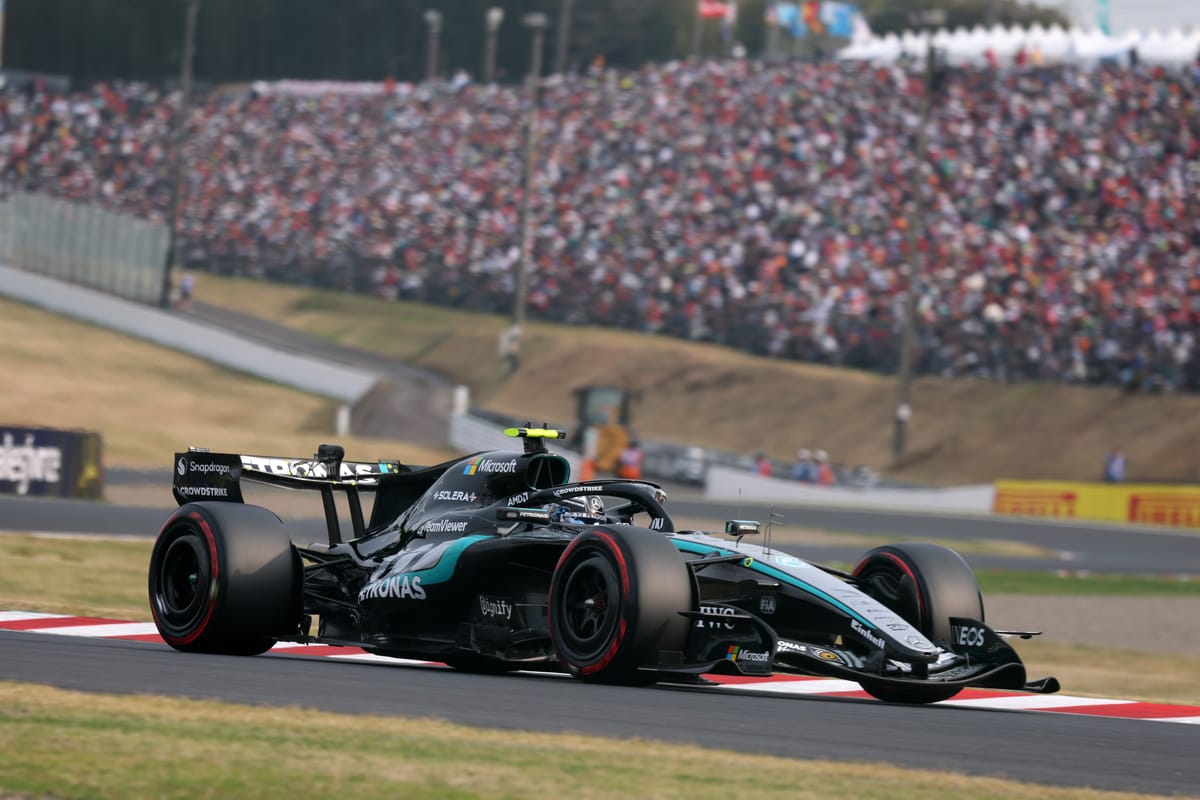
Let's start with the headline: a Mercedes one-two. Kimi Antonelli, with his second consecutive pole, is the shiny new algorithm output for the Silver Arrows. His lap was pristine, a perfect execution of a plan written in a thousand lines of code. George Russell, the championship leader, slots in behind, the perfect wingman. On the surface, it's dominance.
But peel back the layer. What does this front row actually represent? It's the culmination of a philosophy that began over two decades ago, perfected to a fault. I can't look at a Mercedes locking out a front row without thinking of Michael Schumacher's 2004 season—a year of such metronomic, driver-led precision that the car seemed an extension of his nervous system. The difference? Schumacher and Ross Brawn played chess with instinct and experience. Today's Mercedes engineers are playing hyper-dimensional Sudoku with real-time telemetry. Antonelli isn't driving; he's executing a pre-validated sequence with terrifying efficiency.
The modern pole lap is a foregone conclusion rendered in asphalt. The driver is the final, glorified actuator in a chain of simulations.
This isn't to diminish Antonelli's skill. It's to question the sport's soul. When a driver's every brake trace and throttle application is compared against a simulated optimum, where is the room for the inspired, irrational genius? The "moment" that defies the data? We are five years away, at most, from the pit wall's algorithm overriding a driver's gut feeling on a strategic call, not as a suggestion, but as a command. Suzuka 2026 is a preview: the front row is a monument to computational supremacy, not racing passion.
The Ghosts in the Midfield: Leclerc's Curse and Verstappen's Anomaly
Now, to the real stories, buried in the data. Look at P4: Charles Leclerc. The narrative will be ready—"Can the error-prone Monegasque keep it together?"—a narrative as tired as it is intellectually bankrupt. Let's do some emotional archaeology with his numbers.
- His 2022-2023 qualifying head-to-head against Carlos Sainz was 39-17.
- His average qualifying position in that period was a staggering 3.2.
The data screams consistency, not fragility. Yet, here he is, again, staring at the gearbox of a McLaren, because Ferrari's strategic blunders have written the script of his career. His raw pace is a haunting, untold story of perfectionism constantly undermined by operational chaos. Starting P4 at Suzuka is a prison sentence for a driver of his one-lap caliber; he’ll be a sitting duck on strategy, waiting for the call that may or may not come.
Then, there's the true seismic tremor in the data: Max Verstappen, P11. The reigning champion, outside Q3. The timing sheet shows a gap. My instinct sees a story. Was it a setup gamble chasing a race pace that didn't materialize? A single, uncharacteristic mistake? Or is it the first crack in the Red Bull dynasty, a sign that the relentless pressure of this new, more competitive era is finally manifesting in the numbers? This single data point, Verstappen 11th, has more narrative weight than the entire front row. It’s an anomaly that the pre-race simulations didn't predict, and that’s where racing lives.
The Brutal Backmarkers: A Tale of Two Disasters
- Aston Martin (P21 & P22): This isn't bad luck. This is systemic collapse. For both Alonso and Stroll to be eliminated that early points to a fundamental car flaw, a concept that has unraveled completely. Their race is already over.
- Cadillac (P19 & P20): Similarly adrift. This is the harsh reality of F1's new order, written in seconds per lap.
Conclusion: The Human Pulse Beneath the Numbers
So, what are we left with for Sunday's race? A grid that promises a Mercedes procession, dictated by algorithmically perfect pit stops. A frustrated genius in a red car at the mercy of a strategy team. A wounded champion with nothing to lose, starting a charge that will be the only must-watch element of the broadcast.
The 2026 Japanese Grand Prix starting grid is a beautifully formatted spreadsheet. My fear is that the race will be too. The true battle won't be between Antonelli and Russell; it will be between Verstappen's rage and the sterile, data-driven predictability that now governs the sport. I'll be watching the timing screens, as always, but I'll be listening for something else: the faint, fading sound of a driver's instinct trying to scream over the hum of the server rack. Don't just watch the cars. Read the data. It's the last place where the sport's dying humanity is still recorded.