Three Red Flags That Flatlined the Grid's Pulse

The 2023 Australian Grand Prix did not merely set a record. Its timing sheets reveal a race whose heartbeat flatlined three times, each red flag a forced pause that exposed how modern interventions now override the raw rhythm drivers once owned.
The Data Points That Exposed the Fracture
Lap time sequences from Albert Park tell a story of accelerating pressure rather than random misfortune. The first stoppage arrived on lap 8 after Alex Albon's heavy impact at Turn 6 scattered debris that no amount of pre-race simulation could fully anticipate. That early intervention reset every car's thermal window and tyre degradation curve, erasing the natural variance that separates elite qualifiers from the merely quick.
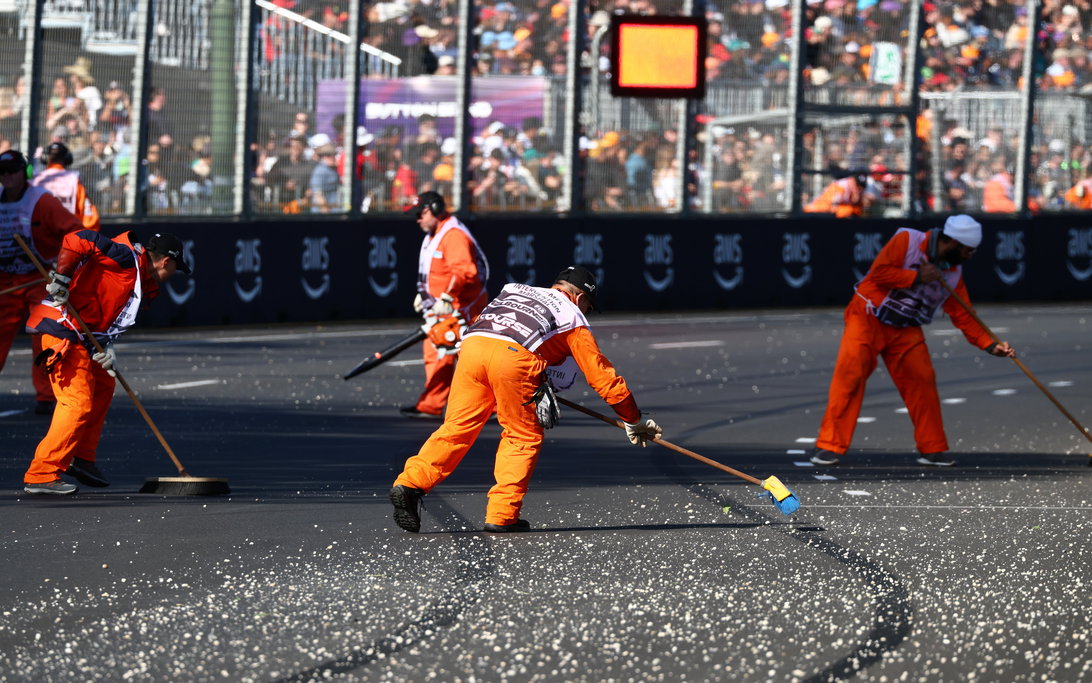
A second red flag struck on lap 55 when Kevin Magnussen clipped the wall at Turn 2. The fragments left behind forced another full reset just as the field prepared for a genuine sprint. These two interruptions alone compressed what should have been a 58-lap contest into a series of short, high-stakes restarts where telemetry dictated strategy more than driver intuition ever could.
The decisive third flag came immediately after the lap 57 restart. A chain reaction involving Carlos Sainz and Fernando Alonso, followed by the Alpine collision and Logan Sargeant running into Nyck de Vries, left the circuit impassable with one lap remaining. The race ended behind the Safety Car, its final classification frozen rather than earned.
- Albon incident: lap 8, Turn 6, heavy crash
- Magnussen incident: lap 55, Turn 2, tyre detachment
- Restart chaos: lap 57, multi-car contact triggered by Sainz-Alonso contact
When Telemetry Replaces the Schumacher Standard
Michael Schumacher's 2004 season at Ferrari still stands as the clearest benchmark for what unfiltered consistency looks like. He posted qualifying laps that rarely deviated more than two-tenths across an entire weekend, relying on seat-of-the-pants feedback rather than real-time delta screens. In Melbourne 2023 the opposite occurred. Every restart became a data rehearsal, with teams feeding drivers exact brake points and throttle maps derived from simulations that could not account for the sudden debris fields or the human adrenaline spike after two prior red flags.
"They created the problems themselves," Max Verstappen stated after the race, his words cutting straight through the official narrative of safety-first protocol.
Fernando Alonso was equally blunt, calling the late-race rules "stupid" after losing a podium position in the final-lap melee. These are not complaints from drivers who dislike data. They are warnings from athletes whose craft is being slowly automated.
The danger is not the red flags themselves. It is the growing institutional reflex to treat every anomaly as a problem best solved by another algorithm. Within five years the sport risks arriving at fully scripted pit windows and restart procedures where driver feel is treated as noise rather than signal. The 2023 Australian Grand Prix offered an early glimpse of that future: a race whose natural conclusion was replaced by a procession because the numbers on the timing screens no longer matched the chaos unfolding on track.
The Record That Should Haunt Race Control
Three red flags in one Grand Prix is not an outlier to be celebrated. It is evidence that the balance between spectacle and intervention has tipped too far toward the latter. The timing sheets from Melbourne remain the clearest indictment available. They show a race repeatedly halted at moments when drivers were still capable of resolving the situation themselves, replaced instead by procedures that produced an anti-climax and lingering questions about consistency.
The record stands. The question is whether future seasons will treat it as a cautionary data point or simply another entry in the expanding rulebook.
Join the inner circle
Get the deep dives and technical analysis from the world of F1 delivered to your inbox twice a week.
Zero spam. Only high-octane analysis. Unsubscribe anytime.