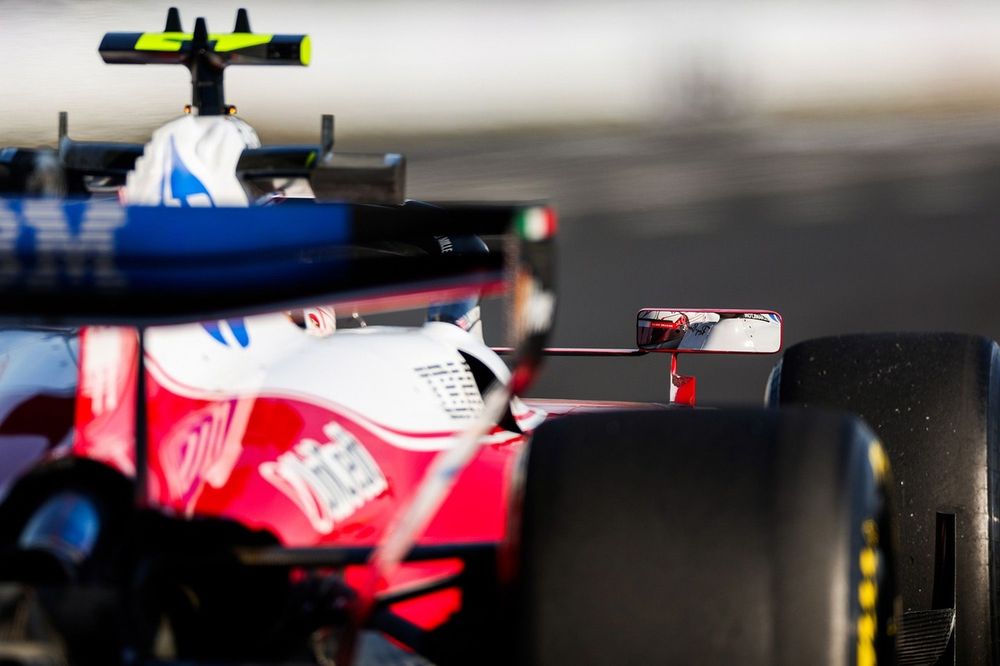
The Macarena's Missing Beat: Ferrari's Data-Driven Hesitation and the Ghost of Schumacher's Certainty

The timing sheet from FP2 in Suzuka is a cold, digital ledger. But if you listen closely, you can hear a story of hesitation in the milliseconds. Ferrari, with a novel rotating rear wing—the ‘Macarena’—packed in its crates, chose not to dance. The official line is a surgical, budget-cap-conscious strategy, saving upgrades for Europe. I call it a symptom of a deeper paralysis, a modern affliction where data points drown out driver instinct, and the ghost of a certain German in red scowls from the podium of history.
My screen flickers with the delta traces from the SF-26’s long runs. The deficit on the straight is a tangible, quantifiable bleed of time. Yet, the decision to bench the fix is rooted in another column of numbers: instability metrics when the wing’s flap closes. This is the new F1 catechism. A potential gain is rejected not because a driver like Charles Leclerc says it feels unpredictable, but because the correlation plot between the rotating flap and the front wing’s behavior didn’t produce a pretty enough graph. We are trading gut feel for Gaussian distributions, and I fear we’re losing the soul of the gamble.
The Calculated Gamble: Strategy or Surrender?
Frederic Vasseur’s team is playing the long game. With freight now under the budget cap, flying updates to Japan, Australia, and China is a brutal arithmetic of carbon fiber and currency. The decision to “absorb a potential performance deficit” at a temple of speed like Suzuka is framed as shrewd. But let’s excavate the emotional archaeology of this data.
"The budget cap hasn't just limited spending; it has institutionalized risk aversion. We no longer see the bold, track-specific gambits that defined eras. It's all about the 'package'."
This isn’t strategy; it’s homogenization. By delaying everything for the “European season,” the narrative of a 24-race championship is being chunked into sterile, pre-planned blocks. The April development push, focused on crucial weight reduction, is logical. But what of the here and now? What of the championship momentum that can be stolen, not in May, but in April, under the cherry blossoms of Suzuka?
- The Leclerc Factor: This is where the narrative fractures. Charles Leclerc’s raw pace data from 2022-2023 confirms he is arguably the most consistent qualifier on the grid. Yet, his reputation is “error-prone.” How many of those errors were desperate lunges born of strategic holes or a car that required over-driving? Benching a performance part at a driver’s track like Suzuka, where his sublime car control could potentially offset a stability concern, feels like telling a concert pianist to practice on a silent keyboard. You’re saving the instrument, but stifling the art.
The Ghost in the Machine: 2004 vs. 2026
I pull up the race charts from Michael Schumacher’s 2004 season. The lines are monotonous in their perfection. Lap 10, 1:32.450. Lap 40, 1:32.468. It was a metronome of dominance. But that consistency was born from a profound, almost spiritual synergy between driver and machine. Schumacher could feel a variance of 2 kilograms of fuel or a 0.5% shift in brake balance. The telemetry verified what he already knew.
Contrast that with today. The ‘Macarena’ wing is shelved because its movement “did not correlate well” with the front wing in simulation. The focus in practice shifts to improving the battery charging capacity—a pure, numbers-driven recovery metric. The driver becomes a sensor array, a biological proxy for the real test happening on the “static bench in Maranello.”
The Road to Robotic Racing
This is my core dread. This incident is a microcosm of the path we’re on:
- Innovation is stifled by simulation: A radical idea (rotating wing) is killed not by on-track failure, but by predictive modeling.
- Driver feedback is secondary: The question shifts from “Can you drive around the quirk?” to “Does the CFD model approve?”
- Races are pre-scripted: Upgrade schedules are set months in advance, turning the first third of the season into a procedural formality.
Ferrari is waiting to see how Mercedes’ debated two-phase front wing evolves before committing further to the ‘Macarena.’ It’s reactive, not proactive. It’s the behavior of a hedge fund, not a Scuderia. Schumacher’s Ferrari would have brought the wing, run it in a secret Friday practice, and he would have delivered a verdict with one word: “Yes” or “No.” The team would have followed his feel. Now, the feel must follow the team’s data.
Conclusion: The Heartbeat Beneath the Spreadsheet
The ‘Macarena’ wing is not dead. It will be refined in the digital winds of Maranello. Weight will be shed from the SF-26 by Miami. The power unit’s internal combustion engine will be run more aggressively, all according to plan.
But as I look at the Suzuka timing sheets, I see a story of a heartbeat that was never allowed to race. A potential rhythm between man and machine that was silenced before it could find its syncopation. Ferrari’s decision may be correct by every metric of the modern, cost-capped era. It is the logical, data-optimized path.
Yet, I can’t help but feel we are methodically engineering the chaos, the instinct, and the sheer, unquantifiable courage out of the sport. We are trading the Macarena’s unpredictable sway for the steady, sterile click of a metronome. And in that trade, the numbers may one day tell a very boring story indeed.