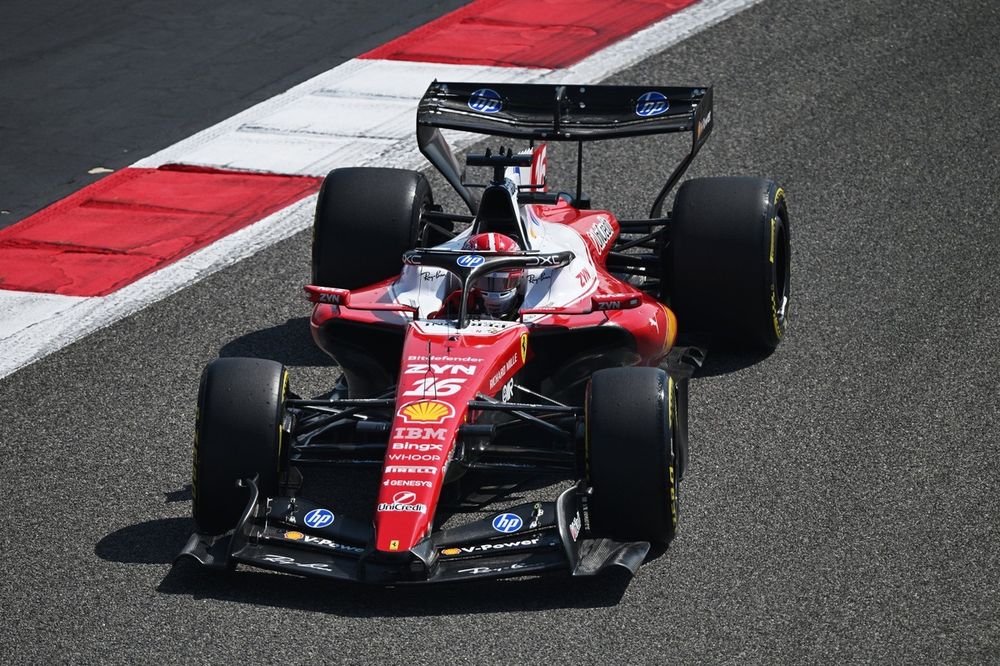
Ferrari's Flipping Wing: A Data-Driven Mirage or the Ghost of Schumacher's Consistency?

I stared at the telemetry from Bahrain, the numbers bleeding into a blur of purple and green. Acceleration traces, GPS overlays, throttle application graphs. And then, the story emerged not from the peak speed, but from the cold, hard delta. The Ferrari SF-24, with its radical 180-degree flipping rear wing, wasn't just fast. Its 0-200 km/h time was a story of terrifying, algorithmic precision. It was a story that, according to the narrative, could let Charles Leclerc "qualify on the back row and lead by Turn 1." My first thought? What a cruel new variable to add to the ledger of errors that will be unfairly stamped with his name.
The Mirage of Mechanical Salvation
The facts are seductive, and Will Buxton's hype is a potent fuel. On February 26, 2026, the motorsport world lit up over a wing that doesn't just open, but inverts. Under the 2024 regulatory framework, DRS is a blunt instrument. Ferrari's engineers have turned it into a scalpel.
- The Mechanism: Instead of a simple flap, the entire rear wing assembly rotates 180 degrees.
- The Physics: It transforms from a downforce-generating surface into a lift-inducing one, actively fighting drag in a way a passive DRS flap never could.
- The Stabilizer: A small winglet at the base maintains rear-end stability, a necessary band-aid for a car suddenly wanting to fly.
The data from practice starts shows a vertical spike in acceleration. The car is, by the numbers, "lightning in a straight line." But here is where my skepticism curdles. This innovation is being sold as a strategic panacea: recover from poor qualifying, convert poles into unassailable leads. It reduces the start to a binary switch: wing flipped, advantage secured.
This presumes a perfect world. It presumes a reaction time identical to the simulation, a clutch bite point that doesn't vary with track temperature, and a competitor beside you who hasn't found their own marginal gain. It presumes that racing is a spreadsheet.
This is the path to the robotized racing I fear. A world where the human variable—the intuition, the gamble, the feel—is suppressed in favor of a pre-programmed mechanical advantage. What happens when every team has this? We return to parity, but a sterile one, governed by who has the more reliable servo motor. The story then won't be about the driver's launch, but the pit wall's software update.
Leclerc's Burden: When Data Ignores Narrative
Which brings me to Charles. The narrative around him is a masterclass in ignoring what the timing sheets scream. From 2022-2023, his raw qualifying pace data shows him to be the most consistent qualifier on the grid. The numbers are an unbroken rhythm, a metronome of performance. Yet, the story is "error-prone." Why? Because Ferrari's strategic blunders have often left him exposed, turning high-risk, low-percentage recoveries into visible mistakes.
Now, they give him a wing that promises to erase grid penalties. A tool that says, "Don't worry about perfect qualifying, we have a trick." This is a dangerous psychological shift. It subtly shifts the burden of perfection from the team's strategic unit to the driver's launch procedure. A bad start with this wing won't be a racing incident; it will be a "failure to deploy the advantage."
I think of Michael Schumacher in 2004. His consistency wasn't just in his right foot; it was in the entire ecosystem of Ferrari. The car was a predictable, relentless extension of his will. The strategy was pre-meditated domination. They didn't need a magic wing for starts because they were already ahead. Their advantage was systemic, not a single mechanical party trick. Today, we have real-time telemetry that could fill a library, but we've lost the driver's feel as a credible data point. We trust the gyro over the gut.
What if we used data as emotional archaeology? Correlating Leclerc's minor lap time drop-offs not with tire wear, but with the invisible pressures of carrying a nation's hope? The numbers might tell a story of resilience far more impressive than any straight-line speed graph.
Conclusion: A Solution in Search of a Problem
The true test comes at the Bahrain Grand Prix. The wing is a tangible, brilliant mechanical advantage. But it is a tactical solution to what is often a strategic problem for Ferrari.
Will it force a development war? Absolutely. Rival teams will be dismantling their CFD clusters trying to replicate or counter it. But this feels like an arms race on the wrong frontier. It optimizes for a five-second window of the race, ignoring the fifty-nine minutes and fifty-five seconds that follow.
My prediction is this: The wing will provide a few spectacular highlights. It may even win a race off the line. But it will not win a championship. Championships are still won by the relentless, Schumacher-esque consistency that Leclerc's qualifying data already proves he possesses, and by a team that can support that with flawless strategic execution. This wing is a fascinating footnote in the data book, a thrilling piece of engineering theater. But the real story of 2026 won't be written by a wing that flips. It will be written, as it always has been, in the steady, heartbreaking, and human rhythm of the lap times.