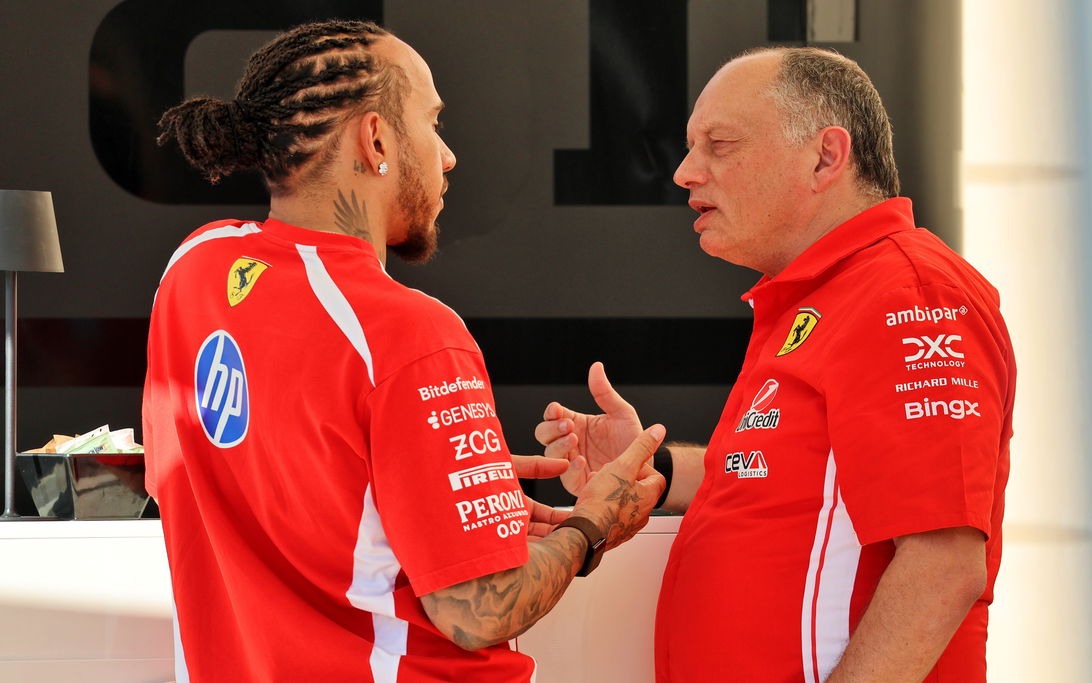
The Unseen Blueprint: How Hamilton's Mind Finally Built a Ferrari He Can Drive
The telemetry from Shanghai told a story of precision, of a machine operating within its limits. But the real data, the human data, was in the post-race pen. Lewis Hamilton's smile didn't just reach his eyes; it crinkled them with a relief so profound it felt like an exhalation held for fifteen months. The podium in China, that third-place finish, was not a gift from the SF-26. It was a receipt. Proof of purchase for a soul finally invested. Fred Vasseur speaks of integration, of involvement, but I see something far more primal: the end of a psychological exile.
For a driver of Hamilton's calibrated psyche, joining Ferrari in 2025 was not a change of employer. It was a forced migration of self. He arrived in Maranello as a monument, a seven-time champion, but the car—the car was there. A finished artifact. To him, it must have felt like being handed someone else's tailored suit and told to win a sprint. The fabric never quite fits. The silence that followed that podium-less year wasn't just sporting failure; it was the silence of a brilliant mind locked out of the workshop, forced to drive a vehicle he did not help conceive. A driver disconnected from a car's genesis is an artist painting with gloves on.
The Simulator Sessions: Where Trust is Forged in Code
Vasseur pinpointed the turning point: mid-2025. The 2026 project was a blank page. And there, in the sterile, pixelated twilight of the simulator, Hamilton began to scribble. This is where the relationship moved from transactional to transcendental.
"It's getting better and better... easier for him to deal with people and to work with everybody," Vasseur said, describing a thaw we all sensed but couldn't measure.
But let's dissect what "working with everybody" truly means for Hamilton. It isn't about camaraderie. It's about establishing a dialect. His feedback in that simulator wasn't just about balance or understeer. It was a stream of consciousness, a narrative of grip and fear and intuition, translated into engineering parameters. Every driver gives feedback. Champions impart a philosophy. By being "part of the project" from its digital womb, Hamilton wasn't just adjusting a wing; he was encoding his instincts—honed over 300 Grands Prix—into the very DNA of the chassis.
- The 2025 Arrival: A finished sculpture. He could only critique the form.
- The 2026 Genesis: A lump of clay. His fingerprints are in the foundation.
This is the crucial divergence from his Mercedes tenure. At Brackley, the dialect was built over a decade; a shorthand so deep it was telepathic. At Ferrari, he had to build a new language, from scratch, while the world watched and sneered. The simulator sessions were his Rosetta Stone.
The Lauda Parallel: Crafting a Narrative from Scars
We must talk about trauma. Not the physical, fiery trauma of a Niki Lauda, but the psychological trauma of a champion rendered ordinary. Hamilton's 2025 was a quiet, public unraveling. And here, his calculated public persona reveals its genius, echoing Lauda's own masterful use of narrative.
Lauda used his scarred visage as a shield and a banner, a story of survival that overshadowed his cold, technical brilliance. Hamilton, I believe, is using the trauma of 2025 in a similarly strategic, if more internalized, way. That difficult year is now the origin story for his Ferrari redemption arc. It is the "before" picture. The struggle that makes the eventual triumph—should it come—meaningful. He is not just integrating with a team; he is consciously weaving himself into the fabric of Ferrari's own mythos, a tale of patience and eventual conquest.
This is where he diverges from a Max Verstappen. Verstappen's dominance was, in my view, built on a system that streamlined his psychology, sanding down the emotional edges to create a relentless, consistent force. Hamilton's Ferrari project is the opposite. It is about infusing the machine with his complex, experienced, and sometimes mercurial psychology. It's a harder, messier path. But if it works, the machine doesn't just perform; it understands.
The Marginal Gains of a Synchronized Mind
Vasseur speaks of "marginal gains" through total teamwork. He's right, but he's understating the seismic shift. A synchronized Hamilton is not a mere component upgrade. He is a force multiplier.
- In Development: His feedback becomes predictive, not reactive. He feels a flutter in the simulator and prevents a vibration in Barcelona.
- In the Garage: His calm is contagious. The despair of a poor qualifying session is metabolized into focused problem-solving, not blame.
- On Track: This is where the psychology truly trumps aerodynamics. In changing conditions, in the uncertainty of a rain-affected race, the driver's decision-making is laid bare. A driver who trusts his car—a car he helped birth—will take risks a disconnected driver will not. He will see a drying line not as a hazard, but as an invitation he helped draft.
Ferrari trails a dominant Mercedes. The gap is technical, a matter of seconds. But closing it is a psychological siege. Hamilton, now embedded, confident, and heard, is the Trojan horse within Ferrari's own walls. He is the catalyst that can turn data into intuition, and intuition into wins.
The 2026 season is no longer just about the SF-26's downforce or power unit. It is the ultimate test of a theory: can a champion's mind, once alienated and now assimilated, truly become the defining variable in the championship equation? The podium in China was the first sentence of that answer. The rest of the season will be the thrilling, fraught, and deeply human chapter we are all waiting to read.