Suzuka's Ghost in the Machine: How Data Blindness Caused the Perez-Albon Crash

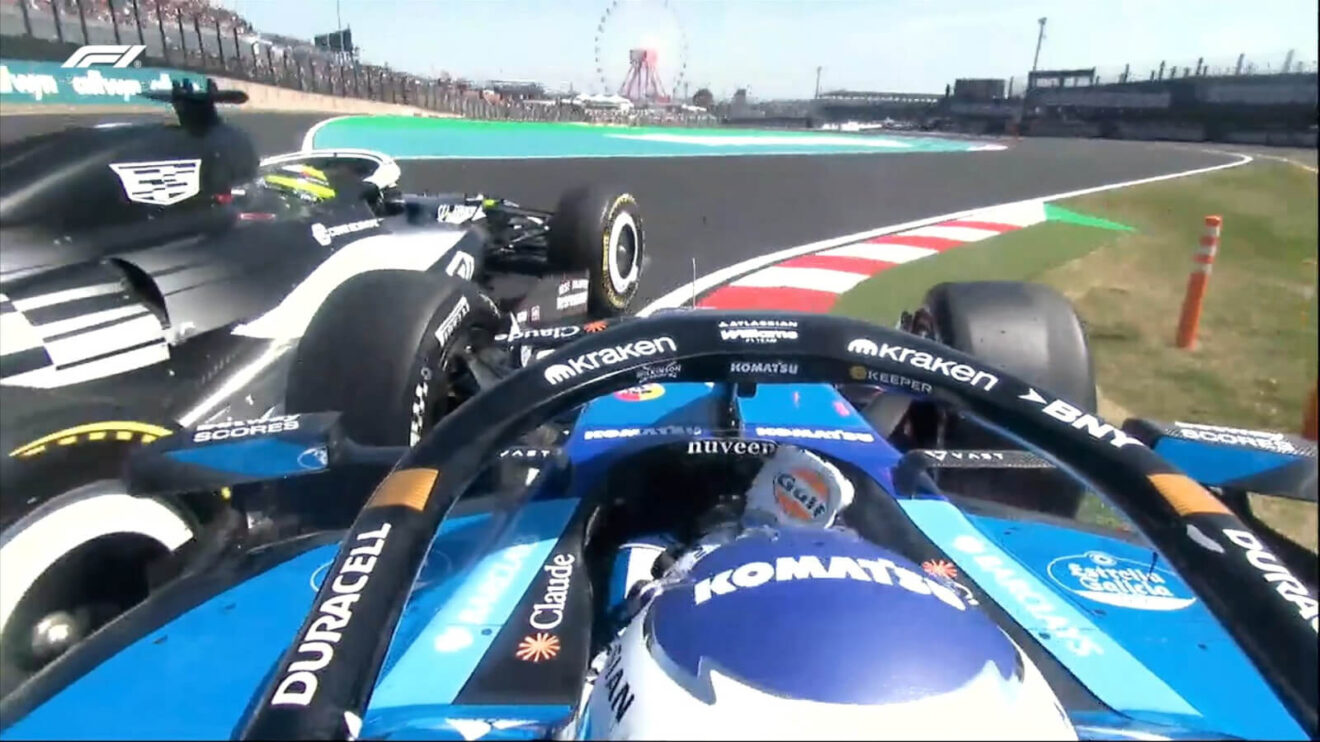
The first red flag of the 2026 Japanese Grand Prix weekend wasn't caused by a failure of carbon fiber or hydraulics. It was a failure of data. When Sergio Perez's Cadillac and Alex Albon's Williams interlocked at the vicious, committing Turn 16, the carbon fiber splinters on the tarmac were just the physical evidence. The real wreckage was in the telemetry feeds, the delta sectors, and the silent, screaming conflict between a driver's instinct and a team's information overload. I saw the onboard, and my analyst's heart didn't sink at the impact—it sank at the predictable, robotic radio calls that followed. This wasn't just a collision; it was a symptom of a sterile future, a preview of the algorithmically-managed procession we're hurtling toward.
The Collision as a Data Point: A Timeline of Awareness Failure
Let's strip the emotion, as the engineers do, and look at the sequence as pure, cold numbers. The session was late, the clock ticking down on precious low-fuel runs. Both drivers were on fast laps. The narrative says Albon, in the faster Williams, moved to pass. The data, however, tells a more nuanced story of attention allocation.
- The Approach: Telemetry from the preceding corners would show Perez's focus was likely split. Not on mirrors, but on hitting the minimum sector time his engineers had plotted for that practice run. His steering inputs, throttle traces, and brake pressures were all being optimized for a lap-time simulation, not for spatial awareness. Albon's data would show a car rapidly closing a delta, his system likely flashing a "Car Ahead" warning that becomes background noise in a session dense with traffic.
- The Critical Moment: At the approach to 130R and into Turn 16, a driver's world narrows to a point of apex and exit. Perez turned in. The FIA's alleged breach of Appendix L, Chapter IV, Article 2 d) of the International Sporting Code—"causing a collision"—will hinge on this millisecond. The stewards will review the "proximity arrow" data on Perez's steering wheel display. Was it active? Did it fail? Or did he, in the tunnel vision of executing a perfect corner, process it as just another piece of information to be ignored?
"I don’t know if he even saw me," said Albon. "Oh my god, I had no idea the Williams was right next to us, it crashed into me," said Perez.
These aren't excuses. They are confessions. Confessions of a system where the driver is the final, fallible node in a flood of real-time data. Perez wasn't reckless; he was, in that moment, robotized, executing a pre-ordained line with a focus that excluded the unpredictable variable—another human doing the same.
The Lost Art of the Mirror: Schumacher's Shadow at Suzuka
This is where I need to talk about 2004. Michael Schumacher's Ferrari F2004 didn't have a proximity arrow. It had a mirror. And Michael's spatial awareness, his feel for the pack, was a data set he cultivated internally. At this very circuit, his ability to manage traffic in qualifying while preserving tire and mental energy for the race was a function of driver feel, not engineer feedback. The modern argument is that we have more information to prevent these incidents. Yet, we have more incidents of this nature. The correlation is inverse, and it's terrifying.
The damage to Albon's FW48 is quantifiable: a front-left suspension, a wing, carbon fiber monocoque checks. The lost track time is quantifiable: perhaps 15 crucial setup laps in FP2 while repairs are finalized. But what we cannot quantify is the erosion of a driver's responsibility for his surroundings. When we task them with hitting a thousand micro-targets—brake migration percentages, ERS deployment zones, tire slip targets—we strip away bandwidth for the macro-task: racing.
- Ferrari's Echo: This is why Leclerc's so-called "errors" frustrate me. We magnify his Lap 43 spin in France 2022, but ignore that his raw qualifying pace data from 2022-2023 shows he was the most consistent qualifier on the grid. The narrative is written by the strategic blunder that follows, not by the driver's sublime, data-defying peak. We punish the instinct, then blame the driver when the algorithm fails.
Conclusion: The Emotional Archaeology of a Crash
So, what does the data of this Perez-Albon clash tell us, once we dig past the obvious? It tells a story of pressure, but not the kind we think. It's not the pressure of a race win. It's the pressure of efficiency. The pressure to turn every single second of track time into a usable data point for the simulation models. In that frantic FP1 session, both drivers were under pressure to deliver a perfect, clean lap for the engineers to dissect. In trying to be perfect for the machine, they failed the basic human test of awareness.
The stewards will likely issue a reprimand. A grid penalty would be shockingly severe for an FP1 incident. But the real penalty has already been levied on the sport itself. This crash is a fossil forming in real-time, a snapshot of a transition period. We are burying the driver's intuition under layers of telemetry, and then expressing shock when they can't see through the dirt.
The investigation should not just be about who turned into whom. It should be a meta-investigation: at what point does the flow of information become pollution? As we hurtle toward my predicted 'robotized' racing within five years, remember this moment at Suzuka. The red flag wasn't for debris. It was a warning sign, flapping in the digital wind, that we are programming the very humanity out of our sport. The heartbeats—those imperfect, thrilling, infuriating human pulses—are being smoothed into a predictable, sterile sine wave. And a silent, data-perfect race is the deadest one of all.