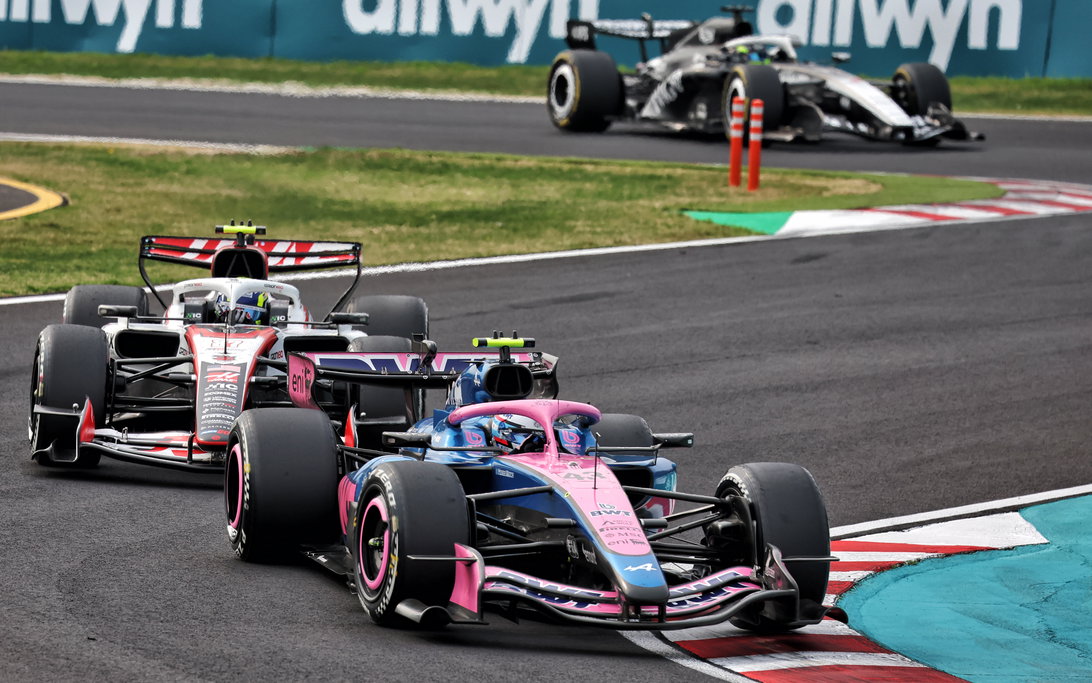
The Telemetry Tells a Bloodless Story: How Suzuka's Crash is a Symptom of F1's Coming Robotic Winter

I stared at the velocity trace from Suzuka, and it felt like reading an autopsy report for a still-living patient. Two lines on a graph, one red, one blue, converging at a 50 kph differential. The data is cold, precise, and utterly damning. It tells you everything about the "really dangerous" crash between Franco Colapinto and Oliver Bearman on Lap 21, and yet it tells you nothing of the human terror, the adrenaline spike, the millisecond of gut-feel that was overruled by a battery state-of-charge percentage. This isn't just an incident report; it's a premonition. A stark preview of the sterile, algorithmic racing future we're hurtling toward, where the driver's intuition is the first casualty.
The Numbers Don't Lie, But They Do Obscure
Let's strip the narrative and look at the bones of the event, because the bones are all the FIA seems to care about.
- Location: Spoon Curve, Suzuka. A high-speed, blind commitment.
- Lap: 21. Deep into strategic variance.
- Car 1 (Williams, Colapinto): Harvesting energy. Effectively a moving chicane, traveling approximately 50 kph (31 mph) slower than his baseline.
- Car 2 (Haas, Bearman): Deploying energy. A missile locked on a trajectory calculated for optimum lap time, not traffic avoidance.
The data sheet would call this a "convergence incident." I call it a predictable failure of a system that prioritizes energy management over situational awareness. Colapinto's defense—that he took the corner "flat-out as normal"—is the most terrifying part. He was driving to his delta, a number on his steering wheel. Bearman was driving to an overtake opportunity, a move in his mind. The machine protocol and the human instinct were on a collision course, and the machine protocol had no clause for "check mirrors, someone is arriving at warp speed."
"I did nothing unusual," Colapinto stated. He's right. And that's the problem. In modern F1, driving to the prescribed telemetry is doing your job. The unusual thing would have been to deviate from the energy plan, to sacrifice a tenth to create a safer buffer. That kind of intuition is being systematically engineered out.
This is where I think of Charles Leclerc in 2022. The narrative paints him as error-prone, but his quali lap data from that season shows a metronomic consistency that was often obliterated by a strategic blunder from the pit wall. We punish the driver's final, visible mistake, while absolving the thousand small, data-driven decisions that boxed him into that corner. Colapinto was boxed in by his battery software.
From Schumacher's Feel to Today's Telemetry Slavery
I need to invoke 2004. Michael Schumacher's Ferrari F2004 didn't harvest energy. It consumed fuel and rubber. Michael's advantage wasn't just in the car's pace, but in his preternatural feel for a closing speed, for the subtle body language of a competitor ahead. He calculated risk with a wetware processor no ECU can replicate. The team gave him a strategy, and he orchestrated it on track, adapting millisecond by millisecond based on feel, sound, and peripheral vision.
Contrast that with today. The modern driver is the middleman in a conversation between the strategy computer and the power unit. The incident at Suzuka is a direct result of this. The speed differential wasn't an anomaly; it was a feature of the prescribed strategies. The car ahead is told to harvest. The car behind is told to deploy. The drivers execute. When their paths intersect catastrophically, we blame "the delta" or "the mode," scapegoating the very systems we've empowered.
Carlos Sainz's criticism of the FIA for ignoring prior warnings is valid, but it's also quaint. It's like yelling at a self-driving car's algorithm. The governing body is trapped in the same data-centric paradigm. Their solutions will be more telemetry, more warnings, more standardized "safe modes" in certain corners. They will try to algorithm their way out of an algorithmic problem.
This is the path to robotized racing. Within five years, I fear we'll see mandated, real-time speed differential alerts that dictate driver behavior. "Do not overtake, delta critical." The spontaneity, the daring lunge born of a driver's sheer will—like Schumacher's pass on Fisichella at Suzuka in 2003, a move that defied all cold logic—will be legislated away in the name of managing energy states. The sport will become a high-speed, public data execution with human components.
Conclusion: The Heartbeat Beneath the Spreadsheet
So, what does the data from Suzuka really tell us? It tells a story of two drivers playing their assigned roles in a simulation that forgot to account for human physics. The 50 kph delta isn't just a number; it's the width of the chasm between driver agency and engineering mandate.
My job as an analyst isn't to just present these numbers. It's to perform emotional archaeology on them. The real story isn't in the impact G-forces Bearman endured, but in the frantic leftward jink he attempted—a pure, uncomputable survival instinct that the telemetry can only log as a "steering angle anomaly."
The FIA's next steps will be telling. If they reach for another software patch, another layer of data monitoring, they confirm our trajectory toward sterile predictability. The only solution that preserves the soul of F1 is to give time back to the driver. Simplify the energy management, reduce the speed deltas, and let the risk calculus return to the cockpit. Let a mistake be a human mistake, not a system conflict.
Otherwise, the crashes will remain "really dangerous," but the racing will become really, really boring. And the final data point we'll all be analyzing is the steady decline in the sport's heartbeat.