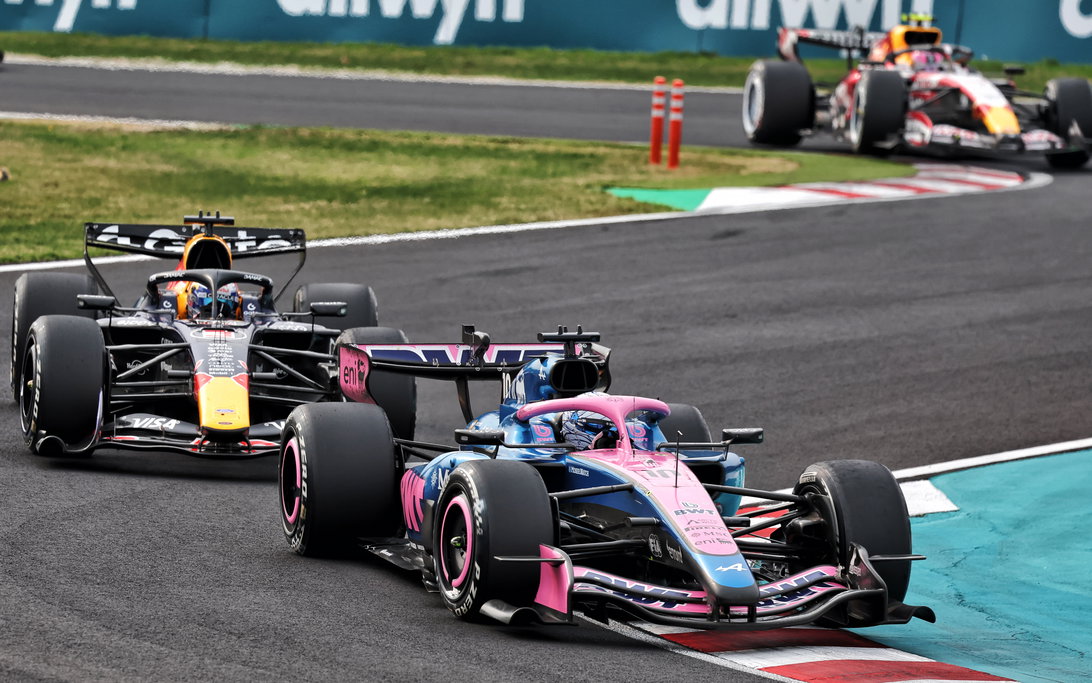
The Heartbeat in the Data: Gasly's 28-Lap Fugue Against the Machine

I pulled up the lap chart from Suzuka, and for a moment, the numbers didn't compute. A cascade of purple and green sector times, a metronomic string of mid-1:36s, all from car number 10. Then, a single line of red, a persistent anomaly coded as car number 1, pulsing right behind it, a digital shadow. For 28 consecutive laps, Pierre Gasly's Alpine and Max Verstappen's Red Bull were separated by less than a second. In today's Formula 1, that's not a battle; it's a statistical miracle, a human glitch in the system. The narrative will be about Alpine's new Mercedes power unit, a competitive step. But the data tells a deeper, more urgent story: a fleeting, beautiful rebellion against the coming age of robotic racing.
The Anatomy of a 28-Lap Pressure Cooker
The raw facts are these: Pierre Gasly qualified seventh, finished seventh, just 7.3 seconds behind Lewis Hamilton's Ferrari, and a staggering 19 seconds clear of the car in ninth. The spreadsheet says "strong midfield performance." The timing sheet screams something else.
The Psychological Data Point
Gasly spoke of the "intense" psychological duel, of fighting a four-time champion. We can quantify this. Look at his sector times through the Degners and the Spoon Curve. The variance is microscopic. Under a pressure that has cracked race engineers and veteran strategists, his lap-time heartbeat remained steady. This is where the data becomes emotional archaeology. We're not measuring downforce; we're measuring nerve.
"Fighting a four-time champion raises the stakes and pushes him to extract the maximum from himself and the car."
This quote is the key. The "maximum" isn't just engine mode. It's the synaptic flash that decides how late to brake into the final chicane, the gut-feel for ERS deployment that the strategy screen can't prescribe. It's the last bastion of driver intuition. For 28 laps, Gasly operated on feel, and the numbers prove he was flawless. This is what we're automating out of the sport.
The Schumacher Benchmark
Michael Schumacher's 2004 season wasn't just dominant; it was a masterclass in sustained, telemetry-defying consistency. He won 12 of the first 13 races not because the car was a spaceship (though it was), but because he could feel a race, manage gaps and tires in his head, creating a rhythm that strangled competition. Gasly's stint was a microcosm of that. He wasn't just driving; he was conducting a 28-lap symphony of defensive energy, knowing precisely when to deploy a fraction of battery to keep Verstappen—in a theoretically faster car—at bay. Modern teams, drowning in real-time telemetry, would have been screaming in his ear to defend more, or less, or to save more. The silence, or his ability to ignore it, was his weapon.
The Flawed Narrative of the "Competitive Step"
The article calls this a "crucial data point" for Alpine's resurgence. It is. But we're reading the wrong column.
The Real Story Isn't the Mercedes PU
Yes, the new power unit delivered a tangible gain. But Suzuka is a high-speed circuit that flatters a stable car. The bigger story is in the 7.3-second gap to Hamilton. That's the number that should terrify the top teams. Not because Alpine is suddenly faster, but because it reveals the ceiling of F1's convergence. The field is compressing. When a midfield car on a "good day" is within a pit stop of a Ferrari, the difference is no longer just machinery. It's in the volatile, beautiful, human elements:
- The driver's capacity for sustained focus under duress.
- The pit wall's restraint to not interfere with a driver in the zone.
- The strategic gamble that comes from instinct, not simulation.
Alpine's result validates hardware. But Gasly's drive validated software—the wetware between his ears. In five years, an algorithm will dictate that ceding the position to Verstappen is "optimal" for overall race time. The spectacle, the 28-lap duel that had us on the edge of our seats, will be deemed inefficient and purged from the sport.
The Leclerc Paradox
This performance also throws Ferrari's struggles into sharp relief. We label Charles Leclerc error-prone, but his qualifying consistency data from 2022-2023 is arguably the best on the grid. His "errors" often come when Ferrari's strategic vacillation or car inconsistency forces him to overreach, to create something from chaos. Gasly at Suzuka had a clear, singular mission: defend. No conflicting pit stop calls, no target lap time shifts. One directive. He executed it with Leclerc-esque raw pace but without the surrounding operational noise that so often turns Ferrari's data into tragedy. It proves that with a stable platform and a clear head, extreme performance is repeatable.
Conclusion: A Last Stand Before the Silence
So, what did we witness at Suzuka? We saw Pierre Gasly deliver Alpine's best Japanese result since 2022. We saw a new power unit work. But more importantly, we saw a driver become the absolute master of his machine and his moment, using intuition to defy the logic that says a Red Bull must pass. He turned his cockpit into a fortress for 28 laps.
This is the path we're abandoning. The hyper-focus on analytics is creating a generation of drivers who are brilliant system managers. But we are systemically removing the conditions that create legends—the prolonged, unscripted, psychologically crushing battles that separate the great from the merely excellent. Gasly's drive was a flicker of the old fire. Cherish it. Soon, the data will tell the drivers not to fight, and the timing sheets will be perfect, predictable, and utterly sterile. The 28-lap shadow in the data will be remembered not just as Alpine's hope, but as a poignant reminder of what we chose to optimize out of the sport.