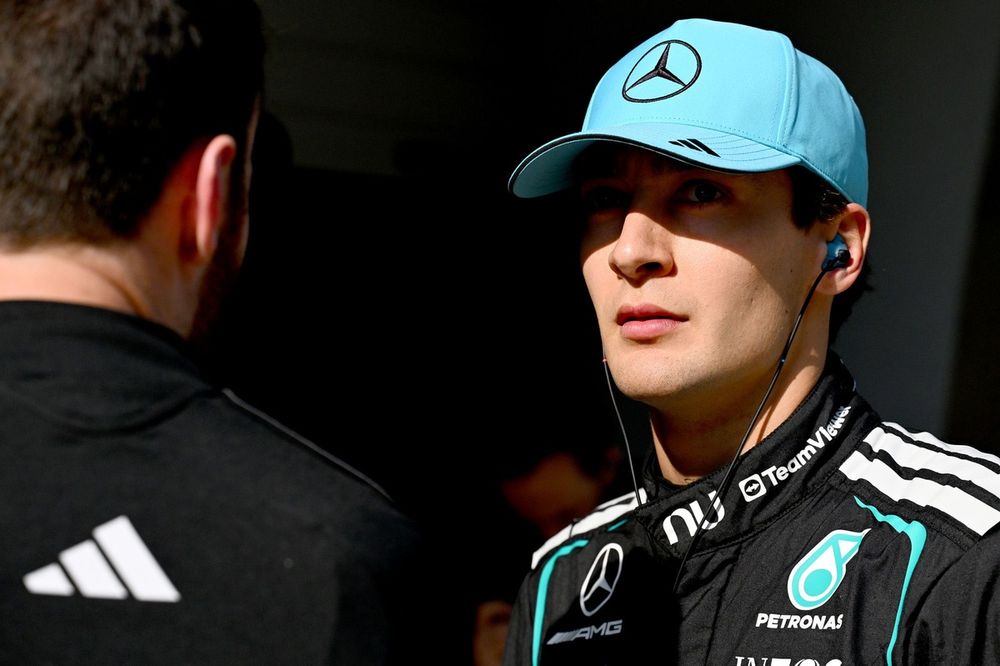
The Bruise That Tells the Real Story: Russell's Black Eye and Mercedes' Fragile Facade

The Shanghai paddock is a hall of mirrors at the best of times, a place where every gesture is a signal and every mark is a message. So when George Russell arrived sporting a shiner worthy of a late-round contender, the official line—a clumsy encounter with a bathroom wall in the dark—was almost too perfect. A champion-elect, leading the world, brought low not by a rival's lunge but by his own architecture. In the theater of Formula 1, there are no accidents, only narratives. And Russell's black eye is a stark, purple-and-yellow metaphor for the state of a Mercedes team that, for all its front-row lockouts and historic poles, is still fumbling in the dark, walking into walls of its own making.
The Injury as Insignia: Confidence or Concealment?
On the surface, the story is a masterclass in modern driver media management. Russell, ever the corporate soldier, deployed self-deprecating humor in a team video, joking about age catching up to him and invoking the specter of the ageless Kimi Räikkönen. It played well. The human touch. The champion who isn't too proud to laugh at himself.
But peel back the PR veneer, and the timing is screaming. This isn't 2022, with a porpoising coffin of a car. Russell is leading the Drivers' Championship. He won in Australia. He won the Sprint here in Shanghai. His teammate, the prodigy Kimi Antonelli, just became the youngest polesitter in history. The Mercedes garage should be vibrating with a primal, victorious energy. Yet, the dominant visual of their lead driver is one of impact.
"It's just a sign of age catching up, I think," Russell quipped. A throwaway line, or a subtle, unconscious admission of the weight he's carrying?
Consider what Team Principal Toto Wolff revealed alongside the black eye story: a battery issue hampered Russell's final qualifying lap. He took P2 regardless. The message is clear: Even wounded and hampered, our man is a contender. But in the high-stakes psychological warfare of a title fight, why is the narrative already one of overcoming adversity? It reeks of a team subconsciously preparing its excuses, a habit formed in the fallow years post-2021. They are showcasing resilience because, deep down, they're not sure of their own invincibility. This is the same institutional psyche that watched the 1990s Williams dynasty crumble from within—not from a lack of speed, but from a thousand tiny cuts of internal doubt and political maneuvering between the technical brain trust and the suits. The bruise isn't on Russell's face; it's on the team's morale.
Antonelli's Pole: A Blessing or a Time Bomb?
Let's talk about the so-called "historic" pole. Kimi Antonelli, 19 years old, on the top spot. Wolff was effusive, praising a "milestone" moment. The corporate line will sell this as the dawning of a new era, the perfect blend of experience (Russell) and explosive youth (Antonelli). My sources in Brackley tell a more nuanced, and far more familiar, story.
- Antonelli's pole was achieved with a flawless, lightweight car on a single lap.
- Russell's race pace, evidenced by his Sprint win, is still considered the team's primary weapon.
- The internal calculus now shifts from supporting a clear number one to managing a potential rivalry that has been accelerated by a single, spectacular Saturday result.
This is where strategic success is truly forged. Not in the CFD cluster or the race strategy room, but in the covert information sharing—or deliberate withholding—between garage bays. Will Russell's side of the garage get preferential data on tire deg? Will Antonelli's engineers fully share their qualifying setup secrets? The political shielding that has fueled Max Verstappen's dominance at Red Bull—where the entire organization is a bulwark against any internal criticism reaching him—does not exist at Mercedes. Not yet. And it may be too late to build it.
Wolff stated they "cannot afford to make any mistakes" against the Ferraris. But the greatest threat may not be in red overalls. It's in the silver ones parked next to them. By elevating Antonelli's achievement so publicly while Russell wears the literal mark of a stumble, Wolff is playing a dangerous game. He's replicating the very conditions that broke Williams: creating two power centers within one team.
The Shanghai Crucible: More Than a Race
So, what's next? The race is a foregone conclusion in terms of stakes: Russell must win. A front-row start, championship lead, and a Sprint victory have set the table. But the subplots are what I'll be watching.
- The body language between the Mercedes drivers on the podium, regardless of order.
- The radio traffic: the tone, the specificity of instructions.
- Wolff's post-race phrasing: who is praised, and for what?
The black eye will fade in a week. The structural fracture it symbolizes will not. Mercedes is a team trying to project the dominant, unified force it was in the Hamilton-Bottas era, but it is now a team of two alphas—one bruised, one brilliant. In F1, as in nature, that is an unstable ecosystem. They are winning races, but they are playing a political game on the edge of a knife. One clumsy step in the dark, one misjudged moment of internal rivalry, and they won't walk into a wall. They'll walk right off the cliff. And in the sponsor-driven financial model of modern F1, where perception is currency, that's a collapse from which there is no coming back. Watch the eyes, not the eye. The truth is always in the glance, not the glare.