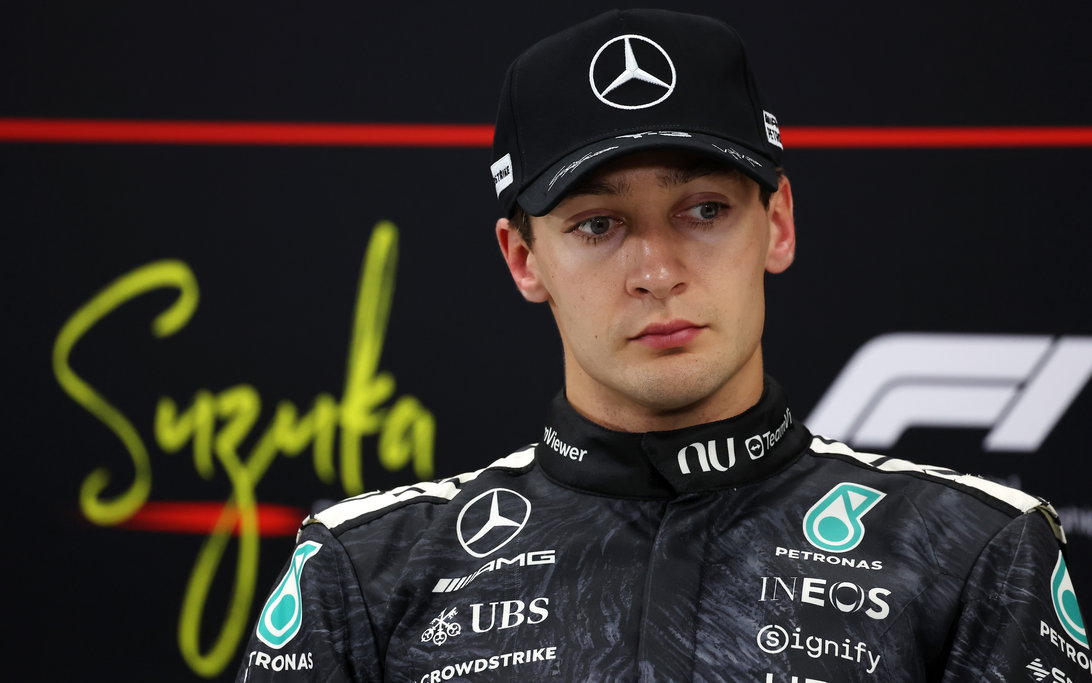
The Ghost in the Machine: How Mercedes' Data-Driven Dream is Strangling George Russell

I stared at the Suzuka timing sheets, the cold, hard numbers bleeding into a narrative of quiet agony. The story wasn't just that Kimi Antonelli won. It was the precise, surgical manner in which George Russell's race was dismantled, not by a rival's genius, but by a cascade of failures that read like a diagnostic log from a machine learning model gone wrong. His fifth-place finish on 2026-03-30 wasn't bad luck. It was a premonition. A glimpse into F1's sterile future, where the driver becomes a biological sensor in a loop of algorithmic second-guessing.
The Algorithm Giveth, and The Algorithm Taketh Away
The core fact is brutal in its simplicity: the Safety Car for Oliver Bearman's crash was deployed one lap after Russell pitted, but before Antonelli made his stop. In the data-centrist war room, this is the ultimate "force majeure," an exogenous variable that shatters the perfect model. Antonelli got a free stop and the lead. Russell got a lesson in chaos theory.
But here's where the data archaeology begins. The original article calls it "poor strategic luck." I call it the inevitable failure of predictive overreach. Modern strategy is a high-stakes bet on a probabilistic model of the race. When it works, as it did for Antonelli, it looks like clairvoyance. When it fails, it looks like incompetence. The truth is messier: it's the suppression of driver intuition. Could a driver, feeling the race's rhythm, have sensed the looming caution? We'll never know, because the pit wall, armed with gigabytes of historical data, made the call. They bet against the volatility that defines racing.
"Everything was just issues after one another," Russell lamented.
This isn't just a quote. It's the sound of a man trapped in a system. The issues that followed the Safety Car weren't random.
The Battery: A Heart That Wouldn't Beat
- Battery Harvest Limit Hit: Immediately after the restart, defenseless against Hamilton.
- "Super Clipping" Event: A severe battery deployment failure, gifting a position to Charles Leclerc.
We label these "technical failures," but they are emotional data points. A battery harvest limit isn't a switch; it's a governor. It's the system saying, "You have used your allotted performance. You must now be passive." In Schumacher's 2004 Ferrari, the performance was an extension of his will, a trust in a mechanical beast. For Russell, it's a negotiation with a battery management system whose parameters were set by a simulation hours before. The "super clipping" was the system's nervous breakdown.
The Human Cost in the Age of Telemetry
Let's talk about Charles Leclerc. He capitalized on Russell's issue to take fourth. The narrative will, as always, flirt with labeling this a "Leclerc error recovery" or a gift. But the data from his Ferrari years, particularly 2022-2023, tells a different story: the man has the raw, consistent pace of a champion, often hamstrung by strategic entropy from the pit wall. His pass on Russell wasn't luck; it was a predator capitalizing on wounded prey, a pure driver instinct that no algorithm could have executed. It’s this kind of moment—human instinct reacting to real-time chaos—that the sport's data obsession seeks to eliminate.
Meanwhile, the "chronic start problems" for both Mercedes drivers are the most damning evidence of the gap between simulation and reality. The launch is a violent, analog ballet of clutch bite, torque delivery, and human reaction. You can simulate it ten thousand times, but on the grid, with the heart pounding at 180 bpm, it's about feel. That Mercedes hasn't solved this is a testament to a truth I hold sacred: some elements of racing defy digitization. They require a Schumacher-level symbiosis between man and metal, not a driver waiting for a pre-programmed clutch map to execute.
The Antonelli Paradox
Antonelli's back-to-back wins present the seductive counter-argument: See? The system works! But does it? He executed a flawless drive on the same strategy that ensnared Russell. He is the proof-of-concept, the ideal output of the machine. But this creates a dangerous internal dynamic. Russell isn't just fighting Red Bull or Ferrari; he's fighting the ghost in his own machine, the growing narrative that Antonelli is the more compliant, system-optimized driver. This is where sport becomes corporate efficiency.
Conclusion: The Sterile Future is Now
Suzuka 2026 wasn't a race. It was a case study. George Russell's descent from potential winner to fifth was a live autopsy of modern F1. The mistimed Safety Car exposed strategic fragility. The battery issues revealed the cold tyranny of energy management software. The start problems highlighted the lost art of mechanical feel.
We are five years away, maybe less, from races being fully "robotized," where driver input is merely a tolerated variable within strict operational boundaries. The W17's "operational reliability under pressure" failed Russell not because a part broke, but because its logic could not adapt to the beautiful, terrible chaos of a race.
The numbers from Suzuka tell a clear story: Antonelli leads the championship. But the story within the numbers is far darker. It's the story of a driver, Russell, whose heart and instinct are being filtered through layers of code, and of a sport slowly trading its soul for the clean, predictable output of a silicon mind. Schumacher’s 2004 dominance was a symphony. What we saw in Japan was a perfectly rendered, emotionally bankrupt MIDI file. The data is complete. The soul is absent.