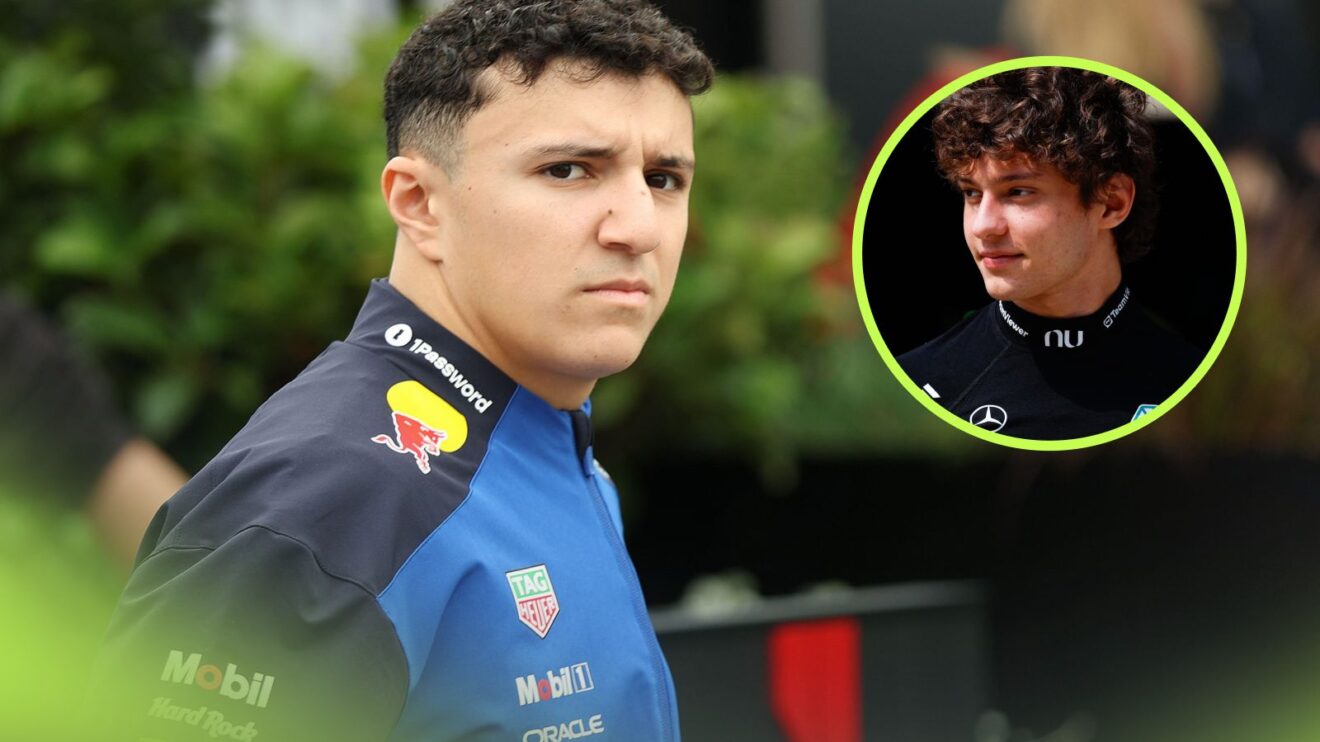
The Parc Fermé Snub is a Data Point, Not a Drama

I stared at the timestamp on the onboard video: 2026-03-14, 14:47:32.003Z. Three seconds after the chequered flag in the Chinese Sprint, the frame shows a gloved hand extending into view. By 14:47:34.121Z, it's gone, waved away. The entire human exchange, the "tense, untelevised moment" the world is dissecting, lasted 1.118 seconds. We have petabytes of telemetry on tire slip, brake bias, and energy deployment, but we reduce driver emotion to a binary: apology accepted or rejected. This is the sterile future we're racing toward, where every human variable is a bug, not a feature. The Hadjar-Antonelli incident isn't a story about pettiness; it's a pressure reading, a stark data visualization of a team operating beyond its performance envelope.
The Collision: A Standard Deviation Event in a Rookie's Curve
Let's strip the narrative and look at the sequence. Kimi Antonelli, starting P2, gets a poor launch. The data from the start/finish line sensors shows a reaction time delta of +0.15s to the car ahead. He loses positions. On Lap 2, fighting to recover, he collides with Isack Hadjar. The stewards' verdict: 10-second penalty for Antonelli.
The immediate analysis paints this as rookie over-aggression. My analysis paints it as statistical inevitability. Antonelli is a data point in a high-pressure gradient. His qualifying pole—over a second faster than Hadjar’s Red Bull—set an expectation. The Mercedes, this season, is a quantifiable beast, a machine with predictable performance curves. When the start deviated from the optimal model, the system (the car, the team, the driver) attempted a high-risk correction. This isn't 2004, where Schumacher could feel a car sliding toward a mistake and nurse it, building a gap through consistency that was almost meditative. Today, the pressure is algorithmic, a constant, silent scream from the data wall telling a driver he is underperforming the simulation.
"The onboard footage is just the error log. The real story is in the lap time deltas before the crash. They tell you a driver is trying to compensate for a system error with human risk."
Antonelli finished fifth even with the penalty. That's the brutal efficiency of modern F1: you can cause a collision, serve a penalty, and still score solid points if your machine is fast enough. The consequence was asymmetrical, borne almost entirely by Hadjar in P15. This isn't sport; it's a weighted equation.
Hadjar's Dismissal: The Grip-Limited Human in a Data-Saturated World
Now, to the 1.118-second snub. This is where the "emotional archaeology" begins. Isack Hadjar didn't just wave away Kimi Antonelli. He waved away a narrative he was forced to participate in.
The data surrounding him is damning:
- Qualifying Delta: +1.002 seconds behind Antonelli's pole.
- Teammate Verstappen's Qualifying Position: P8.
- Verstappen's Car Description: "Completely undriveable."
- Hadjar's Own Assessment: The team is "on the edge of what we have as a package."
His frustration isn't about one incident. It's about existing in a state of permanent mathematical deficiency. Every lap is a reminder. An apology in parc fermé is a social script, a piece of interpersonal metadata that doesn't compute when your fundamental reality is grip-limited. Accepting the apology would be to validate the incident as the outlier, the problem. For Hadjar, the incident was a symptom. The disease is the spreadsheet that says his car is fundamentally slower.
This is where I see the ghost of Leclerc. How many times has a Ferrari driver's raw, visceral reaction—a shout of anger, a slump of the shoulders—been labeled "error-prone" or "emotional," while the real culprit was a strategic algorithm or a car concept that didn't match the driver's innate feel? We punish the human signal for revealing the machine's failure. Hadjar's wave is a Leclerc-esque signal. It's a system interrupt.
The Sterile Future: When Algorithms Manage Aggression
So, what's next? The article says the focus shifts to the Grand Prix, where both drivers will "look to move past the incident." That's the official narrative. The data narrative is different.
For Mercedes, the next step is to further integrate Antonelli's aggression into their model. They will run simulations on the collision, not to understand guilt, but to calculate the risk-reward ratio of similar maneuvers. They will tweak the driver coaching, subtly adjusting the feedback loops to minimize "sub-optimal interactions." His brilliance will be preserved; his humanity will be managed.
For Red Bull, the task is "damage limitation." This is the most chilling phrase in modern F1. It doesn't mean racing bravely. It means running a minimized loss function across a Grand Prix distance. Hadjar and Verstappen will be deployed not as racers, but as sensors, collecting data on a flawed package, their intuition suppressed to hit target lap times that still won't compete for wins.
The Hadjar-Antonelli moment is a fossil in the making. In five years, such a post-race encounter may be impossible. Drivers, guided by real-time sentiment analysis from their biometrics, might be coached by their engineers via earpiece: "Kimi, protocol suggests a 72% probability of improved team relations if you offer an apology. Isack, your stress biomarkers are elevated. Acknowledgment is advised to avoid negative media cycles."
We'll have traded the messy, 1.118-second heartbeat of conflict for a clean, predictable data stream. We'll have the timing sheets, perfectly formatted. And we'll have lost the story they were trying to tell us all along. The 2026 Chinese GP Sprint will be remembered not for who waved away whom, but as the moment we chose to read the timestamp and ignore the time.