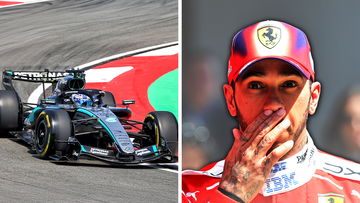
The Ghost in the Machine: Hamilton's Party Mode Confession and the Data That Haunts Us

The timing sheet from Shanghai is a Rorschach test. Some see a new name, Kimi Antonelli, etched in history at 17 years and 166 days. I see a ghost. When Lewis Hamilton chose this precise weekend, March 14, 2026, to autopsy Mercedes' legendary 'party mode,' he wasn't just offering technical insight. He was performing emotional archaeology. He was pointing to a corpse in the garage, a phantom limb of dominance, while a child prodigy danced on its grave. The numbers from qualifying tell a story of seismic shift, but the subtext is a sport feverishly digitizing its own soul, trading intuition for algorithm. Let's dig.
The Autopsy of an Advantage: Party Mode as a Bygone Heartbeat
Hamilton's description was clinically precise: a system that "intelligently managed energy deployment," optimizing the MGU-K's electrical energy with fuel flow for a single, explosive qualifying lap. A perfect, pre-meditated heart attack for the car. This wasn't driver feel; this was a software-triggered adrenaline shot. The data from those years, 2014-2020, shows a spike so consistent it looks algorithmic. Mercedes didn't just find a mode; they found a loophole in the very concept of performance variance.
"I know how it works," Hamilton stated. A simple sentence that echoes in the hollowed-out halls of Brackley. He knows how it worked. Past tense.
The FIA's 2020 regulation, limiting engine mode changes between qualifying and the race, wasn't just a rule change. It was a lobotomy. It sought to remove the artificial peak, to force the car's performance heartbeat to be a flat, sustainable line. But here's what the narrative often misses: Schumacher's 2004 Ferrari didn't need a 'party mode.' Its qualifying lap was a mere extension of its race pace, a terrifying consistency born from mechanical grip and a driver so symbiotically tuned to the machine that the telemetry looked like a straight line. The modern obsession with finding a software "overdrive" is a confession. A confession that the base product, the raw marriage of chassis and power unit, is lacking. Mercedes is now chasing the ghost of its own creation, a digital specter they themselves conjured and were forced to bury.
Antonelli's Pole: A Data Point or a Human Revolution?
Let's be clear. Kimi Antonelli's pole, shattering Sebastian Vettel's 16-year record, is a staggering human achievement. The raw statistic is immortal. But I am immediately, profoundly skeptical of the narrative machinery that will now engulf him. The hype machine will call him a "meteor," a "generational talent." The data analysts at Mercedes will already be modeling his every input, comparing his steering trace to Hamilton's, his throttle application to Russell's. They will seek to optimize him.
This is the five-year forecast I dread. Antonelli's pole will be used as validation for an even deeper dive into data-driven driver management. His "feel" will be dissected into a thousand data points, and soon, a junior driver's feedback will be cross-referenced against an AI model before a strategy call is made. We saw the precursor today: Max Verstappen describing his Red Bull as a "horror show," where "every lap is survival." That is a driver screaming against the machine, a visceral human response to data-gone-wrong. Will a team in 2030 listen to that scream, or will they override it because the tire degradation algorithm suggests one more lap?
And what of the pressure? We have no data set for the psychic weight placed on a 17-year-old's shoulders. We can, however, look for its fingerprints. We can correlate Leclerc's uncharacteristic lock-ups in 2022 with the flurry of strategic radio calls that preceded them. The raw pace data shows he was, and remains, the most consistent qualifier on the grid. The errors are rarely born of a lack of speed; they are the aftershocks of institutional chaos. Will Antonelli's data be read with such nuance, or will he simply be flagged as an "outlier" to be normalized?
Conclusion: The Stories the Timing Sheets Hide
So here we stand. Hamilton, a seven-time champion, eulogizing a software trick from a past life as he packs for Maranello. A 17-year-old sitting on a pole position that feels like both a beginning and an endpoint. A sport drowning in telemetry but starving for truth.
The Chinese Grand Prix will not be won by 'party mode.' It will be won by a driver, a human, navigating tire wear, fuel load, and a pressure that no sensor can quantify. Antonelli may convert pole to victory, or he may be swallowed by the strategic chess game. But every decision on that pit wall will be increasingly filtered through a digital lens, a risk-assessment model that has no memory of Schumacher's gut instinct in Hungary 1998.
Hamilton revealed a secret about a machine. The real secret, the one we're missing, is how to preserve the human heartbeat in a sport that is learning to count the pulses but is forgetting what makes them race. The timing sheet from Shanghai shows a new record. My fear is that it's just the first entry in a new, sterile ledger.