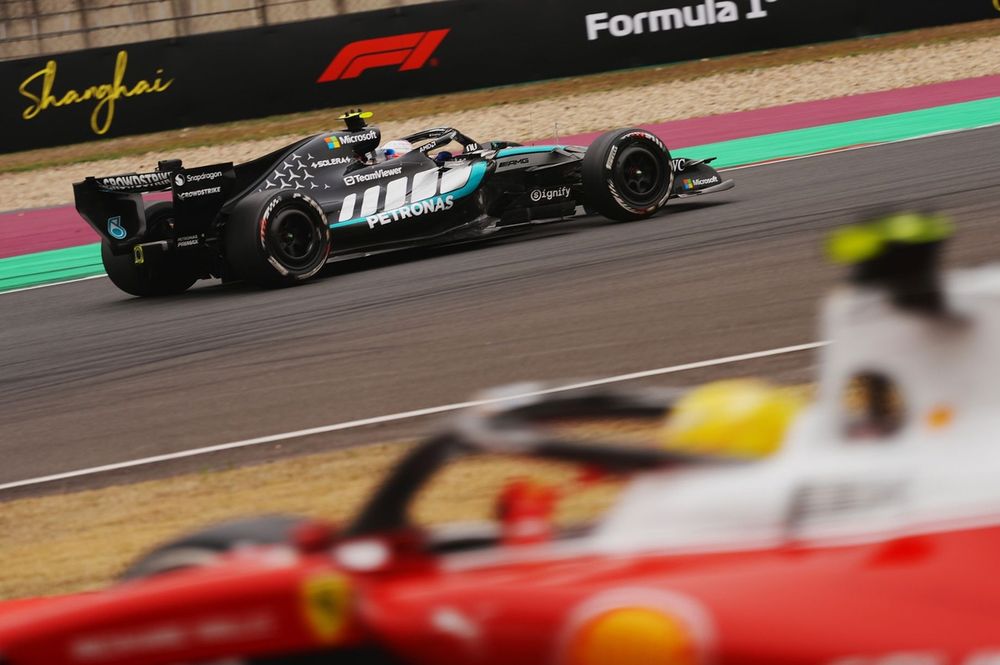
The Ghost in the Machine: Hamilton's 'Party Mode' Theory is a Data Point in a War of Perception

I was knee-deep in the sector time deltas from Bahrain, the numbers bleeding into a familiar, frustrating pattern, when Hamilton's quote hit my screen. My first thought wasn't about engine modes. It was about the 0.6-second gap in Q3, a chasm so vast it feels less like an engineering deficit and more like an emotional one. Hamilton, the archaeologist of his own past, had just dug up a ghost. Norris, the pragmatist with a customer receipt, tried to bury it. This isn't a technical debate. It's a raw, beautiful case study in how narratives fracture under the weight of data, and how we use numbers to tell the stories we need to survive.
The Data Tells a Story, But Which One?
The facts, as my spreadsheets coldly present them, are indisputable. Hamilton observed a progression Ferrari has felt like a physical blow:
- Q1 Gap: ~0.1 seconds. A whisper.
- Q3 Gap: >0.5 seconds. A scream.
The FIA's Article C5.23, mandating a single ICE mode, is the law. Hamilton’s suggestion is that Mercedes has found a way to make that single mode profoundly elastic, storing energy or managing electrical deployment to create a qualifying-specific power crescendo. Norris says it’s fiction. The stopwatch says something is happening.
"Sometimes when you're a bit off you create things in your head," Norris stated.
This is where pure data fails us. Is Hamilton, now looking in from the outside, projecting the muscle memory of his Mercedes dominance onto a new puzzle? Or is Norris, whose McLaren lives on Mercedes' hand-me-down horsepower, contractually or psychologically unable to entertain the idea? The data point of the widening gap is neutral. The interpretation is soaked in bias, history, and competitive pain. I see this and think of Charles Leclerc, a driver whose raw qualifying pace data from 2022-2023 marks him as the most consistent Saturday performer on the grid, yet whose narrative is "error-prone." Why? Because Ferrari’s strategic blunders amplify every micro-mistake. The number is pure. The story we wrap around it is not.
Schumacher's Shadow and the Sterile Future
Hamilton’s "pattern he recognizes" sent me spiraling back to 2004. Michael Schumacher’s Ferrari didn’t need a speculative party mode. It had a party season. The consistency was inhuman, but it was built on a trinity: a dominant car, a ruthless team, and a driver whose feel was the final, irreplaceable data point. The telemetry served Schumacher; it did not command him.
Contrast that with today. Hamilton’s theory, true or not, is a symptom of our hyper-analytical age. We can’t accept a half-second gap as just a better car. We must reverse-engineer a secret, a loophole, a digital ghost in the machine. This obsession is a preview of the sterile future I fear: within five years, this data fetish will robotize racing. Strategy will be a live, algorithmic feed, suppressing driver intuition for the sake of marginal gains. We'll have predictable, optimized processes and mourn the death of the gut feeling, the inspired gamble, the human error that makes drama.
What if, instead, we used this data as emotional archaeology? What if we correlated that 0.6-second Q3 deficit not just to engine modes, but to the pressure cascade on a driver knowing his team’s history of operational errors? The lap time drop-off isn't just aerodynamic; it's psychological. The numbers are a heartbeat. Hamilton’s comment is the palpitation.
Conclusion: The Numbers Are a Rorschach Test
So, does Mercedes have a modern party mode? The regulation says no. The Q3 delta shouts maybe. Norris’s denial is a data point. Hamilton’s nostalgia is another.
This scandal-in-a-teapot is about more than horsepower. It’s about the stories we tell when the stopwatch confounds us. For Hamilton, the story is a familiar technical masterpiece from his former kingdom. For Norris, it’s a rival’s psychological crutch. For Ferrari, it’s a target for development. For me, Mila Neumann, it’s a perfect snapshot of modern F1’s identity crisis.
We are drowning in data but thirsting for meaning. We chase milliseconds while forgetting that racing is, at its core, a human drama measured by machines. The pursuit of the "ghost mode" will intensify, paddock lawyers will scour Article C5.23, and Ferrari will chase a half-second in the wind tunnel. But the real story is already in the numbers: a pattern of dominance, a fracture in perception, and the haunting, unquantifiable ghost of doubt that drives every competitor in the chase. The truth is probably somewhere in the merge. And the merge, like the best racing, is messy, human, and utterly compelling. For now.