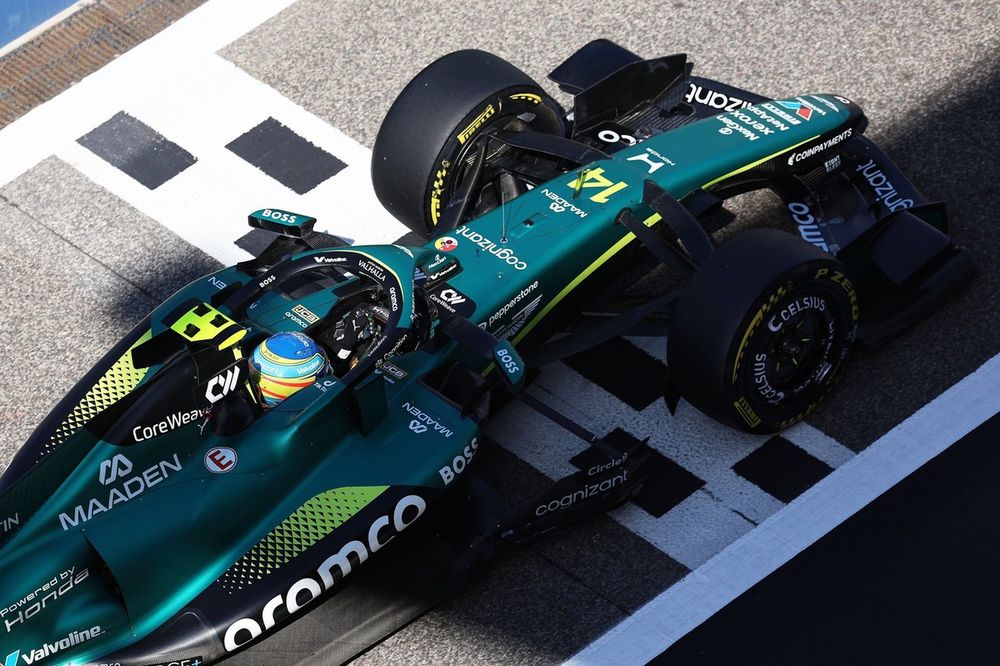
The Heartbeat Monitor is Flatlining: Honda's 2026 PU Data Tells a Story of Premature Birth

I stared at the timing sheets from Bahrain, and for a moment, I thought there was a formatting error. A column of numbers so anemic, so detached from the pack, it looked like a different category. This wasn'tt a performance gap. This was a chasm, and the data pouring out of it was cold, clinical, and screaming. Aston Martin's 334 laps over six days isn't just a low number. It's a narrative of failure written in lost time. Each missing lap is a question unanswered, a correlation unmapped, a story untold. Honda's frank admission that its 2026 power unit lacks both performance and reliability isn't news. It's a coroner's report, delivered before the patient has even left the garage.
The Numbers Don't Lie, They Scream
Let's strip the narrative and look at the raw archaeology. The headline is Lance Stroll's best time: a 1:35.974s. In the hyper-compressed world of modern F1 testing, where teams hide their true pace in plain sight, being the only team not to break into the 1m34s bracket is a statement of profound distress. It's over four seconds off the benchmark. Four seconds. In 2004, Michael Schumacher's Ferrari could lap the entire field. Today, that gap would see an Aston Martin lapped before half-distance. The data point isn't just slow. It's historically off the pace.
But performance is nothing without reliability, and here the data becomes a tragedy of scarcity.
- Total Laps: 334. The next lowest team completed nearly 50% more running. This is the foundational crisis.
- Four hours lost on Wednesday to an unspecified PU issue. That's an entire session, a dataset erased.
- Thursday ended by a battery fault. Another chapter closed prematurely.
- Friday: six intermittent laps. The final, whispered page of a very short book.
Shintaro Orihara, Honda's trackside chief, stated they did not achieve their mileage target and are "not happy with our performance and our reliability at the moment." This is the understatement of the pre-season. The data shows a program in intensive care. When your sole customer team finishes slowest, behind even a new entrant like Cadillac, the telemetry isn't just reporting a problem. It's writing the obituary for your pre-season goals.
The Ghost in the Machine: Data vs. Intuition in a Crisis
"Crews in Japan, the UK, and Bahrain are working around the clock on solutions."
This quote is the modern F1 mantra. It sounds like decisive action. But from my perspective, it reeks of panic-driven data overload. Here is my core fear playing out in real time: the hyper-focus on data analytics leading to 'robotized' problem-solving that lacks soul. Honda's engineers are undoubtedly drowning in terabytes of telemetry from those scant 334 laps. Every vibration, every temperature spike, every electrical murmur is being logged, cross-referenced, and modeled.
But what are they missing? The feel. The instinct. When Schumacher rolled out of the garage in 2004, the car was an extension of his will, and the feedback loop was human-to-machine. Today, the loop is machine-to-engineer-to-machine, with the driver reduced to a highly sensitive, albeit error-prone, sensor. In a crisis this deep, with time this short, can algorithm-driven diagnostics truly replace the gut instinct of a seasoned engineer hearing an odd harmonics in the dyno room?
The admission makes the AMR26's chassis a ghost. Adrian Newey's aerodynamic potential is an unproven theory because the power unit, the heart, cannot sustain a heartbeat long enough to test the body. This creates a data vacuum. We have no correlation between chassis setup and long-run performance. No understanding of tire degradation. The story of the AMR26 is currently a single, repeated sentence: "PU fault. Session stopped."
Conclusion: The Race Against Time is a Race Against Sterility
The season opener looms not as a race, but as a deadline for a science project gone wrong. The immediate priority, they say, is "achieving basic reliability to allow Aston Martin to run meaningful race simulations."
I say this is where the sport risks losing its last shred of humanity.
If they succeed, what will follow? A frantic, data-maximizing scramble where every lap is prescribed to extract the last byte of correlation. Driver intuition will be suppressed in favor of executing a pre-ordained run plan designed to salvage a points finish. This is the sterile, predictable racing I fear. Aston Martin's drivers will become executors of a survival algorithm, not racers probing for limits.
Honda's 2026 project is a stark warning. The numbers from Bahrain are a story of pressure, of a timeline too aggressive, of expectations sky-high from their Red Bull finale crashing into the hard wall of new regulation reality. This data isn't about lap times. It's about heartbeats per minute of a stressed organization. The emotional archaeology reveals a team in triage.
My prediction? They will find reliability. The data crunchers will eventually solve the equation. But the performance, the soul of a works engine that was meant to roar back into the sport, may have been fatally compromised in this premature birth. They might finish races, but they'll be doing so by the numbers, in every sterile sense of the phrase. And in my book, that's not racing. That's just accounting.