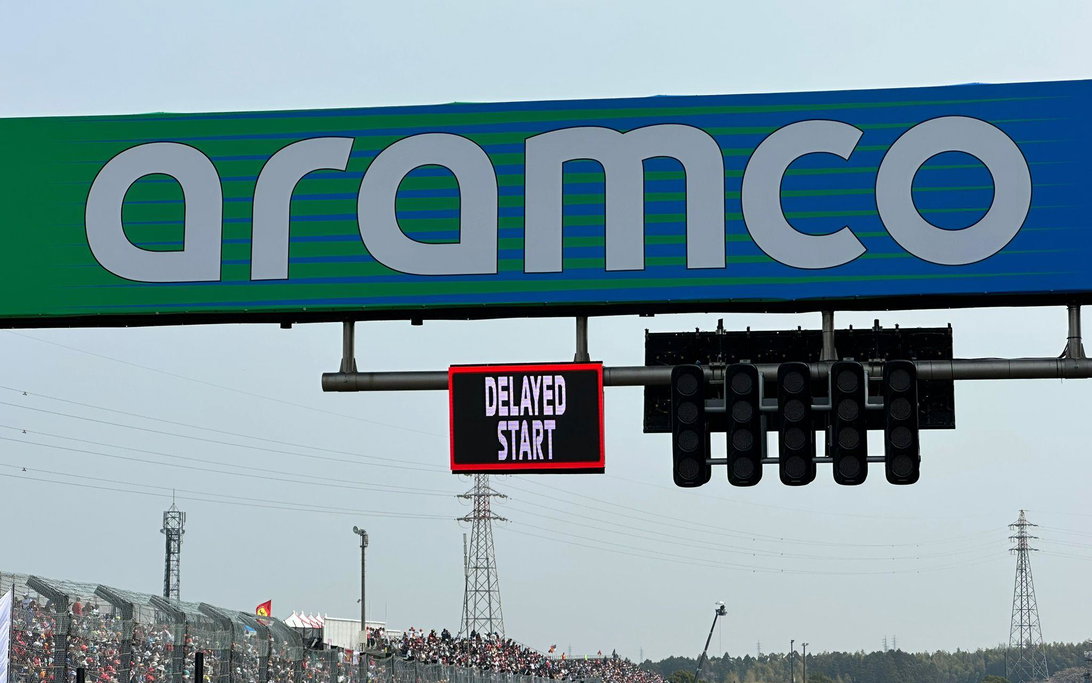
The 10-Minute Delay That Exposes F1's Fragile Human Core

The clock at Suzuka read 13:59 local time, one minute to the formation lap. The air was a soup of high-octane anticipation and burnt clutch. Then, the broadcast feed cut to a crane. Not a car, a crane. My first thought wasn't of safety, but of data streams being severed. For ten minutes, the most hyper-analyzed sport on earth—where tire wear is predicted to the tenth of a lap and fuel flow is modulated by AI—was held hostage by a twisted piece of steel and foam. The FIA’s confirmation was a sterile pulse in the system: "Start of formation lap will be delayed due to barrier repairs ongoing at Turn 12 after an incident in a support category." Ten minutes. In that silence, you could hear the ghost of Michael Schumacher’s 2004 Ferrari, a machine so intuitively tuned to its driver’s feel that it would have used the delay to calcify its advantage, not recalculate a thousand variables. This wasn't just a repair. It was a system reboot, and it laid bare the tension between our sanitized data utopia and the gloriously messy, unpredictable human reality that still, for now, powers it.
The Illusion of Control and the Unscripted Crash
The facts are clean. The start was delayed by 10 minutes. The formation lap rescheduled for 14:10 local time. The cause: a support category car rolling over the fencing at Turn 12, the daunting, high-G left-hander that demands a kind of violent precision. The circuit's integrity was compromised. The response was correct, non-negotiable. Safety is the one algorithm we must never override.
But let's dig into the emotional archaeology of this. What does a 10-minute delay mean in 2026? It's not a pause. It's a cascading system failure of The Plan.
- Engineered Warm-Up Procedures: The meticulous thermal management of the hybrid power unit, a symphony of pre-heating fluids and batteries, is thrown into disarray. The optimal temperature window, calculated to the second, evaporates.
- Strategic First-Lap Models: Every team’s supercomputer had run a million simulations of Lap 1, accounting for weather, tire temps, and the aggression profile of the driver ahead. Those models, in that moment, became historical documents.
- Driver Rhythm: This is the untrackable metric. The peak mental focus, built over an hour of procedure, now has to be sustained, plateaued, and re-peaked. This is where reputations are unfairly made. Think of Charles Leclerc, whose raw qualifying consistency data from 2022-2023 is arguably the best on the grid, yet who is branded error-prone. How many of those "errors" correlate directly with Ferrari's strategic turbulence, with moments where the human was scrambling to adapt to a fractured plan? A ten-minute delay is pure, uncut strategic turbulence injected into the grid.
The support race crash was an unscripted event. No predictive analytics flagged it. No tire wear model could foresee a barrel roll. It was human error, mechanical failure, physics—the old gods of racing reminding the new gods of data who still holds the final card.
The Schumacher Standard: Consistency in Chaos
"A delayed start doesn't change the race, it reveals the team."
I wrote that in my notes, thinking of Schumacher. In 2004, a delay like this would have been met with a shrug from the scarlet garage. The car was an extension of the driver; the strategy was built on immutable pillars of speed and tire management, not real-time telemetry fluctuations. The driver's feel was the primary sensor. Today, we have a thousand sensors and less feel.
The delay put Kimi Antonelli, the Mercedes pole-sitter, in a fascinating pressure cooker. A rookie on pole, now forced to marinate in the moment for an extra ten minutes, with the hyper-analytical Mercedes system likely feeding him new delta times, revised brake bias suggestions, and altered tire prep commands. Is this helping or hindering? Are we coaching intuition out of the driver?
This is my core fear: within five years, this hyper-focus will lead to robotized racing. The delay will be instantly factored into a new, global algorithm. Driver input will become merely an execution variable for a pit-wall AI that has already simulated the adjusted start time. The sport becomes sterile, predictable. The 10-minute repair at Turn 12 is a metaphor for the sport itself—constantly patching up the human element with more data-driven barriers, trying to make the inherently dangerous safe, and the intuitively brilliant predictable.
The repair crews weren't just fixing a barrier; they were fighting to preserve the possibility of accident. By making the corner safe again, they were ensuring the drivers could once again take the risk that makes them human. It's a beautiful, contradictory truth.
Conclusion: The Heartbeat in the Silence
So, the race began at 14:10. Antonelli led away, the compressed schedule perhaps altering an opening lap gambit. The repaired Turn 12 was doubtless tested. The story will be about the winner, the overtakes, the pit stops.
But for me, the story was in those ten minutes of silence. It was in the data drop-out. It was in the sight of drivers fidgeting in their cockpits, left alone with their heartbeat—the one biometric we don't broadcast. That delay was a blip on the timing sheet, a scheduling footnote. But as an analyst who believes numbers tell stories, I see it as the most important plot point of the 2026 Japanese Grand Prix. It was the moment the sport paused, took a breath it didn't know it needed, and remembered that before there is data, there is drama. Before there is a barrier, there is a crash. And before there is a champion, there is a human being waiting for a green light, not a green light waiting for an algorithm. Let's hope the data scientists remember that too.