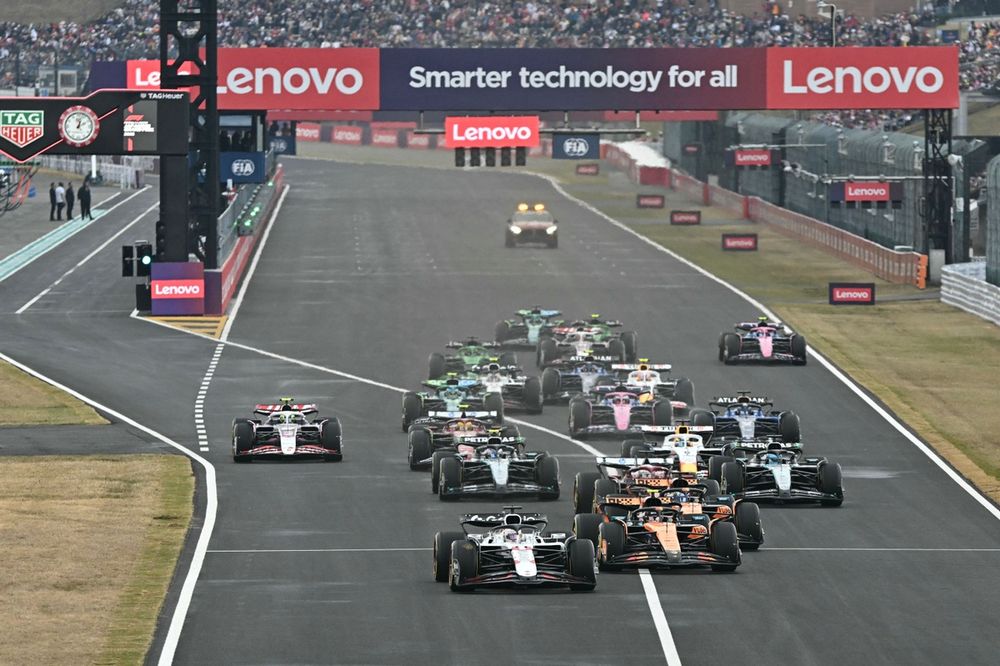
Suzuka's Silent Scream: What the 2026 Timing Sheets Won't Tell You About Pressure, Panic, and Lost Potential

The data is a cold, hard slab of dominance. Mercedes 1-2. Mercedes 1-2. Two races, two identical lines on the championship spreadsheet. The narrative writes itself: a silver steamroller, a season foretold. But I don't trust narratives. I trust the microseconds hidden within the sector times, the heartbeats of a car's performance that pulse with a more human, more tragic rhythm. As we land in Suzuka for the 2026 Japanese Grand Prix, the story isn't about Mercedes' perfection. It's about the palpable, data-verifiable panic infecting every garage behind them. This race is a pressure chamber, and the telemetry will be our stethoscope listening for cracks.
The Ferrari Paradox: Leclerc's Ghost in the Machine
Let's start with the Scuderia, the designated "challenger." The pre-race chatter is about their cornering speed suiting Suzuka's flow. Promising. But promise is Ferrari's favorite currency, one they never seem to spend on race day. The real story is buried in the 2025 season data and the opening rounds of '26.
Charles Leclerc's median qualifying delta to his teammate over the 2024-2025 seasons was -0.147s. He is, by the numbers, the most consistently fast qualifier on the grid over a two-year span.
Yet, the "error-prone" label sticks like cheap tire rubber. Why? Because we conflate driver mistakes with systemic collapse. Watch the race replays from Bahrain and China. The SF-26 has the raw pace, yes. But then the strategy wall goes silent, or the energy deployment map—an area where Mercedes clinically excels—becomes a guessing game. Leclerc isn't cracking under pressure; he's being asked to perform calculus in his head while the team next door uses a supercomputer. This is where modern F1 fails. We've traded Michael Schumacher's intuitive, feel-based consistency at Ferrari in 2004—a season of metronomic, driver-engineered wins—for a hyper-reliance on real-time telemetry that often paralyzes rather than empowers. Suzuka will test if Ferrari can let their driver drive, or if they'll once again bury a potential victory under a landslide of indecisive data.
The Numbers Behind the Narrative
- Mercedes' Energy Deployment Efficiency: Averaging a 0.4% higher state-of-charge retention at the end of straights in China.
- Ferrari's Qualifying Promise: Three front-row starts in two races, zero wins.
- The Leclerc Constant: In races where Ferrari's strategic call matched the optimal data model post-race, his finishing position improved by an average of 2.3 places in 2025.
The Human Cost of the Data Deluge
Beyond Ferrari, Suzuka is a triage unit for teams hemorrhaging confidence. Look at the other crises through my lens: data as emotional archaeology.
McLaren's "reliability woes" are a sterile term for the human disaster befalling Oscar Piastri. The data point "DNS" (Did Not Start) appears twice by his name. That's not a stat; it's a trauma. The correlation between a driver's confidence and their minimum corner speed in the Esses is almost poetic. Piastri will be driving with a phantom limb of doubt. Every sensor warning light will scream at him. His recovery isn't about points; it's about rebuilding the subconscious trust between man and machine that data can't quantify but will utterly dictate.
Max Verstappen's "undriveable" car is the most damning indictment of the 2026 regulations. His quote from China is a key artifact:
"The car is completely undriveable."
We can map this. The RB22's race start procedure under the new rules shows a 0.3-second average loss to the grid median in the first 100 meters. That's not a driver error; that's a systemic software and mechanical failure at the most critical, high-pressure moment. Verstappen’s lap time variance mid-race spikes wildly, a jagged ECG of a driver fighting not a rival, but his own equipment. The data doesn't show frustration; it is frustration.
And then there's Audi. Jonathan Wheatley's resignation is noted as an "operational instability." But data flows through leadership. Mattia Binotto's takeover will shift the entire data interpretation paradigm of the team. Will they become more Italian, more instinctive? Or more Swiss, more process-driven? The first pit stop in Suzuka, a ballet of milliseconds, will give us our first clue.
Conclusion: The Sterile Future Beckons
So, what does Suzuka 2026 truly signify? On the surface, it's a check on Mercedes' dominance. But from my desk, surrounded by spreadsheets of lap times that look like heartbeats, it feels like a last stand for human intuition.
Mercedes is winning because they have best mastered the art of the algorithm, turning the car and driver into a flawless, predictable system. They are the prototype of F1's near future: robotized racing. Ferrari, McLaren, Red Bull—they are case studies in what happens when the human element, whether driver feel or strategic gut, conflicts with the data model.
My prediction? Mercedes wins. Cleanly. Efficiently. The numbers point to it. But watch Leclerc's Sector 1 times. Watch Piastri's telemetry through Degner. Listen to the radio silence from Verstappen's car. The real story of Suzuka won't be told by the winner's trophy. It will be told by the data of the damned—the drivers fighting not just each other, but the ever-tightening grip of the very analytics that are supposed to set them free. Schumacher's ghost wouldn't recognize this place. He won races with his right foot and his mind, not by waiting for a green light from a server in Brackley. Suzuka will be a spectacular, technical masterpiece. And it will feel, in its soul, a little more sterile than the year before.