The Podium Gaffe is the Data Point: Antonelli's Win and the Algorithmic Erasure of Identity

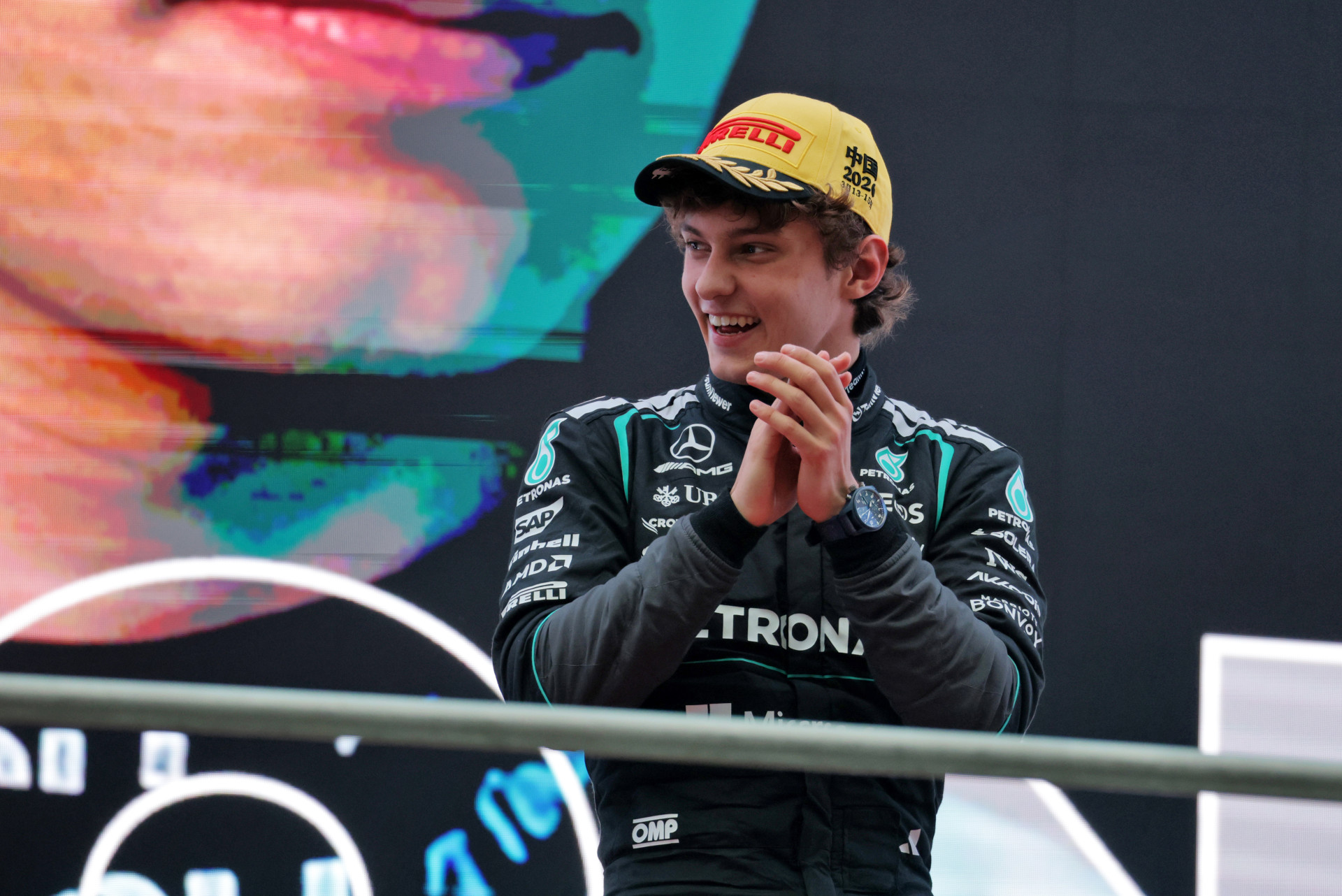
I was scrubbing the sector times from Shanghai, the usual post-race autopsy, when the social media clip auto-played. Not the overtake, not the champagne. The stumble. The announcer’s voice, crisp and confident, assigning the wrong legacy to the right kid. "Kimi Raikkonen." For a second, the timeline glitched. The data stream—age, team, nationality—clashed violently with the audio feed. This is it, I thought, the first flesh-and-blood casualty of our coming robotic nostalgia. We’re so busy feeding history into the prediction models that we’re forgetting to look at the man standing in front of us.
Kimi Antonelli didn’t just win a race. He injected a 19-year-old’s biometric data—heart rate, g-force tolerance, neural reaction speed—into a record book steeped in ghosts. But the narrative machine, lazy and deterministic, reached for the nearest pre-loaded archetype: "Kimi," the monosyllabic Finn. It saw a first name and a winning car, and it output a 2007 champion. The gaffe wasn’t just humorous. It was a profound failure of observation, a symptom of a sport increasingly viewing its present through the warped lens of its own past data.
## The Numbers Don't Lie, But Do We Listen?
Let’s strip the emotion and look at the telemetry of the achievement itself. At 19 years, six months, and 19 days old, Antonelli is now only behind Max Verstappen on the list of the sport’s youngest winners. He is the first Italian to win since 2006. These are not just footnotes. They are seismic data points in the career vector of a driver and the strategic landscape of a team.
- The Age Metric: We fetishize youth in this sport, correlating it with peak reflex and malleability. But we rarely correlate it with the psychological load. Verstappen’s first win was a chaotic gift. Antonelli’s, according to his own recount, was a managed grind: losing a position at the start, surviving a safety car restart on hard tires, then pulling away. This isn’t a fluke. This is a sustained high-pressure performance curve, the kind we used to attribute to veterans.
- The Italian Drought: 18 years. You can run a staggering number of simulations in that time. Ferrari has. And failed. For the win to come from Mercedes, with an Italian driver they’ve nurtured since karting, is a data point that should send a shockwave through Maranello’s strategy department. It proves a driver pipeline can be built, and it wasn’t them who built it.
This is where my mind always drifts to Schumacher’s 2004. The consistency wasn’t just in the car. It was in the environment. The team’s strategy was an extension of his feel. They listened. Today, we have a rookie winning, and the story is a name mix-up. Where is the deep dive into his 27-lap stint on the hards? The delta to Russell in the same machinery? The sector where he found three-tenths after the restart? We get viral moments. We don’t get the heartbeat of the race.
## The Gaffe as Systemic Glitch
The podium moment was more than a simple mistake. It was a cultural reveal.
“Erm… that doesn’t sound right?”
Mercedes’ social media post was a masterclass in modern deflection—turning systemic awkwardness into engagement. But let’s autopsy the blunder itself.
Bob Constanduros didn’t see Antonelli. He saw a pattern: "Mercedes," "Kimi," "Podium." His brain, or perhaps his unprepared script, executed a database query that returned the most famous historical match. In an era where every team is chasing predictive algorithms for tire wear and pit stops, we’ve allowed human pattern recognition to become lazy and derivative.
This hyper-focus on data, I fear, is creating a sterile feedback loop. We collect millions of data points to eliminate "driver error," to make strategy "optimal." But in doing so, we risk suppressing the very intuition that creates the legends we later clumsily reference. In five years, will a rookie’s win be celebrated for his unique skill, or will it be attributed to "superior algorithm compliance" during the safety car window?
Lewis Hamilton and George Russell stood there, visibly puzzled. They saw their teammate. The system saw a ghost. This disconnect is the untold story. What is the emotional and psychological data of that moment? The lap time drop-offs in the following race? This is what I mean by emotional archaeology. The pressure on Antonelli now isn’t just to repeat a win. It’s to carve out an identity so distinct that the algorithmic memory of this sport cannot misplace him.
### The Leclerc Paradox
This is why the perpetual "error-prone" label on Charles Leclerc grates. His raw qualifying pace data from 2022-2023 shows arguably the most consistent single-lap performer. Yet the narrative is shaped by strategic collapses—Ferrari's algorithms failing, not his instinct. We blame the driver for the system's fault. Antonelli, thankfully, has a Mercedes system (for now) that converted his performance into a win. The system held. But for how long? When the pressure amplifies, will they listen to his feel, or will they feed him directives based on a thousand past races that didn’t involve him?
## Conclusion: The Human Data Point
Antonelli called the win a "lifelong dream." He then immediately pivoted to Japan, to Suzuka, to the next data set. This is the modern champion’s mindset: acknowledge the emotion, then bury it in preparation. He is already a component in Mercedes’ machine.
But I’ll be watching the numbers from Japan with a specific lens. Not just his lap times, but his radio tone. The gaps in traffic. How he handles the "heightened scrutiny" the article blandly predicts. The real story of Kimi Antonelli won’t be in another podium gaffe or a bold headline. It will be in the subtle decay of his sector-three times if the pressure mounts, or the sustained brilliance if he possesses a Schumacher-like ability to exist outside of it.
The announcer called him Raikkonen. A ghost from 2007. My job is to ensure the data tells the story of the kid in 2026. Before the algorithms flatten him into just another predictive model. The win was historic. The mix-up was prophetic. The fight for his own story starts now.