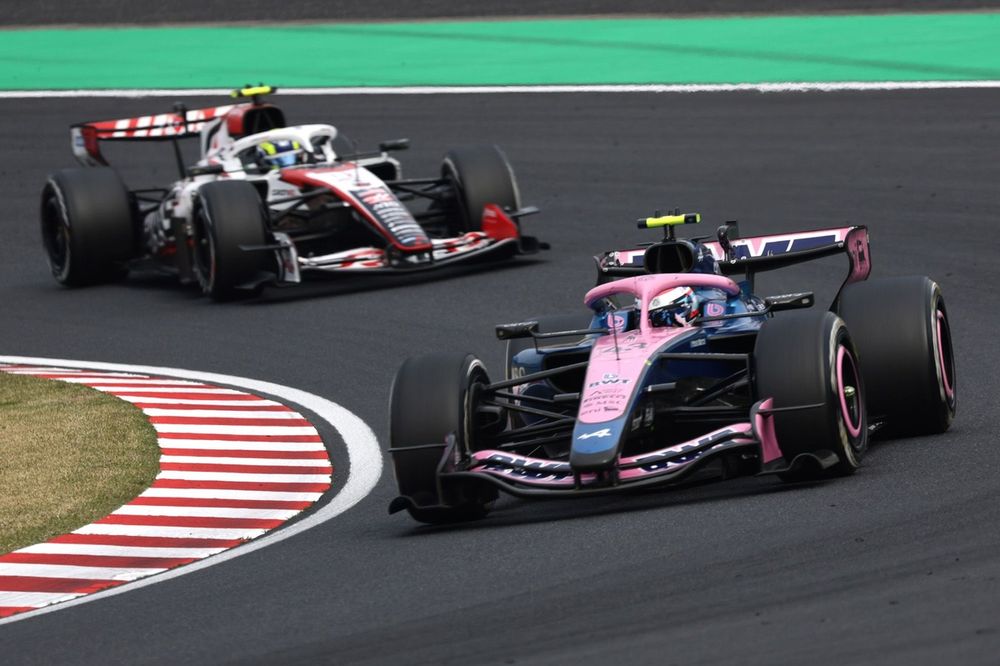
The 50G Spike: When Data Became a Blunt Instrument at Spoon

I felt my own heart rate spike when I saw the telemetry overlay from Spoon. Not at the impact trace—the brutal, vertical line of a 306km/h conversation with a barrier—but at the two speed traces leading to it. They weren't just diverging; they were telling two completely different stories, authored by algorithms, not drivers. The crash that wrote off Oliver Bearman's Haas in Japan wasn't a story of blame, but of predictable unpredictability. Ayao Komatsu, ever the pragmatist, called it a "small misjudgement" born of a 45km/h closing speed differential. I call it the first major fracture in F1's new era, where energy management software creates chasms of speed that human instinct cannot bridge.
The Numbers That Lie: 45km/h as a Symptom, Not a Cause
The facts, as cold and hard as the Suzuka barrier, are these: On March 29, 2026, Oliver Bearman approached Franco Colapinto's Alpine with a consistent 20km/h advantage. He then activated an extra energy boost. The FIA-confirmed closing speed ballooned to 45km/h before the braking zone. At 306km/h, Bearman lost control. The impact registered 50G. He emerged with a knee contusion. Komatsu was relieved: "It could have been a lot worse, right?"
But let's dig into what this "differing energy management" truly means. Under these new regulations, the car isn't just a machine; it's a rolling spreadsheet. Its power output is dictated by a complex equation of harvested energy, allocated deployment zones, and prescribed savings. Colapinto's Alpine was likely in a high-harvest mode, banking energy for later. Bearman's Haas, fighting from 18th, was in a spend-now mode.
This created a scenario where two cars, on the same piece of tarmac, existed in separate temporal realities. One was in the present lap; the other was already racing the next.
The 45km/h isn't a random number. It's the precise, calculable output of two opposing algorithmic strategies. Bearman didn't misjudge Colapinto's speed; he misjudged the intent of Colapinto's software. The driver was reduced to a spectator in his own cockpit, reacting to a differential that was decided seconds earlier by a engineer's mouse click. This is where we're headed: a sport where the critical overtake is initiated not by a driver's bravado, but by a battery's state-of-charge satisfying a pre-set condition.
The Ghost of 2004 and the Erosion of Instinct
Komatsu was careful, diplomatic. He refused to call it a clear error, framing it as a systemic challenge for the "F1 community." He's right, and that's what terrifies me. We are systematically removing the very thing that makes racing a human drama: intuitive risk assessment.
I keep a dataset from Michael Schumacher's 2004 season on a second monitor, always. It's my baseline for flawless, human consistency. At Suzuka that year, Schumacher won from pole, managing a 14-second gap over the field. His speed differentials with backmarkers were judged by sight, by feel, by the vibration through the wheel. He computed closing rates with a wetware brain that had processed thousands of similar scenarios. The car served the driver's will.
Contrast that with Bearman's reality. This was only the third race under these new rules. His dataset for a 45km/h closing speed on approach to a high-speed corner was empty. His intuition had no prior experience to draw from. The telemetry screamed "GO," but the racing line, the shrinking gap, the g-forces building in his periphery, whispered "WAIT." In that cacophony, the crash was almost a foregone conclusion.
This is the sterile future I fear: races decided not by the man who can best feel the fading grip of his front-left tyre, but by the team whose data scientists best optimize the energy deployment algorithm. We will trade stories of legendary instinct for case studies of efficient code.
Where is the emotional archaeology in that? What story does a line of Python code tell about pressure? The real data we should be correlating isn't just battery charge to lap time; it's the driver's biometric spike in that moment of algorithmic betrayal against their own instinct. The untold story of Bearman's crash is the 200-millisecond lag between his brain processing the impossible closing speed and his hands trying to correct it—a lag that data engineers will now seek to eliminate by removing the human variable altogether.
Conclusion: A Call for a Human Buffer Zone
Komatsu said the team will "analyze how to improve their approach." I know what that means. It means more prescriptive coaching. "Oliver, do not deploy if differential exceeds 35km/h past marker board 7." It means further shackling driver initiative to pre-approved scenarios.
But what if the analysis took a different path? What if, instead of making the driver adapt to the algorithm's harsh logic, we mandate a buffer for human fallibility? The FIA introduced the Virtual Safety Car to slow cars to a delta for safety. Could we envision a software-mandated maximum closing speed differential in certain zones? A temporary, automated governor that prevents the algorithm from creating such lethal splits?
The 50G impact at Suzuka was a physical warning. The 45km/h differential is the data point that proves the danger is calculable, and therefore, preventable. If we ignore it, we are willingly walking into an era where crashes are not accidents, but the output of conflicting datasets. The sport will become a high-speed simulation, where the only heartbeats are the ones we imagine in the telemetry. And that is a story the numbers will tell very, very poorly.