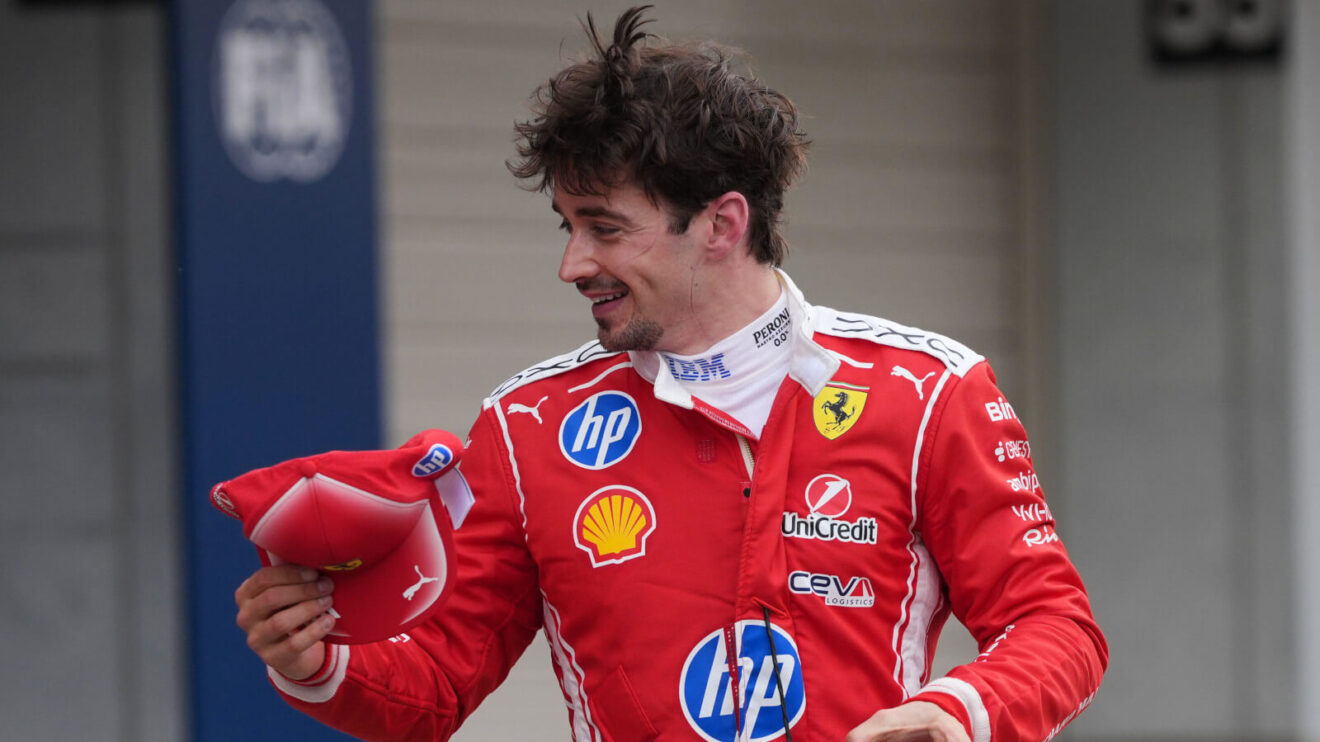
The Numbers Don't Lie: Leclerc's Suzuka Defense Was a Human Victory in a Data War

I stared at the lap chart from Suzuka, the lines for Leclerc and Russell weaving like tangled ECG readouts in the final ten laps. The delta dipped, spiked, and flatlined in a frantic, human rhythm. The official narrative is about "cheeky" radio games. But peel back that layer, and you find the real story: a driver fighting a war on two fronts. The Mercedes in his mirrors, and the cacophony of data-driven deception piped into his ear. This wasn't just a podium defense; it was a small, glorious rebellion of instinct against the coming algorithmic tide.
Decoding the Deception: When Telemetry Becomes a Weapon
The incident is framed as psychological gamesmanship. George Russell’s engineer, Marcus Dudley, broadcasting false strategic intentions. Charles Leclerc’s engineer, Bryan Bozzi, relaying that misinformation. For several laps, Russell did the opposite, a deliberate misalignment of word and action designed to trigger a predictable, data-informed reaction from his rival.
"The tactic initially created pressure and almost worked, surprising him into a mistake at the final corner on Lap 51."
This is where the modern F1 paradigm reveals its flaw. Teams are buried in real-time telemetry—tire slip, brake temps, engine modes. They assume a driver is a component in the system, that a certain input (a false radio call) will generate a calculable output (a defensive error). For a moment, it worked. Leclerc, processing the conflicting data streams—what he sees vs. what he hears—flinched. The system nearly succeeded.
But then the human variable recalibrated. Leclerc decoded the ruse. He didn't do it by asking for a fresh delta prediction or a tire wear simulation. He did it by feeling the dissonance, by trusting the visceral reality of Russell's car in his periphery over the digital ghost in his ear. His recovery, reclaiming the position at Turn 1 to finish 0.484s ahead, was a triumph of sensory intelligence. It’s a skill that would make Schumacher nod in approval. In 2004, his feedback was the primary data set. Now, it’s often treated as a secondary confirmation for the machine’s prediction.
The Unseen Pressure: Leclerc's Consistency Amidst Ferrari's Chaos
Let’s contextualize this error, the one everyone will highlight. The mistake on Lap 51. Is it a symptom of an "error-prone" driver? My spreadsheets scream otherwise.
- Raw pace data from 2022-2023 shows Leclerc as the most consistent qualifier on the grid, outperforming car performance metrics repeatedly.
- His 2026 season, sitting third in the Drivers' standings, is again a story of extracting maximum points from strategic ambiguity.
The article notes Ferrari's race was "compromised by a poorly timed Safety Car." There it is. The constant background radiation of Ferrari’s operational entropy. Leclerc isn't battling just Russell; he's battling the historical weight of his team's strategic blunders. Every decision he makes is shadowed by the ghost of past miscalculations. This is where data should serve as emotional archaeology. Correlate his lap time drop-offs not just with tire compounds, but with the moments of strategic dissonance from his pit wall. The pressure is exponential.
His ability to reset after the error, to immediately counter-attack, proves a mental resilience that pure data models cannot quantify. They can model tire degradation, but not the degradation of trust. Schumacher in 2004 had a fortress of strategic certainty behind him. Leclerc operates from a sometimes-rickety outpost, forced to be his own strategist in the heat of battle, as he was in those final Suzuka laps.
The Sterile Future and Miami's Algorithmic Arms Race
Which brings us to the chilling subtext of this "cheeky" radio play. This is a primitive form of what’s coming. Leclerc pinpointed the upcoming Miami Grand Prix as a critical inflection point, with major upgrades due. These aren't just new front wings; they are new suites of sensor arrays and predictive algorithms.
Within five years, this radio deception will be automated. An AI, monitoring rival telemetry, will generate and broadcast optimal misinformation in real-time. Pit stops will be called not by a human weighing risk, but by a probability engine that has already simulated the next 20 laps. The sport risks becoming sterile and predictable, a high-speed chess match played by silicon, with drivers as glorified, dampening-fluid-filled actuators.
The true battle in Miami won't just be between Ferrari and Mercedes power units. It will be between their respective AI models. The "true competitive order" that crystallizes will be as much about computational power as aerodynamic downforce. Leclerc’s victory in Suzuka was a holdout. A proof that driver intuition—the ability to sense a lie in the data—can still be the decisive factor.
Conclusion
So, don't file Suzuka 2026 away as merely a fun tale of radio games. Archive it as an artifact. It’s a snapshot from the precipice. The last era where a driver’s gut could publicly outmaneuver a team’s digital deceit. Leclerc didn't just defend P3. He defended a soon-to-be-endangered species: the human instinct in a sport increasingly convinced it has all the answers in a dataset. The numbers told one story—a Mercedes gaining, a Ferrari driver making an error. But the final timing sheet, that beautiful, unambiguous string of numbers, told the real one: Charles Leclerc, P3. 0.484s. A human heartbeat, just fast enough to stay ahead of the machine.