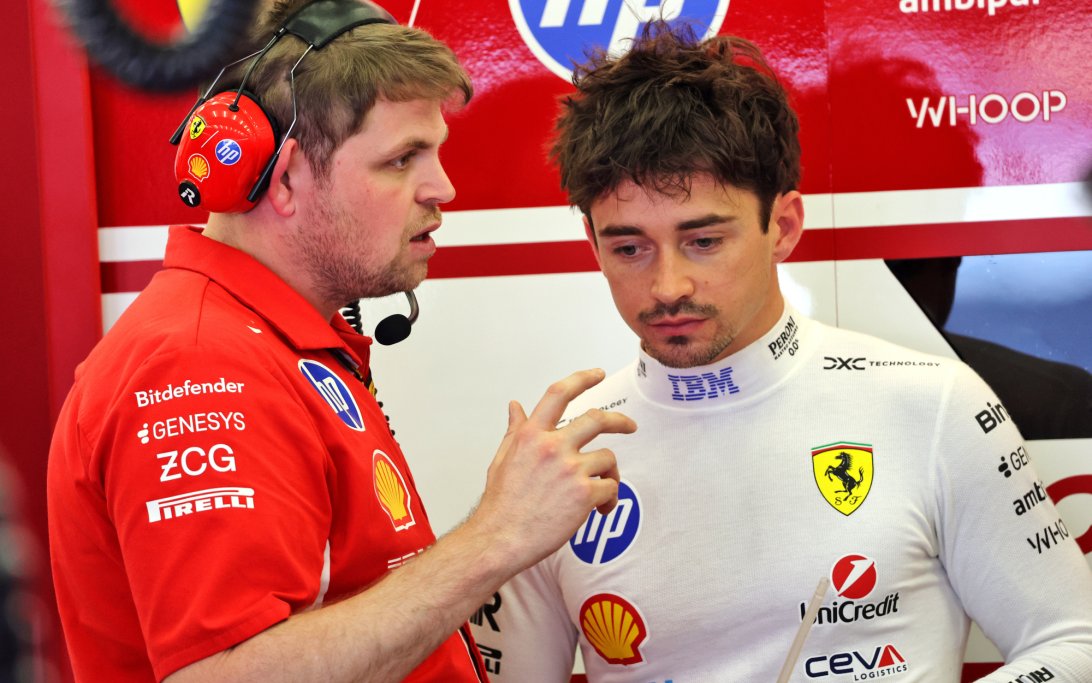
The Mask of Calm: Leclerc's Fastest Lap and the Weight of Ferrari's Unspoken Trauma
The stopwatch doesn't lie, but it is a masterful deceiver. In the Bahrain dusk, a number flashed on the timing screen: 1:31.247. Charles Leclerc, in the scarlet Ferrari, had carved a wound in the track nearly a full second deeper than any other soul dared. The tifosi’s collective heart-rate, measured from a thousand social media pulses, would have spiked into the red. Yet, from the cockpit emerged not a conqueror’s roar, but the measured, almost serene tones of a man practicing a mantra he does not yet believe. This is the opening act of Ferrari’s 2024 season: not a car launch, but a psychological operation. The fastest lap was a fact. The immediate, practiced calm that followed? That is the story.
The Calculated Suppression of Hope
Leclerc’s post-session comments were a masterclass in emotional regulation, a script so flawless it felt manufactured. "It is difficult to understand where we really stand because teams are hiding their true form," he stated, redirecting the wildfire of optimism toward the safe, barren ground of data and unknowns. He called the day "very smooth," praised the team’s completion of 132 laps, and spoke of the "lot of data to analyse." This is not just driver-speak. This is the language of an institution—and a man—scarred by the violent oscillation between euphoria and despair.
"The headline time is a phantom. Our focus is the procedure, the understanding, the build-up. The real test is in Melbourne."
Listen to the subtext. It screams of past sins: the blistering pole positions that dissolved into strategic chaos on Sunday, the mechanical heartbreaks that stole certain victories, the championship leads that evaporated not in a single crash, but in a death by a thousand tiny uncertainties. Leclerc, the driver who feels every micro-lockup as a personal failure, is now the public face of a team trying to surgically remove emotion from its process. He is performing the Charles Leclerc of 2024: a driver whose talent is being wrapped in layers of psychological Kevlar. It is a direct, if unspoken, response to the Red Bull model of champion-building—the systematic suppression of public emotional outbursts to project invulnerability. But where Verstappen’s calm often reads as cold, born of dominance, Leclerc’s feels like a fragile dam holding back a reservoir of desperate want.
The Ghost in the Machine: Data vs. Desire
Ferrari’s test was, by the numbers, impeccable. 132 laps of reliability. A program "comprehensively" completed. The SF-24, on paper, is a foundation. But foundations in Maranello have a history of being built on psychological fault lines. The real analysis happening now isn't just in the CFD clusters; it's in the driver's mind.
- The Lap Itself: On the softest C4 compound, in a low-fuel, engine-turned-up scenario, Leclerc proved the machine has a peak. But what of the driver's peak? That lap required a surrender to risk, a silencing of the internal calculator that reminds him of every points loss since 2019. Did he drive it freely, or was there a hesitation, a micron of steering correction born of memory, invisible to the telemetry but felt in his soul?
- The Hamilton-Lauda Paradox: We must look at this through the lens of trauma-crafted personas. Lewis Hamilton transformed his 2016 title loss into a narrative of spiritual awakening, a calculated persona that shields his competitive fury. Niki Lauda’s post-crash resilience became his brand, overshadowing his sublime feel for a car. Leclerc is now crafting his own: The Thoughtful Heir. The Patient Prince. It is a necessary armor, but one risks muffling the very instinct that makes his qualifying laps works of art. Can you methodically build a championship, when your greatest weapon is an unpredictable, emotional spark?
This is where my belief—that driver psychology trumps aerodynamics in the wet—extends to the desert. The uncertainty of testing is Formula 1's psychological rain. Teams hide their pace, programs are obscured, and the driver is left in a cockpit of doubt. His decision-making in this environment—what to say, how to feel, what to believe—reveals more than any debrief. Leclerc chose to project calm. The question is, did he choose, or was he instructed?
Melbourne: The Unmasking
The Australian Grand Prix will not be a revelation of pace. It will be a revelation of psyche. When the visor comes down in Q3 at Albert Park, the procedural calm of testing evaporates. The "hidden forms" are laid bare in a single, brutal lap.
Ferrari’s stated goal is to "methodically build performance." This is the language of the engineer. But championships are won in the moments between the engineer's final instruction and the driver’s application of throttle. They are won in the red mist, a zone Ferrari has historically feared and fostered in equal, disastrous measure.
Leclerc’s calm is a promising, dangerous facade. It suggests a team learning from its mental errors. Yet, I cannot help but watch this and feel we are nearing an era where such psychological management will be forced into the light. Within five years, I foresee mandates for mental health disclosures after major incidents. When that happens, the crafted personas will crack. The world will see the cost of suppressing a Leclerc-level passion, or maintaining a Verstappen-level frost.
For now, we have only the performance. A blistering lap time, immediately buried under a avalanche of cautious words. The fastest man in testing is asking you not to look at the clock, but to look at him. To see the calm. I am looking, Charles. I see the effort it takes to hold it. And I wonder what happens when, in two weeks' time, the lights go out and you must finally, desperately, let it go.