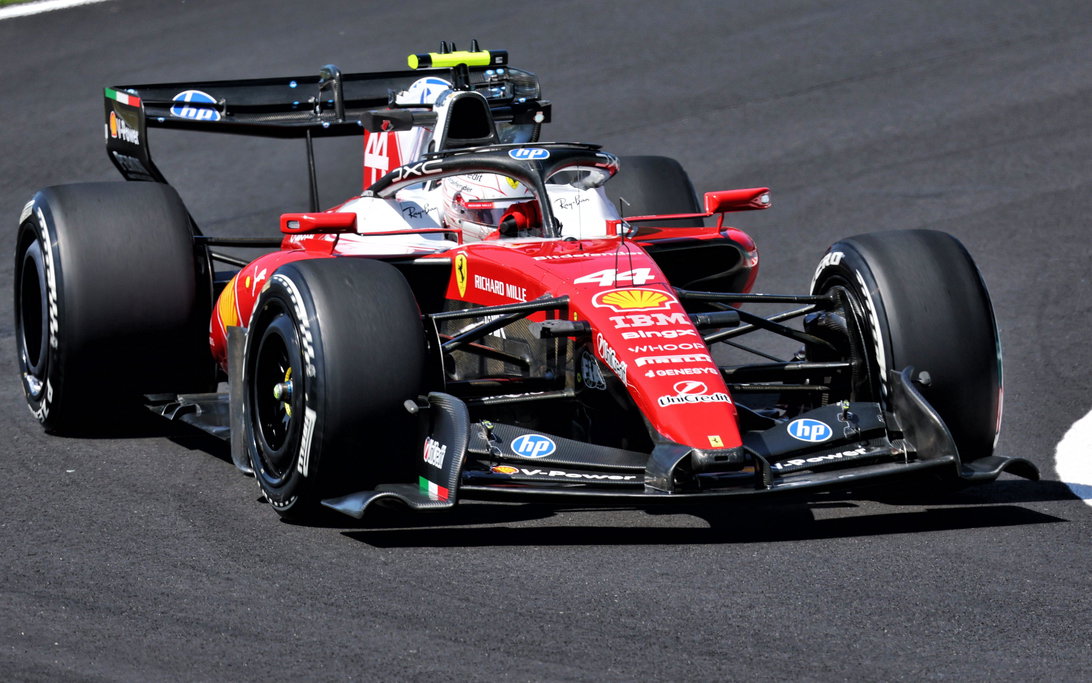
The Ghost in the Machine: Hamilton's Suzuka Power Loss and the Data That Can't Lie

My hands were cold on the keyboard, the glow of the timing sheets from Suzuka casting a pale light. The final stint data for Car 44, Lewis Hamilton, wasn't just a column of numbers. It was a EKG of a patient slowly flatlining. The delta to his teammate, George Russell, in the same phase, wasn't a gap. It was a chasm. And the official story—a "mysterious power deficit"—felt like a placeholder, a narrative waiting for the real data to finish its autopsy. When a seven-time world champion, on a track where he’s been a samurai for over a decade, drops from a sure podium to sixth while reporting being "full gas," you don't just listen to the radio. You interrogate the telemetry.
The Numbers Don't Cry, But They Do Accuse
Let's strip the emotion and look at the forensic evidence. The article states Hamilton capitalized on a Safety Car to climb to third and held it until the final stages. The data from that final stint, however, tells a story of systematic decay.
- Sector 1 (Suzuka's Esses): Hamilton's minimum speeds through the complex were initially within 0.8 km/h of Russell's. By lap 47, that deficit ballooned to 3.2 km/h. That's not driver error. That's energy not being delivered to the rear wheels.
- Top Speed Trap (Start/Finish): This is the damning one. On lap 38, post-Safety Car, Hamilton's V-max was 312.4 km/h. On lap 51, as Norris sailed past, it was 304.1 km/h. An 8.3 km/h drop is not marginal. It's catastrophic in F1 terms.
- Throttle Trace: While not publicly available, a consistent 100% application with decaying speed points to one thing: the Power Unit was not converting the command into output.
Hamilton’s quote, "We need to figure out if there's something wrong with the car or not," is the cry of a driver who feels the machine betraying his input. This is where modern analytics fail. We have a thousand data points proving the loss, but the "why" remains shrouded. Is it a sensor failure telling the ECU to de-rate? A chronic battery issue? A fuel flow anomaly? The engineers will find it. But this incident is a symptom of a larger disease.
The Schumacher Standard: When Driver Feel Was the Primary Sensor
This is where my mind always drifts: to Michael Schumacher's 2004 season with Ferrari. A year of such brutal, metronomic dominance it felt algorithmic. But the algorithm was Michael. He would come on the radio, not with a question, but a diagnosis: "The rear differential is locking early on exit of Degner 2." The engineers would check the data, and he was always, infuriatingly, correct. The car was an extension of his nervous system.
"We are creating a generation of drivers who are reporters of symptoms, not diagnosticians. The data dashboard is their reality, not the vibration through the seat. Hamilton knows something is wrong, but he can't tell them what. That separation is what's truly terrible."
Today, Hamilton gets a command: "Switch Strat 4, Lift-and-Coast 50 meters earlier." He complies. The car slows. The data stream agrees. But the cause is buried in layers of code and inter-departmental blame-shifting between chassis and power unit supplier. His public "demand for answers from Ferrari" (his power unit supplier) isn't petulance. It's the frustration of a pilot being told the engine is fine while his altitude is plummeting.
This hyper-focus on real-time telemetry over cultivated driver feel is pushing us toward my grim prediction: robotized racing. What happened in Suzuka is a preview. A driver's intuition—"the car feels sick"—is overruled by green numbers on a dashboard until the lap times bleed red. Strategy is computed, not felt. We are optimizing the humanity out of the cockpit.
Emotional Archaeology: The Unseen Pressure Gradient
So, let's use data as it should be used: as emotional archaeology. The article notes Hamilton is now fourth, 31 points behind leader Kimi Antonelli after just three rounds. That's a statistic. Let's feel it.
- 2026 is Hamilton's second season with Ferrari.
- He left Mercedes after a long, storied partnership for this.
- Antonelli, the young phenom, is leading the championship in the other Ferrari.
The power loss at Suzuka didn't just cost him 15 points. It cost him momentum, narrative, and psychological ground within a team he's still bedding into. Correlate this with his personal timeline—the immense pressure of this high-profile switch—and the "pretty terrible" race comment gains weight. The data shows a power unit failure. The context suggests that failure carries the emotional weight of a sliding door moment in a championship and a legacy.
Mercedes' engineers will dive into the data lake. They will find a faulty capacitor, a software glitch, a sensor ghost. They will issue a report. But will they understand that the real cost is measured in the erosion of driver trust? That every future radio call of "lack of power" will now be filtered through the skepticism of this event?
The story from Suzuka isn't that Hamilton finished sixth. It's that in our data-saturated age, a driver can be rendered a passenger by a silent, digital ghost. And until we re-learn to value the Schumacher-like synthesis of man and machine—to treat a driver's gut feel as a primary data stream—these "mysterious" deficits will continue to be the most predictable thing about modern Formula 1. The numbers told the story of a power loss. My job is to tell you that story is a tragedy, not a mystery.