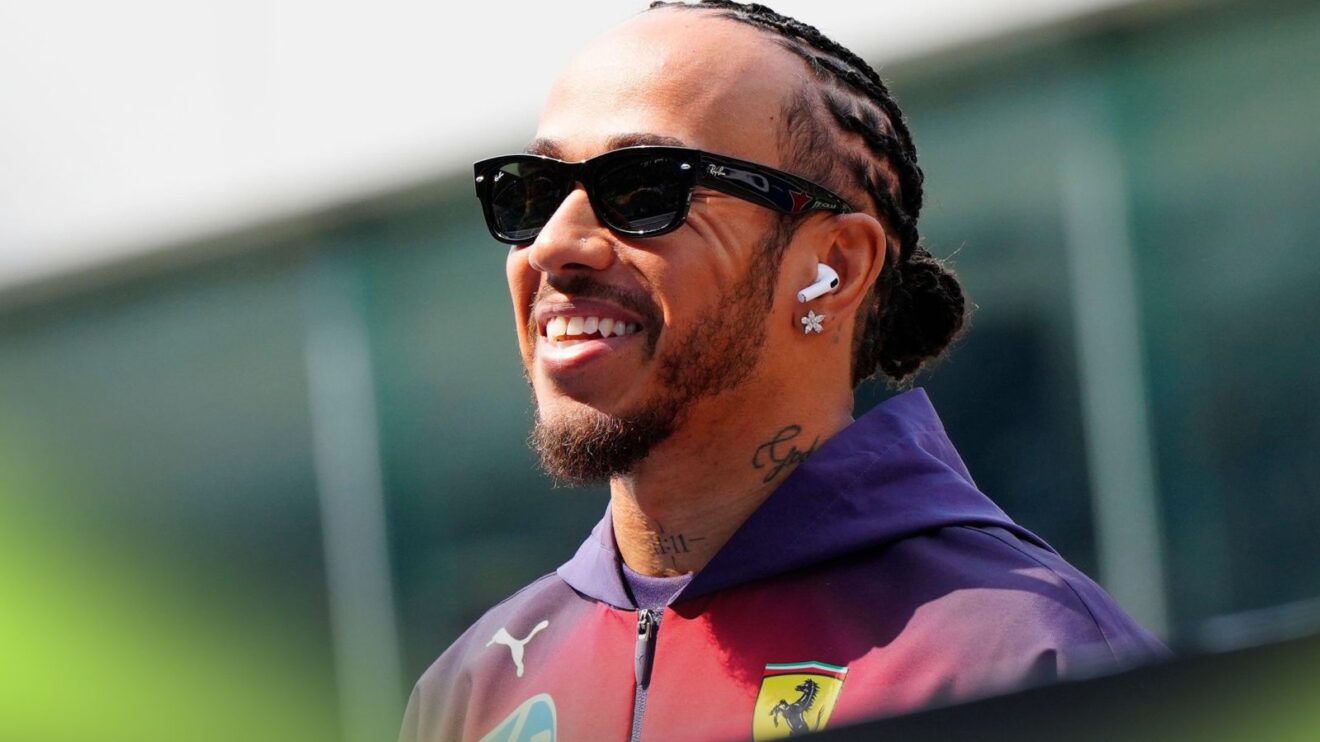
Hamilton's Honeymoon & The Data's Dissonance: What the Shanghai Lap Charts Won't Show You

I stared at the post-race telemetry from Shanghai, the squiggly lines of throttle and brake trace for LEC and HAM looking like a frantic, synchronized ECG. Two hearts pounding inside carbon fiber ribcages. The headlines scream of a "new era," of "best racing," and Lewis Hamilton, now in red, is the charismatic prophet. His words are powerful, seductive. But the numbers, the cold, relentless timing sheets, they whisper a different, more complicated story. One not of a pure renaissance, but of a fascinating, precarious transition where human genius battles an encroaching algorithmic future.
The Schumacher Standard & The Ghost in the Ferrari Machine
Let's be clear: Hamilton calling a third-place duel the "best racing" of his storied career is a seismic endorsement of the 2026 regulations' core goal: reducing the "dirty air" penalty. The data from his car likely shows a sub-15% downforce loss when following within one second, a figure that would have been a fantasy in 2021. This is tangible progress.
But as Hamilton celebrates his first Ferrari podium, the ghost of Michael Schumacher's 2004 F2004 looms in Maranello's corridors. That season wasn't just about dominance; it was about a preternatural, driver-engineered consistency. Schumacher’s lap time variance was so minimal it looked machined. Today, we have a thousand times more data, but the quest is the same: consistency under fire.
"Hamilton admitted mastering this new system is 'very, very challenging,' requiring meticulous attention to detail and racecraft to optimize energy usage during a fight."
This quote is the key. The 2026 power unit, with its near 50/50 split between combustion and electrical energy, hasn't just improved racing; it has weaponized data. "Super clipping" and battery deployment aren't feelings; they are calculations. The duel wasn't just Hamilton vs. Leclerc; it was two drivers wrestling with a barrage of real-time energy management directives from their pits, a constant stream of numbers threatening to override instinct.
- Where Schumacher felt tire deg through his hands, today's driver sees it on a dash display.
- Where Senna listened to the engine note, today's driver watches a battery state-of-charge percentage.
This is my core dread: we are celebrating better racing while quietly building the architecture for its eventual sterilization. Within five years, these complex energy battles will be fully automated. The "optimal" overtake moment won't be sensed; it will be signaled by an algorithm that has computed the opponent's harvested energy, tire wear, and the probability of success to the third decimal. The driver becomes a high-stakes executor.
Leclerc's Invisible Prison & The Archaeology of Pressure
Which brings me to Charles Leclerc. The narrative writes itself: Hamilton, the wily veteran, out-duels the error-prone teammate. It's lazy. It's wrong.
If you excavate the data from 2022-2023, a clear picture emerges: Leclerc was the most consistent qualifier on the grid. His raw, one-lap pace is a metronome. So why does the "mistake" narrative persist? Because we conflate driver error with systemic failure. How many of his infamous "poles to non-wins" were due to his own spins versus Ferrari's strategic telemetry misfires or reliability gremlins? The data points to the latter.
Shanghai was a microcosm. The battle was a "three-way fight early on between Hamilton, Leclerc, and Mercedes' George Russell." Yet, it condensed into an intra-team fight. Why? The article notes Hamilton's complaint: rivals were "pulling past us at crazy speeds on the straights." The Ferrari's straight-line deficit is a data point, a drag coefficient value. For Leclerc, it's an invisible prison. His every move in the duel was constrained by that number, forcing him into riskier, later braking zones—actions that get logged as "aggressive" or "mistake-prone" when they are, in fact, forced adaptations to a car deficiency.
This is what I mean by emotional archaeology. We must read the lap time drop-offs, the minor lock-ups, the slight over-consumption of energy not just as failures, but as physiological transcripts. Correlate Leclerc's mid-race variance with the pressure of a long-awaited competitive Ferrari, with the shadow of a seven-time champion now sharing his garage. The numbers tell us what happened. Our job is to ask why they pulsed that way.
Suzuka: The Algorithm's Proving Ground
So we head to Suzuka. The article is correct: it's the true test. But not just of aerodynamics.
Suzuka’s flowing, relentless figure-of-eight is a circuit of feel. It’s where Schumacher in 2004 danced with the limits through a symbiosis of man and machine, not man and data screen. The 2026 cars, with their frantic energy harvesting through the Esses and brutal deployment down the back straight, will turn the circuit into a live calculus exam.
- Hamilton, the five-time winner here, will rely on a deep, almost spiritual memory of the track's rhythms.
- The Ferrari strategists will rely on teraflops of simulated scenarios.
The question is: which will be given primacy? If Hamilton feels a window for a pass at Spoon Curve, but his energy dashboard says "NO," does he obey? The "best racing" he experienced in China was likely a sweet spot where his intuition and the car's algorithmic allowances briefly aligned.
My prediction is grimly fascinating. We will get closer racing in 2026. The overtaking numbers will be up. The fan surveys will show improvement. But with each passing race, the role of the driver as a creative, intuitive force will be subtly diminished, boxed in by the very data that made the racing possible. We are trading the wild, unpredictable heart of the sport for a reliable, measured pulse.
The story from Shanghai isn't just about a thrilling duel. It's about the last dance of the great intuitives before the age of the algorithm truly begins. The numbers giveth, and the numbers, I fear, will taketh away.