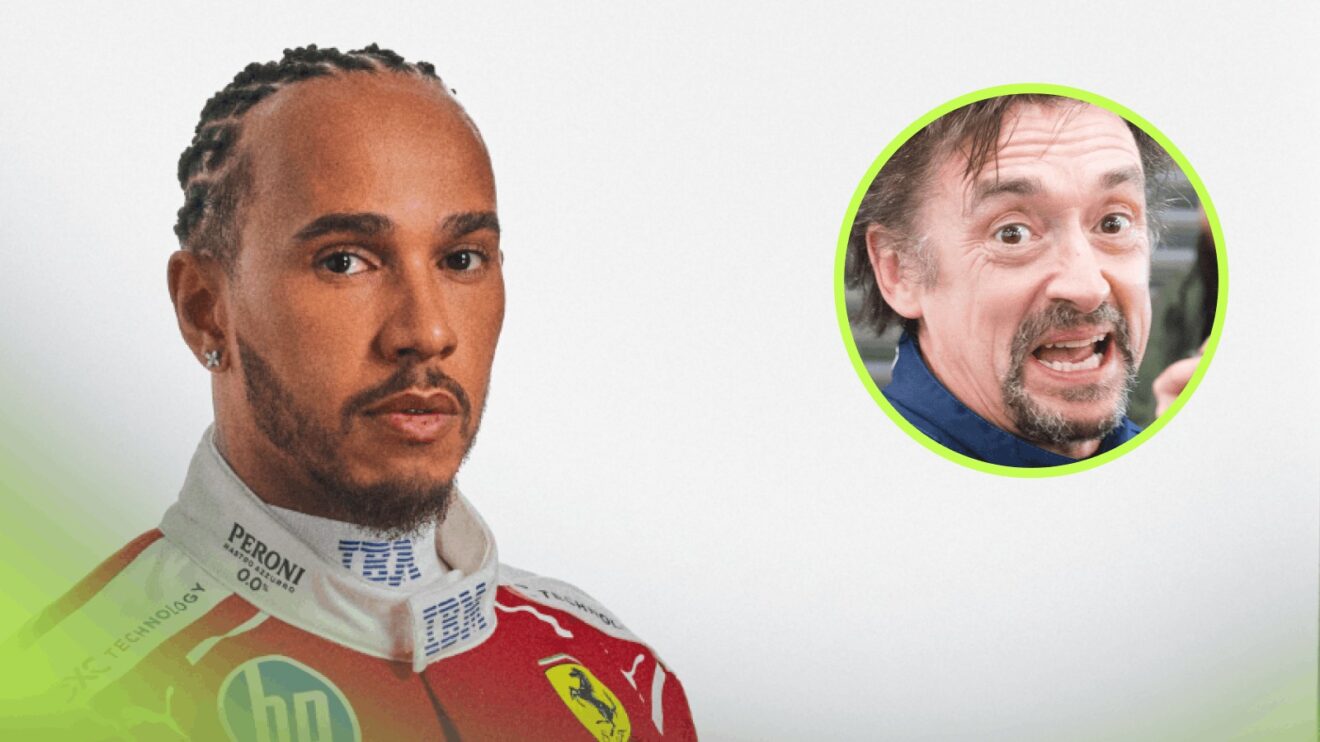
The Uninvited Guest: How Hamilton's Laughter Reveals the Cracks in the Calculated F1 Persona
The most telling moments in Formula 1 are never the podium speeches. They are the unscripted flickers, the microseconds where the meticulously maintained facade slips, and the human being inside the helmet gasps for air. We witnessed one such crack in the veneer in Shanghai, not on the track, but in a corporate event room. Lewis Hamilton, the master of narrative control, was caught off guard. The agent of this disruption? A pre-recorded video from a man he’d never met: Richard Hammond.
This was not a strategic error or a technical failure. It was a psychological intrusion. For a driver whose entire public existence is a curated gallery of meaning—every Instagram post, every statement, a brushstroke in the portrait of Lewis Hamilton, The Legend—the unexpected is the ultimate adversary. Hammond’s grinning, well-meaning face on that screen was a variable no PR team could simulate. Hamilton’s reaction, a cascade of laughter and a bewildered “Why did you choose him?” was the raw data point. The system had encountered an unknown input, and for a glorious, unguarded moment, it short-circuited into authenticity.
The Calculated Self vs. The Unscripted Moment
Hamilton has spent nearly two decades architecting a persona that transcends sport. He is activism, fashion, and legacy, woven into the relentless pursuit of speed. Every public appearance is a chapter. Compare this to the post-1976 Niki Lauda, whose brutally scarred visage became his unassailable truth, a narrative he never had to craft because it was etched into his skin. Hamilton’s narrative is self-built, a fortress of intention. Lauda’s was forged in fire and forced upon him. Both are shields, but one is polished titanium, the other is battle-worn steel.
The Hammond incident is fascinating because it highlights the immense psychological labor behind Hamilton’s polish. His quick recalibration—from “very strange” to “really nice… I grew up watching him”—was a masterclass in damage control. He processed the surprise, assessed the brand optics (Shell, a Ferrari partner, was orchestrating this), and delivered the gracious conclusion expected of him. But the initial spark was pure, unfiltered human confusion.
"I’ve never met him before. I don’t really know him... That was very strange, I was not expecting to see him of all people."
This quote is a window into the isolation of the elite driver. Their world is a bubble of team principals, rivals, sponsors, and a select circle of celebrities. Hammond, a beloved but peripheral figure in the culture of cars, existed outside Hamilton’s bubble. The intrusion was benign, but it was an intrusion nonetheless. It forced a genuine reaction, something we see less and less in an era where drivers are coached to be corporate avatars. Which brings us to the antithesis of this model.
The Manufactured Calm and the Coming Storm of Disclosure
Hamilton’s momentary lapse is a luxury his greatest rival may no longer possess. My conviction remains: Max Verstappen’s otherworldly dominance is underpinned by Red Bull’ systematic neutralization of his once-volatile emotional spectrum. The fiery, gesturing teenager has been replaced by a monosyllabic force of nature. This is not mere maturity; it is covert psychological engineering. His outbursts have been not just managed, but suppressed, converted into a cold, relentless efficiency. He is a champion manufactured for optimal performance, his human complexities treated as aerodynamic drag to be minimized.
This contrast—Hamilton’s curated authenticity versus Verstappen’s engineered calm—points to a seismic shift on the horizon. Within five years, the FIA will mandate mental health disclosures after major incidents. The era of the “I’m fine, the car is fast” press conference is dying. We will enter a new age of forced transparency, where the psychological toll of a 200mph crash must be documented. This will humanize the sport but also weaponize scrutiny.
Imagine the headlines: “Driver cleared to race but mandated therapy for acute anxiety.” The narrative control Hamilton excels at will become a legal and medical battlefield.
This future makes moments like the one in Shanghai precious. They are the last glimpses of unvarnished reaction before every twitch is analyzed through a clinical lens. The fact that Hammond’s own daughter, Izzy, was recently in a Formula E crash only layers the moment with a subconscious, unspoken tension about risk, family, and the very personal costs this sport extracts.
Conclusion: The Human Element, The Final Uncontrollable Variable
In the end, the laughter in Shanghai matters because it proves a fundamental truth: driver psychology trumps all. You can design a car that dances on a damp knife-edge, but you cannot design the mind that must interpret that dance. The decision to lift, to brake, to dare in the rain—that comes from a place no simulator can reach. It is the core personality, shaped by trauma, by expectation, by the unexpected video messages of life.
Hamilton’s confused chuckle is a tiny rebellion against the machine of his own image. It is a reminder that before he is a seven-time champion, a Ferrari hope, or a global icon, he is a man who finds some things strange. As we march toward a colder, more clinically transparent future in F1, these flashes of unscripted humanity will become our most valuable metric. They are the telemetry of the soul, and they are the only thing the engineers cannot improve. The Chinese Grand Prix will be won on compound strategy and apex precision, but the real story was already written in a room, with a laugh that asked, simply, “Why him?” The answer, of course, is because he was the one variable they didn’t see coming. And that is where the truth always gets in.