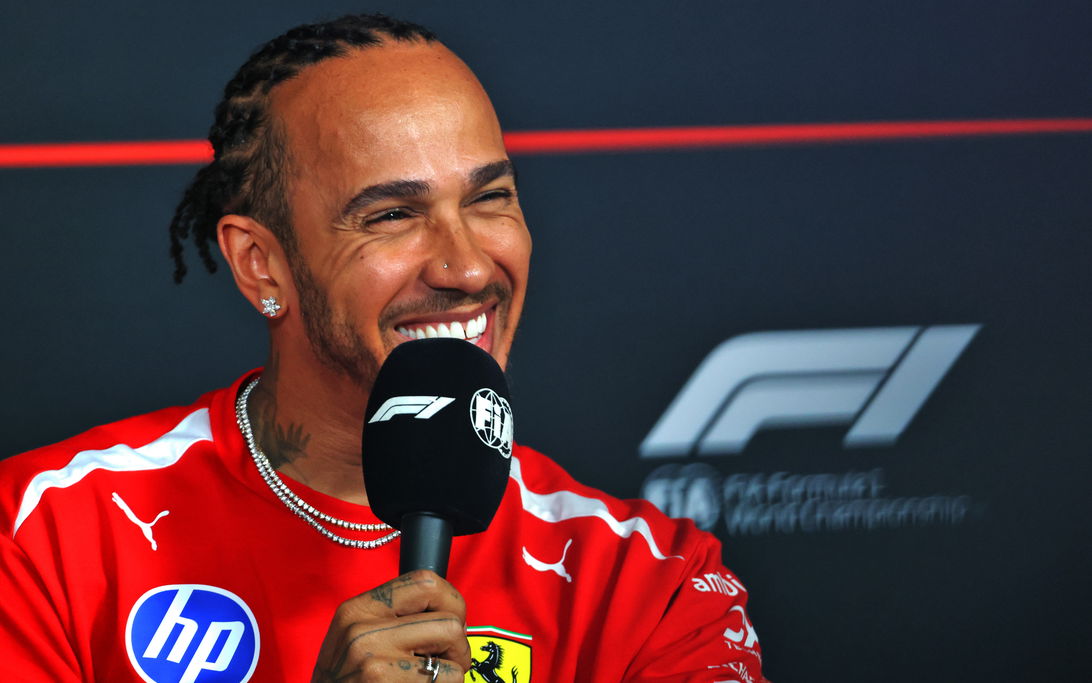
Hamilton's 1:00.470: The Ghost in Ferrari's Machine and the Data We'll Never See

I pulled up the timing sheet for Fiorano. A single line, cold and absolute: 1:00.470. Lewis Hamilton’s best, over 297 laps in a Ferrari SF-26. To the narrative-spinners, it’s a symbolic first dance, a PR-friendly teaser. To me, that number is a ghost. It’s the echo of a heartbeat in a machine designed to be deaf to it. For two days, Formula 1’s most storied team hosted its future seven-time champion and was legally, contractually forbidden from listening. That’s not a test. That’s emotional archaeology, and we’re digging in the wrong trench.
The "Blind" Protocol: When Data Isn't King, It's a Prison
The article calls it a ‘blind’ Pirelli tire test. A harmless bit of corporate protocol. I call it the perfect metaphor for modern F1’s schizophrenia. We have a car, the Ferrari SF-26, one of the most data-rich organisms on the planet, capable of streaming a thousand parameters a second. We have a driver, Lewis Hamilton, whose feel through a steering column is arguably the most valuable qualitative dataset in the sport’s history. And we have a rulebook that, for this session, erected a wall of silence between them.
- Hamilton’s feedback went solely to Pirelli. Ferrari engineers, the people who will need to build a car around his instincts in 2025, heard nothing.
- The run-plan was dictated by Pirelli. Ferrari could not test upgrades, evaluate engines, or adjust settings.
- The focus was on the crossover point between full wet and intermediate tires. A critical performance cliff-edge decided by human feel, not telemetry.
"We are creating a library of sensations without a card catalog. Hamilton just donated 884 kilometers of subconscious feedback on Ferrari’s brake-by-wire system, its hydraulic damping, the very seat he sat in, and we filed it under ‘tire wear.’"
This isn’t progress. It’s compartmentalization so severe it borders on the absurd. It reminds me of Michael Schumacher’s 2004 tests at Fiorano. The goal wasn’t just to set a time; it was to make the car an extension of his nervous system. Ross Brawn and Jean Todt didn’t just collect data; they absorbed his complaints. They valued the grunt over the graph. Today, we have more graphs than ever, but we’re institutionally blocking the grunts that give them meaning.
297 Ghost Laps: The Story the Numbers Hide
Let’s talk about those 297 laps. That’s 884 kilometers. On a short, twisting circuit like Fiorano, that’s a brutal, repetitive physical and mental grind. Hamilton’s second day alone was 461 km—the distance from London to Zurich. For what? To generate a spreadsheet for Pirelli on tread squirm?
The real story is in the fatigue curve no one is allowed to plot. How did his lap times trend over those 155 laps on Day 2? Did they hold a metronomic consistency, a la Schumacher’s legendary ability to run qualifying laps on heavy fuel? Or did they show a drop-off, a tell-tale signature of a driver learning the unique weight transfer of a Ferrari, its peculiar bite on curbings a Maranello engineer designed but can’t now ask about?
This is where my skepticism blooms. We’re told Charles Leclerc is error-prone. But show me the data on when those errors occur. Correlate them with the lap numbers in a race where Ferrari’s strategy software has just served him a catastrophic pit call, shattering his rhythm. The raw pace data from 2022-2023 shows he’s the most consistent qualifier on the grid. That’s not accident-prone; that’s a driver operating at a knife-edge, sometimes cut by his own tools, sometimes by the team’s. Hamilton just did 297 laps. I’d wager a significant portion of that runtime was his brain building a model of where this car’s knife-edge lies. And Ferrari’s servers have no record of it.
The Sterile Future: Wet Tires and Dry Algorithms
They were testing wet tires. How poetic. The last bastion of true, un-digitizable driver intuition. The feel of aquaplaning, the sound of spray, the instinct to switch lines. And yet, this test is a cog in a machine moving us in the opposite direction.
Pirelli gets its data. They’ll refine the compound. By 2025, the crossover point from wet to intermediate will be another box ticked by a strategy algorithm. The driver’s "it’s time for inters" call will be overruled by a central computer that has processed Hamilton’s 1:00.470 lap against a thousand other data points. This is the robotized racing I fear: a sport where intuition is suppressed not by team orders, but by the incontrovertible, data-driven "optimization" of every decision.
The next test is a dry weather run at the Nürburgring with McLaren and Mercedes. More data, more isolation, more specialization. The driver becomes a high-functioning sensor, not a storyteller. We are meticulously building a sport that is perfectly predictable and emotionally sterile.
Conclusion: The Heartbeat in the Static
So, we are left with the ghost. Lewis Hamilton, in a Ferrari, for the first time. 1:00.470. A number that tells us nothing and everything. It’s a data point in Pirelli’s wet tire development. But it is also the first faint heartbeat of a new era at Maranello, one that the team’s own diagnostics were forbidden from monitoring.
The real test won’t be in Miami or beyond. It will be in 2025, when Hamilton slides into a car built without the benefit of those 297 laps of subconscious feedback. Will Ferrari have built another machine that requires a driver to operate its complicated software, or will they have found a way, in a data-obsessed age, to finally listen to the heartbeat again? The numbers from Fiorano can’t tell us that. But the fact that they weren’t even allowed to try screams volumes.