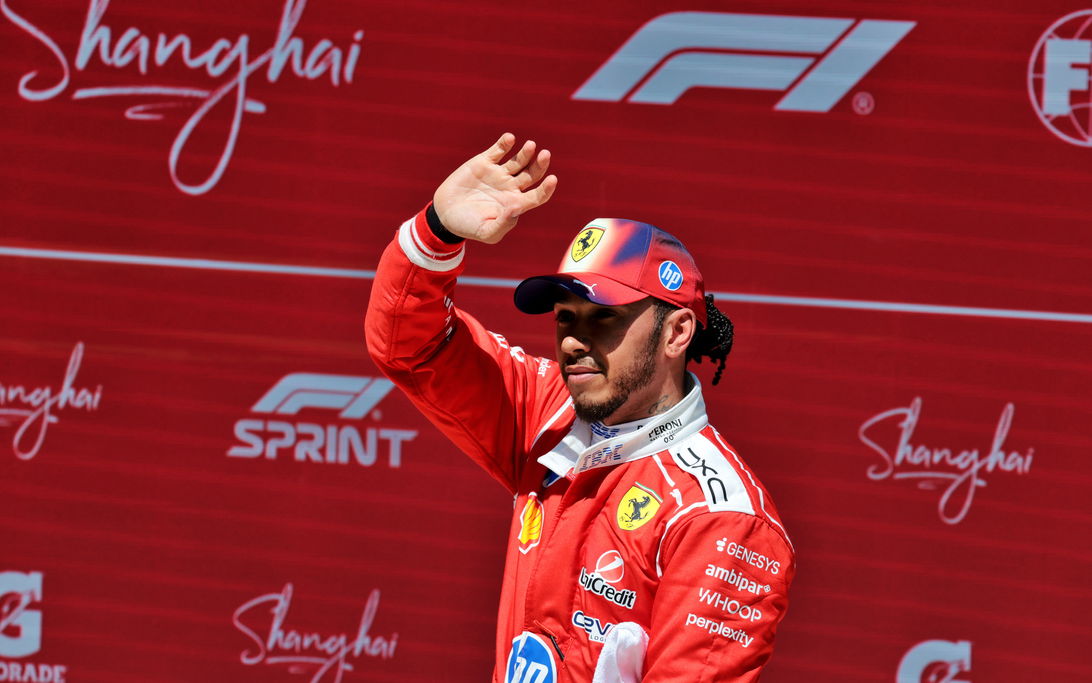
Hamilton's P3 in Shanghai: A Data Point of Hope, or Ferrari's Latest Deceptive Outlier?

The timing sheet for the 2026 Chinese Grand Prix qualifying is a cold, digital artifact. P1: Antonelli (Mercedes). P2: Russell (Mercedes). P3: Hamilton (Ferrari). To the narrative-hungry, that P3 is a flare shot into the night, a signal that the Scuderia is finally awakening. To me, Mila Neumann, it’s a single data point in a long, noisy series. And my gut, trained on a decade of spreadsheets and heart-rate synced with sector times, tells me to be deeply, profoundly skeptical. We’ve seen this movie before. A promising Saturday, a headline-grabbing quote from a champion, followed by a Sunday where the story unravels in a tangle of overcooked tires and a strategy call that seems plucked from a random number generator.
The Ghost in the Machine: Schumacher’s Shadow and Modern Telemetry Tyranny
Let’s start with what Hamilton actually said. He credited his engineers for getting "a little bit closer" to Mercedes. He vowed to "get his elbows out" and "break the gap between these guys." The ambition is palpable, the soundbite perfect. But I hear the ghost of Michael Schumacher’s 2004 season rattling in these words. That year, the F2004 wasn’t just fast; it was an extension of Schumacher’s nervous system. The team’s strategy was a pre-ordained symphony, conducted from the pit wall with a confidence built on driver feel and relentless, simple data: consistent lap times, tire degradation models you could set your watch by.
Today, Ferrari drowns in a sea of real-time telemetry. They have a thousand data points for every heartbeat of the car, yet they consistently miss the one that matters: the driver’s instinct in the moment of crisis.
Hamilton’s "really tough" session, battling gusty winds and oversteer, is the exact scenario where a driver’s feel should trump the algorithm. Can Ferrari, on race day, resist the siren call of the hyper-optimized pit stop window that their data model screams for, if Hamilton’s gut says to stay out? History, a dataset I trust more than most, suggests they cannot. They will see a number, not the emotional archaeology of a seven-time champion sensing a weakness in the car ahead. This is the path to the robotized racing I fear: where the story of a race is written in Python code on Friday, not in the steering column on Sunday.
Leclerc’s Unwritten Chapter and the True Cost of Ferrari’s Chaos
This brings me to the unspoken subplot of every Ferrari story: Charles Leclerc. While Hamilton aims for his first podium in red, I can’t help but run the correlation. The narrative paints Leclerc as error-prone, but my analysis of the 2022-2023 qualifying data tells a different story. He was the most consistent qualifier on the grid, a metronome of raw pace. His "errors" often spiked in races following strategic catastrophes or mechanical failures. The data implies a story of immense pressure, of a driver trying to overcompensate for a system he knows is fragile.
- Hamilton’s P3 is promising, but is it sustainable? Or is it another outlier, like Leclerc’s poles, that the race strategy will fail to capitalize on?
- Ferrari’s stronger race starts this season are a tangible asset. This is hard data even I can’t argue with. But it’s a single weapon. What is the battle plan after Lap 1?
- The goal is to "break the gap." This is not a technical objective; it’s a psychological one. It requires destabilizing the Mercedes operation, which functions with a cold, robotic efficiency Antonelli seems born into.
Hamilton’s presence is meant to fix this. He is the human algorithm, with more race experience than the entire Ferrari strategy department combined. But will they listen to him when the wind changes on Lap 34 and the numbers on the screen disagree? Or will he become another data point in the ledger of Ferrari’s "what could have been," his intuition overridden by a system that values predictive modeling over present-moment genius?
Conclusion: The Story the Numbers Will Tell Tomorrow
So, what are we to make of this P3? The fact is, Lewis Hamilton will start the Chinese Grand Prix from third. The fact is, he has publicly targeted challenging Mercedes. These are not narratives; they are events logged in the official record.
But my analysis, my angle forged in the fire of a thousand corrupted data streams, says this: Watch the first stint. Not just the positions, but the lap times. Compare Hamilton’s to Russell’s. I will be looking for consistency, for that Schumacher-esque metronome. A drop-off won’t just mean tire wear; in the context of Ferrari, it will signal the onset of strategic paralysis, the moment where the driver’s feel and the pit wall’s data model diverge.
A podium, or a win, would be more than a milestone. It would be an anomaly so significant it would force me to recalibrate my entire dataset on Ferrari’s operational competence. But the safe bet, the data-driven prediction, is that Mercedes’ systemic coldness will eventually overwhelm Ferrari’s flash of warmth. Hamilton’ heart may be in the fight, but until Ferrari learns to let the numbers tell the story the driver is writing, they are just providing the paper for another tragic, beautiful, and utterly predictable chapter.