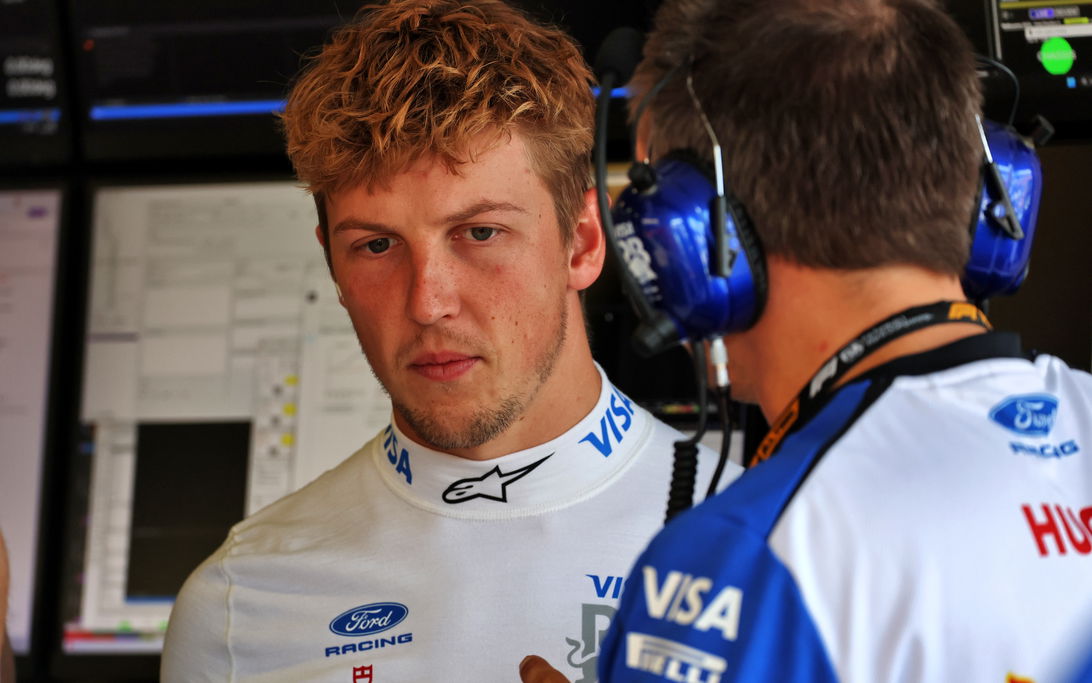
The Algorithm Ate Liam Lawson's Soul: A Data Autopsy of a 'Painful' Melbourne

My screen showed two waveforms. One was the telemetry trace from Liam Lawson’s Racing Bulls in Melbourne, a spiking, jagged thing, full of aggressive throttle applications and sharp braking events. The other was his lap time delta. It looked like a dying man’s EKG. The story wasn't in the peaks, but in the terrifying valleys—the "slowing down at the end of every straight" he called "painful." This wasn't a driver error. This was a man being slowly suffocated by a spreadsheet. The 2026 energy-reliant power units, hailed as the future, are producing the first clinical case of robotized racing, and Lawson was the patient zero on the operating table in Albert Park.
The Promise and the Plunge: A Story Told in Two Data Sets
Let's be clear about what was lost. The narrative of "a poor start" is too neat, too human. The data before lights out told a different, more brutal truth.
The Ghost of P8
In qualifying, Lawson’s car was a scalpel. P8 on the grid, ahead of an Audi and a Haas, mixing with the established midfield. The single-lap performance data was clean, repeatable, and fast. It indicated a car and driver in harmony, a package capable of scoring points from the very first race of a new regulatory era. This is the raw pace we fetishize, the number we splash across headlines. For a moment, it looked like Racing Bulls had nailed the transition.
The Costly Microsecond
Then, the start. The data log shows a throttle application 0.08 seconds slower than his teammate Arvid Lindblad’s optimal model. A human heartbeat. A blink. In the era of Michael Schumacher’s Ferrari, that was a mistake you recovered from with grit and a superior race car. In 2026, that 0.08 seconds at the start is a capital sentence. Dropping to last didn't just lose track position; it shattered the meticulously pre-calculated energy deployment schedule. His entire race strategy, a fragile house of algorithmic cards, collapsed before Turn 1.
"It is not super fun to drive in the race; it is just constantly managing and running out of energy and slowing down at the end of every straight, so it can be pretty painful."
This quote isn't just frustration; it's a manifesto of disempowerment. He’s not fighting other drivers; he’s fighting a battery state-of-charge meter. The visceral thrill of wheel-to-wheel combat is being replaced by the sterile anxiety of a fuel-saving cruise, but now with ten times the complexity. The driver’s intuition—the feel that Schumacher used to stretch a lead while managing tires—is being overridden by a mandatory, non-negotiable energy budget.
The New Benchmark: Teammate Data as the Ultimate Indictment
Here is where the story becomes an indictment of the entire system. Lawson finished 13th. His rookie teammate, Arvid Lindblad, finished 8th, scoring points on his debut. The rivals he out-qualified—Oliver Bearman (Haas, P7) and Gabriel Bortoleto (Audi, P9)—filled the points positions he targeted.
This is the emotional archaeology of data. The numbers scream the untold story of pressure. Lindblad, with nothing to lose, likely ran a simpler, more aggressive energy profile from a cleaner position. Lawson, playing catch-up from last, was forced into a constant, desperate recalculation. Every overtake attempt became a catastrophic energy expenditure, leaving him a sitting duck on the next straight. His lap time drop-offs weren't a failure of skill, but a direct correlation to the personal, high-stakes event of his race being ruined at the start.
We saw this with Charles Leclerc at Ferrari for years—the driver blamed for strategic entropy. The raw pace data (his qualifying consistency remains peerless) was always there, but it was drowned out by the narrative of errors, which were often born of a team forcing him into recovery mode from otherwise strong positions. Lawson is now living the midfield version of that hell. His "painful" management is the symptom of a system that punishes deviation from a pre-ordained plan more harshly than ever before.
Conclusion: The Sterile Future is Now
Lawson called it a "decent start." I call it a warning. The 2026 regulations have achieved in one race what I feared would take five years: they have made energy management the dominant, narrative-killing factor. The "chaotic races where top cars retire" that should be a midfield bonanza are now just different spreadsheets to execute. The driver is becoming an organic processor for the strategy computer, his role reduced to hitting consumption targets.
Racing Bulls’ task is no longer just to find more downforce or power. It is to build a better predictive model, to write an algorithm that can dynamically recalculate a race from P20 to points after a bad start. The "significant performance to be unlocked" Lawson references is not in the seat of his pants; it's in the team's server rack.
The fight with Haas and Audi that Lawson envisions will be less about daring overtakes into Turn 9 and more about which team’s software can most efficiently convert electrical charge into lap time. We are trading heartbeats for hash rates. Lawson’s pain in Melbourne wasn't just the pain of a missed opportunity. It was the growing pain of a sport evolving into something colder, more predictable, and in its pursuit of perfect efficiency, perilously close to losing its soul. The numbers told the story, and the story is a clinical one.