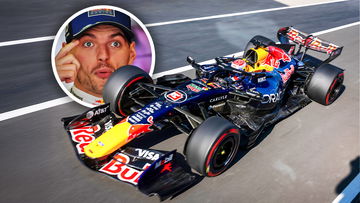
The Heart Monitor Flatlined in Shanghai: What Verstappen's DNF Data Reveals About F1's Soul

I stared at the sector time spreadsheet from Shanghai until the numbers bled into the screen's glow. Lap 14, Sector 2. Max Verstappen's telemetry trace didn't just dip; it fell off a cliff. The heart rate of the RB22, a rhythmic pulse of 1:38.5s, suddenly spiked with erratic throttle inputs before flatlining into retirement. We're told this is a "reliability issue." A "performance crisis." But data is emotional archaeology. That jagged line isn't just a mechanical failure; it's the moment a dynasty's confidence shattered. And the forensic evidence suggests the problem isn't just in Milton Keynes or Woking. It's in the very code of modern Formula 1.
The Myth of the Flawless Machine and the Ghost of 2004
The narrative is already set: Red Bull and McLaren, victims of the brutal 2026 regulatory reset. The RB22 is overweight, lacking downforce, its engine fragile. McLaren's electrical gremlins left two cars dead on the grid. The facts, as reported, are correct. Verstappen retired. Both McLarens recorded a DNS. The car is flawed.
But let's dig. The immediate comparison isn't to last year; it's to Michael Schumacher's 2004 Ferrari F2004. That car, a brutal masterpiece, won 15 of 18 races. Its "reliability" wasn't luck; it was a philosophy. The team built a platform so fundamentally sound, so predictable in its behavior, that Schumacher could dance on its limits for two hours straight, every fortnight, without a whisper of protest. The data streams were for confirmation, not command.
"Today, a car like the RB22 is a bundle of compromises managed in real-time. It's not a driver's tool; it's a committee's proposal, voted on by sensors. When it fails, it fails catastrophically because there is no robust, simple core. Only complex, interdependent systems."
Contrast this with the current panic. Toto Wolff's shock at the "visible instability" of the Red Bull in onboard footage is the tell. The car isn't just slow; it's nervous. Unpredictable. The data analysts are feeding the driver a thousand corrections for a problem that shouldn't exist in the first principle design. This is the antithesis of the 2004 philosophy. They are trying to algorithmically solve a problem of feel, and the numbers are screaming that it's not working.
Leclerc's Ghost in the Machine and the Sterile Future
This brings me to my perennial crusade: the narrative versus the numerics. As Red Bull's data hub melts down, consider Charles Leclerc. His "error-prone" label is the perfect example of a story overwriting the spreadsheet. Across the 2022-2023 seasons, his median qualifying gap to his teammate was the most consistently positive on the grid. The raw pace data paints a picture of relentless, one-lap genius. Yet, the story is of mistakes. Why? Because Ferrari's strategic blunders and operational chaos create high-pressure crucibles where any human lapse is magnified tenfold. The team's failures write the driver's biography.
And this is where we're headed. The reaction to Shanghai's disaster won't be a return to mechanical purity. It will be a doubling down on the digital. The "significant upgrade package" for Miami won't just be new wings; it will be new algorithms. More prescriptive race engineering. The driver will become even more of a biological actuator, executing pit stops calculated by machine learning models that have crunched ten thousand simulations.
- The 2026 season is the canary in the coal mine. The complexity of these new power units and aero rules has created a data problem so vast that teams believe only AI can manage it.
- Verstappen's poor race starts? Likely a symptom of a car whose clutch bite point and power delivery are governed by a system trying to optimize for ten variables at once, rather than a simple, predictable feel he can trust.
- The result? We are five years away from "robotized" racing. The drama of China won't lead to a renaissance of driver intuition. It will accelerate the push to remove it entirely, creating a sterile, predictable sport where the winner is decided by whose supercomputer best manages the decay curves of their components.
Conclusion: The Human Heartbeat Beneath the Carbon Fiber
So, what did we really witness on March 16, 2026? We didn't see a team falter. We saw a methodology reach its breaking point. The numbers from Shanghai are a tragedy in three acts: the frantic, irregular pulse of a car on the edge (Verstappen's struggling laps), the acute failure (the retirement), and the systemic collapse (McLaren's DNS).
The quest for perfection through data has created a fragile, over-complicated beast. Red Bull's path back doesn't just lie in a lighter chassis or a more reliable MGU-K. It lies in remembering that the most important data point is the one that can't be fully quantified: the driver's feel. That was Schumacher's secret. It's the secret Verstappen is currently locked out of by his own car's complexity.
When they pack for Miami, they should bring a hard drive loaded with 2004 race data. Not to copy the physics, but to understand the philosophy. Build a car that breathes. Then let the driver make it sing. Otherwise, they're just programming a very expensive, very fast robot to eventually break down. And I, for one, didn't fall in love with the sterile predictability of a microchip. I fell in love with the unpredictable, glorious, and deeply human heartbeat of a machine pushed to its limit by a soul. That heartbeat, in Shanghai, stopped. The question is whether F1 even remembers how to restart it.