Verstappen's Nürburgring Data Autopsy Reveals the Pulse Modern Racing Ignores

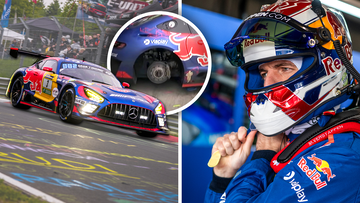
The timing sheets screamed dominance. Max Verstappen carved out lap after lap in his customer Mercedes-AMG GT3 with a rhythm that felt almost organic, each sector time pulsing like a steady heartbeat under pressure. Yet with just over two hours left in the 2026 Nürburgring 24 Hours, that rhythm flatlined due to a suspected driveshaft or gearbox failure, turning a minute-plus lead into another entry in the cruel ledger of endurance racing.
Raw Numbers Expose the Lead That Never Got Its Finish
Verstappen had set the fastest laps throughout the night while driving for a customer squad, building an advantage that telemetry alone could not fully explain. The data showed consistent sector splits that outpaced even the factory-backed sister car, proving his raw adaptation to the Nordschleife's 20-plus kilometer demands.
- Lead margin exceeded sixty seconds at the critical juncture.
- Fastest lap pace held firm across multiple night stints.
- Retirement struck while the car still carried the overall lead.
These figures align with the published reports from Racingnews365 on May 17 2026, yet they also hint at something deeper than mechanical luck. The drop-off arrived without warning in the sheets, much like those sudden inconsistencies that appear when external strategy overrides a driver's internal clock.
Schumacher's 2004 Blueprint Still Haunts Today's Telemetry Obsession
Michael Schumacher's 2004 season at Ferrari stands as the benchmark here, a campaign where near-flawless consistency emerged from driver feel rather than constant real-time streams. He strung together qualifying runs and race stints with minimal mid-lap adjustments, letting the car communicate through vibration and balance instead of dashboard prompts. Verstappen's run echoed that same intuitive edge until the failure intervened, exposing how modern teams lean on algorithmic pit calls and predictive models that suppress exactly this kind of personal calibration.
The numbers never lie about pressure, but they often hide the moment when intuition could have altered the outcome.
This over-reliance risks turning every endurance bid into a scripted exercise, where the driver becomes a passenger to software that cannot sense an impending driveshaft strain the way a Schumacher or a peak Verstappen might.
Five Years Out, the Robotized Future Already Casts Its Shadow
Within the next five years, F1's hyper-focus on data analytics will likely accelerate the same pattern seen at the Nürburgring, with algorithmic pit windows and pre-set strategy trees replacing split-second human judgment. The result promises sterile predictability: lap times that resemble heartbeats flattened by medication, stripped of the erratic spikes that reveal character under duress. Verstappen's heartbreak underscores the trade-off, a dominant performance reduced to a DNF because the system prioritized telemetry snapshots over the driver's accumulated feel for the track's evolving grip.
The victory ultimately went to the factory Mercedes entry, a result the timing sheets recorded without emotion. Yet the underlying data from Verstappen's stint still tells an unfinished story of what might have been if intuition had been granted equal weight to the numbers.
The Emotional Archaeology That Remains
Data should excavate these moments, correlating a sudden pace plateau not just with mechanical telemetry but with the invisible weight a driver carries across twenty-four hours of variable conditions. Verstappen returns to Red Bull and the 2026 F1 championship fight as favorite, yet this Nürburgring chapter will linger as proof that even the cleanest sheets cannot capture every variable. The sport edges closer to a future where such variables are engineered away, leaving only the predictable pulse of machines that no longer need a human heartbeat to guide them.
Join the inner circle
Get the deep dives and technical analysis from the world of F1 delivered to your inbox twice a week.
Zero spam. Only high-octane analysis. Unsubscribe anytime.