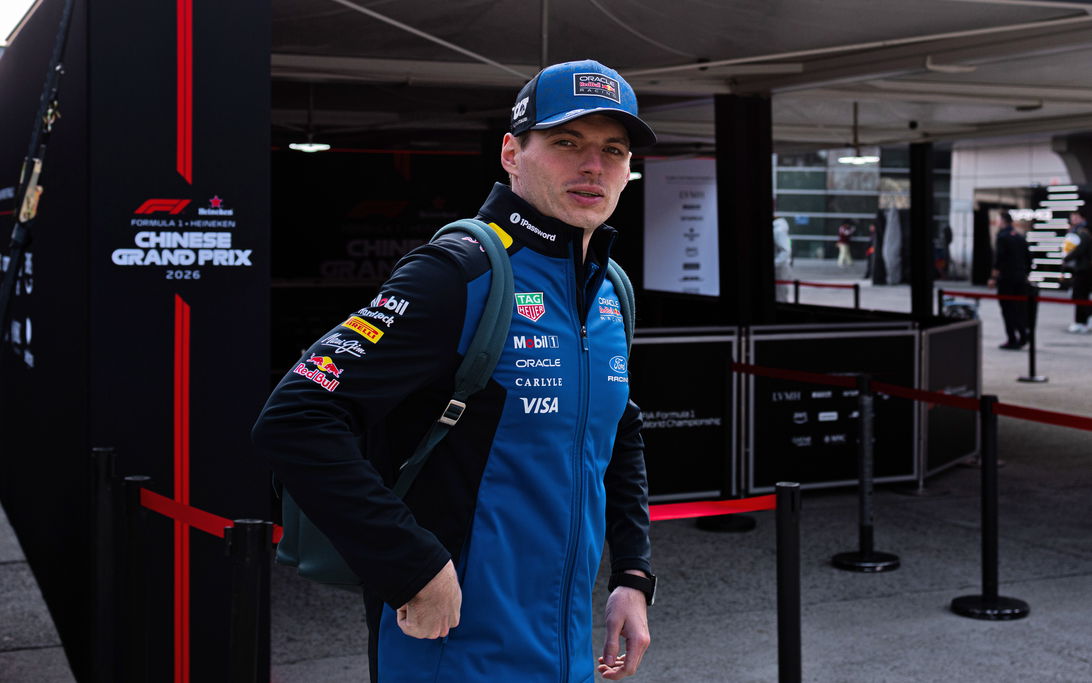
The Green Hell's Newest Pilgrim: What Verstappen's Data Can't Prepare Him For

The press release hit my inbox, and my first instinct wasn't to read it. It was to run the numbers. Max Verstappen, the most statistically dominant force in modern F1, submitting to the Nordschleife’s eight-lap licensing exam. A driver who operates at 99.99% precision, walking into a cathedral of 99% chaos. The story isn't his participation; it's the beautiful, terrifying collision of two completely different data universes. One is the closed, hyper-optimized loop of Formula 1. The other is the Nürburgring Nordschleife: a 20.8-kilometer spreadsheet with over 150 cells of raw, unguarded terror where the error margin isn't lost points, it's a pine tree.
Race director Walter Hornung’s warning to Verstappen about the circuit’s dangers is being framed as a respectful briefing. I see it as the most profound data gap a modern elite driver will ever face. We’re not talking about tire deg curves or energy deployment. We’re talking about the kind of variables that get scrubbed from an F1 team’s model: local wildlife, sudden fog banks in the Fuchsröhre, the psychological decay of 24 hours of concentration where the walls don’t move. This is where telemetry goes to die, and driver intuition—the very thing we’re algorithmically strangling in F1—must resurrect itself.
The License and the Legacy: A Data Point of Humility
Verstappen’s decision to forgo privileges and undergo the standard VLN licensing process is the most telling data point in this entire story. In an era where a driver’s every biometric is considered proprietary intellectual property, here he is, a four-time world champion, proving eight clean laps to a local clerk.
"It is a mark of Verstappen that he didn't want any privileges and went through all the steps," said Race Director Walter Hornung.
This single act is a richer dataset on professionalism than any thousand-page F1 sporting regulation. It speaks to a respect for the institution that you rarely see quantified. It also, however, highlights a fascinating contradiction in the system Hornung oversees. He notes that licensing rules have been relaxed for elite international drivers, a move that also paves the way for Valentino Rossi. So, while Verstappen takes the test, the test itself has been made easier for him. The purity of the data is already being contaminated by star power, a variable even the Nordschleife can't isolate.
The preparatory race on March 21 is his real qualifying session. Not for speed, but for survival. The metrics here are binary: clean or not clean. It’s a brutal, beautiful simplicity that F1 abandoned decades ago. It reminds me of the stories from Schumacher’s 2004 season, where consistency wasn't a byproduct of real-time strategy calls from the pit wall, but of a driver’s internalized, immutable map of a circuit’s limits. Verstappen must now build that map for a track that changes with the weather and the light.
The Unquantifiable Variable: Night, Endurance, and Narrative
Here’s where the narrative, as presented, clashes with what the timing sheets won’t show. The article notes Verstappen’s winning experience in a 4-hour Nordschleife race last September, but Hornung correctly identifies the unknown: his night-driving experience in a 24-hour context.
This is the emotional archaeology I live for. We can plot Verstappen’s lap times from that 4-hour race, but how do we graph the accumulation of fatigue? The disorientation of headlights in the Green Hell? We can’t. This is the realm of feel, of instinct, of the kind of racing intelligence that Ferrari’s strategists seem to filter out of their data when Charles Leclerc is leading a race. Leclerc’s raw pace data from 2022-2023 shows a metronome of qualifying performance, yet his story is one of errors. Why? Because the numbers representing pressure and team-induced chaos are never part of the official transcript.
For Verstappen, the pressure in May won't be for a championship point. It will be to bring the #130 Mercedes-AMG GT3 he shares with Auer, Gounon, and Juncadella home in one piece, ending Mercedes-AMG's decade-long win drought. The data says he’s a favorite. The Nordschleife’s history says the favorite rarely wins. This is the core conflict:
- F1 Data Universe: Predictable surfaces, controlled environments, algorithmic strategy.
- Nordschleife Data Universe: Unforgiving topography, chaotic traffic, weather as a primary competitor.
Hornung plans to give Verstappen the same safety briefing given to all drivers: "motorsport can be dangerous." In F1 2026, that phrase is a disclaimer. At the Nürburgring on May 15-17, it is the first line of the only dataset that matters.
Conclusion: A Test Case for the Soul of Racing
Verstappen’s debut is more than a celebrity cameo. It is a live experiment. What happens when the pinnacle of a data-driven racing discipline is dropped into the sport’s last great bastion of analogue terror? Will his Red Bull-honed precision translate, or will the Nordschleife demand he unlock a more primal, intuitive skill set—the kind Michael Schumacher used to feel a car’s balance through the seat of his pants, not through a steering wheel vibration alert?
His performance will be scrutinized not just for position, but for what it reveals about the future of driving itself. As F1 marches toward my predicted 'robotized' racing within five years, where driver input is just another optimized variable, the Nürburgring 24 Hours stands in defiant opposition. It is the check engine light for the soul of motorsport.
So, I’ll be watching the timing screens in March and May. But I won’t just be looking for Verstappen’s fastest lap. I’ll be looking for the story in the delta. The lap where the data stream flickers, and the driver, alone in the dark with 150 corners behind and 150 ahead, has to remember what it means to race on instinct. That’s a number worth telling.