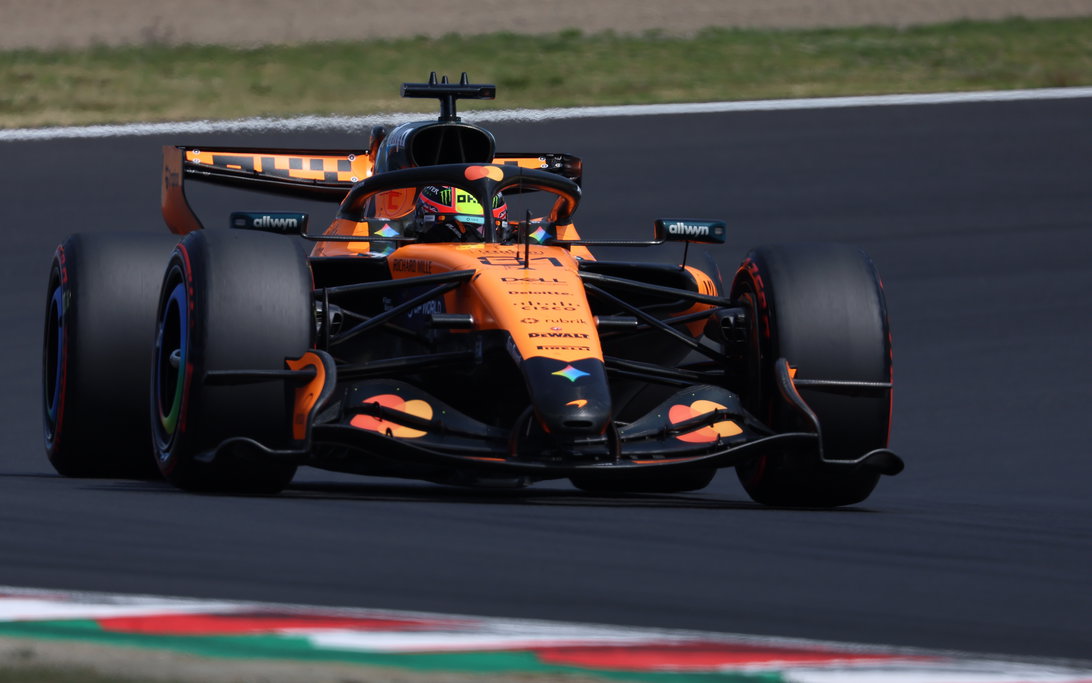
The 50G Ghost in the Machine: Bearman's Crash and the Data We Choose to Ignore

I stared at the telemetry trace from Japan, the two lines converging not like a graph but a scream. Oliver Bearman’s velocity vector, a steep, aggressive climb. Franco Colapinto’s, a sudden, precipitous drop. The space between them evaporated in milliseconds, a digital prophecy fulfilled in crumpled carbon fiber and a 50G impact. The narrative is clean: McLaren’s Andrea Stella demands rules, the FIA must act. But the data tells a deeper, more unsettling story. This isn't just about hybrid deployment. It's about the sport's schizophrenia—our fetish for terabytes of real-time data, while willfully ignoring the human variables those numbers scream at us. We’ve built a system so analytically dense it’s now predictably dangerous.
The Predictable Collision: When Data Becomes a Prophecy
The facts are sterile, and in their sterility, they are damning.
- Incident: March 31, 2026, Japan. Haas rookie Oliver Bearman, on full deployment, approaches the Alpine of Franco Colapinto, who is lifting and harvesting energy.
- Result: A sudden closing speed estimated at 30 mph, a loss of control, a barrier impact at 50G. Bruising, miraculously. A warning, heeded too late.
- The Prophet: McLaren’s Andrea Stella. He flagged this exact scenario during pre-season testing, stating it should be "on the agenda of the FIA" for the 2026 regulations.
Stella’s post-race comment is the chilling key: "We don't want to wait for things to happen to put actions in place, and [in Japan], something happened." This is the core failure. We collect data to predict outcomes, yet we only act after the prediction manifests in reality. We treat the sport like a lab experiment, observing the reaction but refusing to adjust the volatile compounds beforehand.
The numbers foretold a crash. We had the charts, the speed differential models, the energy state probabilities. We just didn't have the institutional courage to believe them until they were painted on the barriers.
This is where my skepticism boils over. We can model tire deg to the tenth of a gram, predict pit windows to the second, yet we allowed a known, quantifiable 30 mph differential—a speed gap you feel merging onto a highway—to exist as a latent track hazard. We prioritized the strategic complexity of the hybrid duel over the baseline physics of a driver's reaction time. It’s not an oversight; it’s a value judgment written in code.
The Schumacher Paradox: Driver Feel vs. Algorithmic Mandates
This brings me to my constant touchstone: Michael Schumacher’s 2004 season. His consistency wasn't just in lap times; it was in a profound, almost preternatural understanding of the car's state and the traffic around him, communicated through his backside and his hands, not a dashboard. He managed gaps, fuel, tires, and yes, mechanical sympathy, with an internal chronometer. The car gave him feedback; he gave it direction.
Contrast that with Bearman’s moment. He was a prisoner of two algorithmic states: his car’s mandate to deploy energy for lap time, and Colapinto’s mandate to harvest it for future lap time. The "driver feel" here was likely a violent shift in visual perspective as the closing rate defied instinct. The system created a no-man's-land where intuition is useless.
This is the robotized racing I fear. We’re not adding data to support the driver; we’re constructing a labyrinth of rules where the driver’s primary role is to execute the energy map and avoid the digital ghosts the system itself creates. The "dangerous closing speeds" Stella cites are a direct byproduct of a formula that values energy-state strategy over organic racecraft. We’re engineering the potential for brilliance out, and engineering predictable, sterile danger in.
And let’s talk about pressure, the story data buries. Put a rookie like Bearman in that Haas seat. The data demands he push, deploy, extract every millisecond to prove his worth. The team strategy, dictated by lap-time simulations, likely mandated that deployment phase. Where in that telemetry trace is the variable for "young driver proving himself"? Where is the data point for the immense, unseen weight that leads to a millisecond of delayed reaction? We see the 50G impact, but we ignore the gigapascals of psychological pressure that led to the moment. We’ll correlate Leclerc’s lap time drop-offs to a bad pit stop, but never dare to look deeper.
Conclusion: The Emotional Archaeology of 50G
So, the FIA will act. They’ll tweak deployment rules, maybe add a driver warning system—another piece of data to clutter the cockpit. A "comprehensive fix" is promised for 2026. It will be a technical solution to a philosophical problem.
The story of Bearman’s crash isn't just about hybrid systems. It’s a stark monument to our modern F1 paradox. We worship at the altar of data, yet we use it reactively, to explain tragedies, not prevent them. We use it to shackle driver instinct in the name of efficiency, creating new, more bizarre risks. We use it to blame drivers like Leclerc for "errors" that are often the terminal symptom of a team's strategic disease, while absolving the systems that put them in impossible situations.
Digging into the archaeology of this 50G impact, I don't find a simple engineering flaw. I find the ghost of Schumacher’s feel, sidelined. I find the pressure on a rookie, unquantified. I find a prophecy in a telemetry trace, ignored. The numbers told the whole story. We just chose not to read it until the story wrote itself in wreckage. The fix isn’t just in the software. It’s in remembering that the heartbeat of this sport isn’t a kilowatt harvest curve, it’s the driver’s pulse in the cockpit, and we’re building a world where that pulse is the last variable we consider.