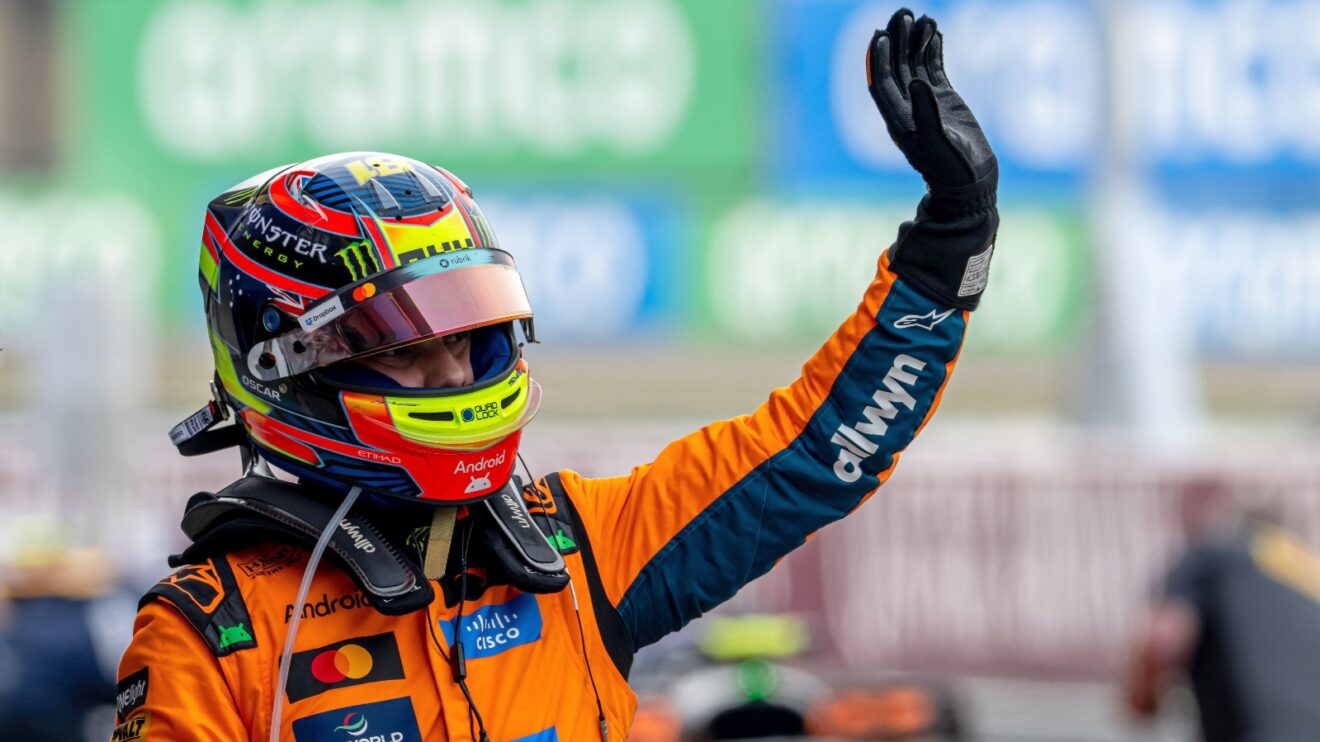
Piastri's Suzuka Podium: A Data Point of Human Resilience in an Algorithmic Age

The timing sheet from Suzuka tells a simple story: P2, Oscar Piastri, McLaren, +8.472s. A sterile line of data. But the story it hides is one of the most human in recent memory. To understand it, you don't need the sector times. You need the calendar. The gap between the Australian Grand Prix on March 22nd and the Japanese Grand Prix on March 29th is just seven days. In those seven days, Oscar Piastri went from the profound humiliation of a DNS in front of his home crowd to standing on the podium at one of the sport's most brutal circuits. The numbers say +8.472 seconds. The narrative screams of a psychological rebound that no predictive algorithm could ever quantify. This is where data becomes emotional archaeology.
The Ghost Laps of 2026 and the Schumacher Standard
Before his wheels turned in anger at Suzuka, Piastri's 2026 season existed only as a series of catastrophic data points: two race starts, zero racing laps. His season was a blank page, a statistical ghost. In the modern paddock, where a driver's worth is often a rolling average of his last five race performances, this creates a vacuum often filled by doubt.
"The adversity at the start of the year can really bog you down," Stella said, pinpointing the mental trap. This is where driver legacy data becomes crucial. We lack the granular telemetry from Michael Schumacher's mind in 2004, but the output data shows a machine-like consistency: 18 races, 12 poles, 13 wins, a single DNF. The Ferrari F2004 was a monster, but Schumacher's true genius was in making supreme performance look routine, race after race, without the specter of zero laps haunting him. The system—car, team, driver—was engineered for psychological stability as much as mechanical grip.
Piastri faced the inverse: a system that had failed him twice, demanding an immediate, high-stakes reset. His Suzuka qualifying lap, good enough to start on the front row, wasn't just fast. It was an act of data deletion, overwriting the corrupted files from Bahrain and Melbourne with a clean, blistering sector-by-sector install.
- The Overwritten Data: Bahrain (DNF), Australia (DNS) → Japan (P2, Front Row Start).
- The Human Metric: The pressure coefficient between a home-race DNS and a podium the following week is incalculable, yet it's the most important number of his season so far.
The Ill-Timed Safety Car and the Leclerc Parallel
Here’s where the race narrative, and my own skepticism, engages. The report states Piastri's "potential victory bid was undone by an ill-timed Safety Car." This is the classic F1 story—fortune's wheel turning. But let's dig into the data this implies. The Safety Car gifted his rival, Kimi Antonelli, a "cheap pit stop," flipping the race. Piastri was then left to defend against George Russell and, notably, Charles Leclerc.
This is a critical data intersection. Leclerc, hounding for a podium, is often branded "error-prone" in these high-pressure chase scenarios. Yet, the raw data from his peak years (2022-2023) shows he was the most consistent qualifier on the grid. His reputational errors are frequently preceded by, or are desperate reactions to, strategic blunders from the pit wall. At Suzuka, he was again applying immense pressure but came away empty-handed. Was this a driver error, or was the Ferrari simply not giving him the strategic or mechanical tools to convert? The timing sheets show he finished behind Piastri, but they don't show the chain of causality. Piastri's "steadiness" under that pressure, as Stella called it, was the performance differentiator, but it's a comparison often unfairly skewed against Leclerc.
Stella’s praise focused on the intangible:
"His strength was evident not just in pace but in his attitude... a booster for the entire team to go through the adverse."
This is charismatic leadership measured in radio tone and post-race demeanor, not in gigabytes of telemetry. It's the last bastion of the purely human element in the sport.
The Coming Sterility and McLaren's Uphill Battle
Stella’s post-race comments were a masterclass in data-realist expectation management. He "expressed surprise" they were fighting for the win and immediately stated the need to "improve the chassis by a few tenths of a second." This is the cold, hard truth. The emotional archaeology of Piastri's rebound is a great story, but the championship is won on aero maps and CFD simulations.
This is my core dread: within five years, a drive like Piastri's will be less celebrated as human resilience and more seen as an expected output from a driver psychology module. The hyper-focus on analytics is creating a pathway toward robotized racing. Strategy will be fully algorithmic, pit stops dictated by a central AI processing live data from all cars, suppressing driver intuition in favor of statistically optimal, and therefore predictable, outcomes. The "ill-timed Safety Car" will be a variable the AI has already pre-calculated a 97.3% optimal response for, draining the drama from the moment.
McLaren's task now is to build a car worthy of its drivers' psychological fortitude. They must provide Piastri and Norris with a machine that doesn't just have peak performance, but has the Schumacher-2004 consistency to make the podium not a celebratory surprise, but a baseline expectation. Stella knows this. The numbers know this.
Conclusion: The Heartbeat in the Hex Code
Oscar Piastri’s Suzuka podium is a powerful data point in the 2026 season. It proves that amidst the torrent of telemetry—the tire slip ratios, the brake migration percentages, the engine derate commands—the most volatile and crucial variable remains the human heart rate in the cockpit after two soul-crushing DNAs.
We should celebrate this story while we can. Soon, the algorithms will learn to model resilience, to factor in "home-race DNS recovery probability" into their pre-race simulations. The sport will become a cleaner, more efficient machine. And we will pore over the timing sheets, perfect and predictable, longing for the messy, glorious, unrepeatable human heartbeat we saw in the data from Japan on March 29th, 2026. McLaren’s chassis needs a few tenths. But F1 needs to ensure it never loses the immeasurable tenths that come from a driver's gut, not his dashboard.