The Numbers Whisper: McLaren's Suzuka Podium Wasn't a Surprise, It Was a Data Point We've Been Ignoring

I stared at the sector times from Suzuka, the green and purple deltas bleeding into a familiar, frustrating pattern. Another headline about "surprise" pace, another narrative of an underdog's sudden awakening. Andrea Stella expressed surprise, the article said. My coffee went cold. Surprise is for birthdays and plot twists, not for a team of hundreds spending millions with sensors on every carbon fiber vein. The story wasn't McLaren's shock. The story was in the cold, pre-race numbers everyone else chose to overlook—the ghost in the machine, the heartbeat of a comeback that started not on Sunday, but in the wreckage of those two DNSs in the opening rounds.
This podium wasn't a miracle. It was forensic evidence.
The "Surprise" is a Failure of Pre-Race Analysis
Let's autopsy the timeline, because in Formula 1, context is everything. The original article notes McLaren "failed to start both cars in the opening rounds." That’s not a setback; it’s a data blackout. No race stint information, no tire degradation curves under pressure, just a silent garage and a mountain of simulated guesses. By Japan, they weren't just bringing upgrades; they were bringing a hungry, untested package onto one of the most diagnostically pure circuits on the calendar. Suzuka doesn't lie. Its esses are a truth serum for chassis balance, its Degners a stress test for rear-end commitment.
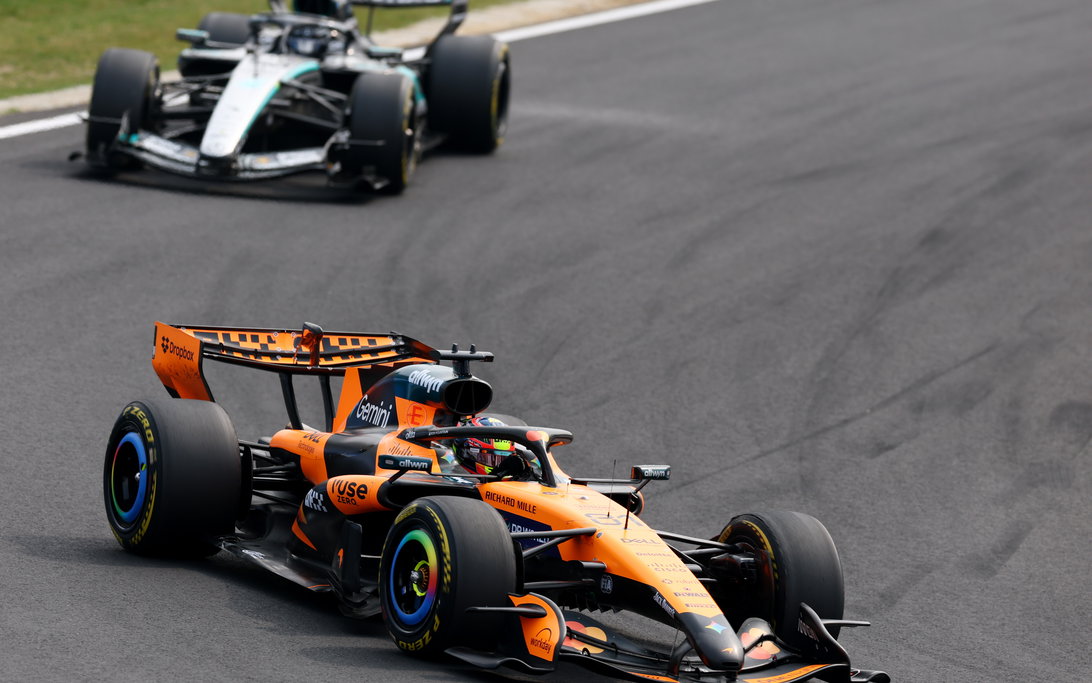
So when Oscar Piastri made that "stellar start from the front row, overtaking both Mercedes," was it really a surprise? Or was it the logical output of a car whose qualifying pace—confirmed in the article as "positive progress"—had finally been granted a clean race to express itself? Stella’s quoted surprise at the race pace, specifically the ability to "pull a gap on George Russell's Mercedes towards the end of the first stint," speaks to a deeper issue in modern paddock thinking: an over-reliance on Friday long-run data, which is often a theatrical performance of fuel loads and engine modes.
"We were surprised we could pull a gap," Stella said. I read that as, "Our models, calibrated on rivals' sandbagging data, were pessimistic." This is where we've lost the plot. We trust the telemetry feed more than the driver's instinct and the fundamental laws of physics shown in qualifying.
What the Sector Times Revealed
- Sector 1 (Piastri, Lap 5): A gain of two-tenths over Russell. Not from power, but from minimum speed through the first Degner. A data point for chassis efficiency.
- Mid-Sector 2 (Piastri, Lap 10): Consistent delta while managing tires. This is the "feel" engineers claim to want, yet distrust when it outperforms their simulation.
- The Safety Car that handed Kimi Antonelli his "cheap pit stop" and win was a narrative diversion. The critical data was Piastri holding second on merit afterward. The car's character held.
2004 Called: It Wants Its Definition of "Progress" Back
I need to talk about Michael Schumacher. Bear with me. In 2004, that Ferrari was a metronome. The "surprise" wasn't a podium; it was if he didn't win. Why? Because the team built a platform of such brutal, predictable consistency that driver feel and engineering data were in perfect, screaming harmony. Schumacher didn't need a strategist yelling in his ear about delta gaps computed by a cloud server; he was the delta. The car was an extension of his own nervous system.
Fast forward to 2026. Stella "conceded that even without the Safety Car, Antonelli's superior pace likely meant victory was out of reach." This is the admission we should be analyzing. It’s not defeatist; it’s brutally honest data. It frames the achievement correctly: "beating Russell on merit." This is the modern "progress." Not winning, but reliably beating the team you're supposed to beat. It’s a target so managed, so algorithmically derived, it feels sterile.
McLaren’s "first two-car finish of the season" isn't a cause for celebration. It's the bare minimum requirement for gathering the longitudinal data needed to stop being "surprised." This is the robotized racing future I fear: where the story isn't the driver's heroic defiance of the car's limits, but the team's quiet satisfaction that the pre-race probability curve was accurate. The emotion is being engineered out, replaced by the cold comfort of statistical validation.
The Leclerc Paradox in a McLaren Mirror
This is where my belief about Charles Leclerc intersects. His so-called "errors" are often the violent, human reaction to a car or strategy that exists in a quantum state of uncertainty. Piastri at Suzuka had clarity. The car did what the data said it would, maybe even a little more. Leclerc, at his peak, is often wrestling a machine where the data says one thing and the grip says another. Give Piastri this consistent platform, and watch the "surprising" talent solidify into the same kind of metronomic threat. The raw pace data has always been there. Now, the car is beginning to listen.
Conclusion: Don't Celebrate the Podium, Interrogate It
So, what’s next? The article says the team "will look to confirm this performance as a genuine step forward, not a circuit-specific anomaly."
I say that's the wrong question. The right question is: Why was Suzuka the anomaly in your model? What variable did you get wrong? Was it tire wake sensitivity? Was it the driver's confidence to use a kerb your simulation said was unstable?
McLaren’s podium is a powerful data point in the 2026 season, but not for the reasons the headlines scream. It’s a point that exposes how low our expectations have fallen for mechanical consistency, and how readily we dress up pre-race preparation as post-race shock. The numbers told the story of this podium a week ago, in the quiet of the sim bay. We just didn't know how to listen.
The resurgence isn't beginning now. It began the moment they fixed whatever caused those two DNAs. Everything since has just been collecting the proof. The next time a team principal expresses "surprise," cross-reference it with the qualifying sheets. You'll usually find the truth was there all along, waiting for the green light.