The Ghost in the Machine: Suzuka's Long-Run Data Exposes F1's Coming Sterility

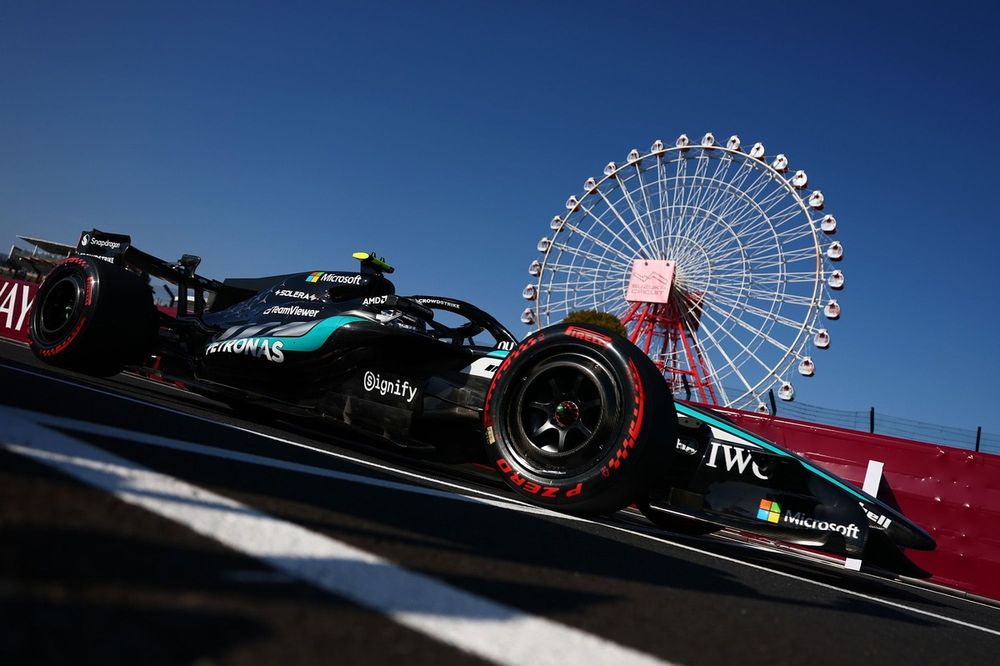
I felt a chill reading the long-run averages from Suzuka. Not from the numbers themselves—Mercedes’ 0.66-second per lap slaughter of Ferrari, Red Bull’s 1.49-second deficit sinking them behind Haas—but from what they represent. This isn't just a pace chart; it's a pre-written race script, a clinical, data-mandated prophecy for Sunday. The story here isn't who is fast. It's that we now know, with terrifying precision, exactly how fast they will be, and in five years, this hyper-clarity will have sucked the soul from the sport. Welcome to the dawn of robotized racing.
The Algorithmic Hegemony of Mercedes
Let's not mince words. What Mercedes displayed on Friday wasn't just speed; it was a systemic annihilation. The timing sheets don't lie, but they also don't weep. They show a team that has turned the chaotic, human variable of a Grand Prix stint into a solvable equation.
Antonelli's Metronomic March
The rookie, Kimi Antonelli, wasn't just quick; he was a metronome. To be 0.25 seconds per lap quicker than the ruthlessly consistent George Russell on heavy fuel isn't a flash of talent—it's the execution of a perfect brief. His sector data is eerily clean: massive gains of up to 15 km/h on the straights, minimal losses in the technical bits. This isn't a driver finding a limit; this is a driver hitting a pre-calculated target, lap after lap. It’s impressive. It’s also a little hollow. Where is the ragged edge, the overreach, the feel? It’s been optimized out.
The Schumacher Benchmark: Consistency vs. Calculation
This is where I drag out the 2004 ghost. Michael Schumacher’s dominance that year was built on a consistency that felt supernatural, but it was a consistency born of symbiosis with the car, a visceral understanding he fed back to the engineers. Today’s Mercedes advantage feels different. It’s extracted from the CFD cluster, validated in the simulator, and delivered via an engine map that maximizes straight-line speed at the expense of nothing. The driver is the final, highly skilled actuator in the loop. The intuition is being suppressed, replaced by fidelity to the model. When the model is this good, you win. But you also sterilize.
The Human Fissures in the Data
Beneath Mercedes' monolithic performance, however, the data cracks open to show the human stories—the ones we should be clinging to as algorithms tighten their grip.
Leclerc: The Island of Competence
While the headline screams "Ferrari trails by 0.66s," a deeper look tells the real tale. Charles Leclerc was, yet again, the island of competence in a sea of Maranello mediocrity. His long-run average was the best of the rest, while his teammate, Lewis Hamilton, suffered a disastrous session 1.3 seconds per lap adrift with high degradation.
This is the emotional archaeology of data: one driver extracting something pure from the package, the other lost in it. Leclerc’s raw pace, as his 2022-2023 qualifying data proves, remains elite. The error-prone narrative is a lazy overlay; more often, it’s the strategic blunders and operational chaos around him that force him into Hail Marys. The numbers from Suzuka don’t show a driver cracking. They show a driver carrying a team.
Red Bull’s Emotional Core
Then there’s Red Bull. A 1.49-second deficit. Behind Haas and Alpine. The telemetry shows the RB22 loses its time in the corners, specifically the fast esses of Sector 2. This is a chassis problem, not just power. But look at the emotional data point: Max Verstappen, the apex predator of the last era, is now a midfield soldier. How does that pressure correlate? We can’t see it in the lap time trace, but it’s there, a silent harmonic vibrating through every garage radio transmission. This is the story data often misses—the corrosion of confidence.
The Midfield: Where the Pulse Still Beats
Paradoxically, the sterile predictability at the front makes the midfield battle the last bastion of true racing.
- Haas (+1.35s) & Alpine (+1.37s): Their scrap, separated by a whisper, is where strategy will be reactive, not pre-ordained. Driver instinct will matter.
- Audi (+1.52s): Matching Red Bull’s pace is a psychological victory, a story of momentum.
- Aston Martin (+3.65s): A distant last. Here, the data isn’t a script; it’s a cry for help. The human struggle to fix a broken concept is the raw, unoptimized drama we’re in danger of losing.
Conclusion: The Predictable Future
So, what’s next? The article says Mercedes controls the Grand Prix from the front. And it’s right. That’s the problem. The long-run data has made the race a foregone conclusion before a single lap is run on Sunday. McLaren’s flashy single-lap pace is a diversion, a last gasp of unpredictability before the relentless, algorithm-driven race pace of Mercedes grinds them down.
F1 is at a crossroads. The pursuit of perfect information is creating perfectly predictable outcomes. We’re trading the heart-in-mouth uncertainty of a Schumacher pit stop gamble—based on a gut feel and a glance at the skies—for a pit stop triggered by a deterministic model that is right 99 times out of 100. I live for data. But I fear the day the numbers stop telling a story and start writing the entire, boring book themselves. Suzuka 2026 might just be the first chapter.