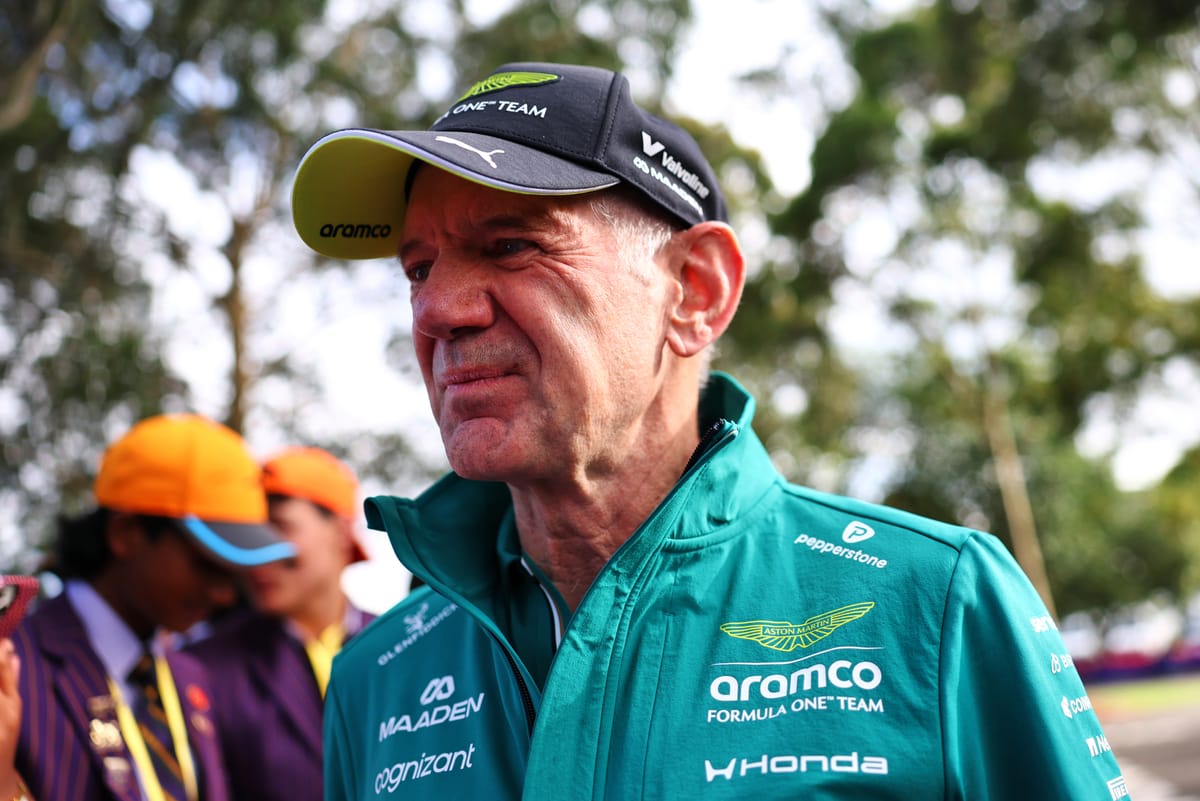
The Double-Edged Sword: Newey's Public Grievance and the Psychology of a Team in Freefall
The data sheet from Melbourne is a clinical document of failure. 64 laps. A number that echoes in the silent, sterile halls of Aston Martin's factory, a stark numerical representation of a dream unraveling. But numbers are just the surface tremor. Beneath lies the seismic shift in human dynamics, a psychological fracture more dangerous than any carbon fiber flaw. At the epicenter stands Adrian Newey, a man now split in two, his genius at war with his new reality. His public critique of Honda isn't just a tactical error; it's a cry of frustration from an engineer who finds himself navigating the murky, political waters of a role he may never have truly wanted. This is no longer about downforce or drag coefficients. This is about trust, ego, and the terrifying silence that falls between a pointed comment and its reception 6,000 miles away in Sakura.
The Architect vs. The Politician: A Mind Divided
Newey's dual role as team principal and technical director is a psychological experiment playing out in real-time, under the white-hot glare of a public crisis. We are witnessing a profound internal conflict.
- The Technical Director's Mind: This is Newey's native state. A realm of pure cause and effect, where a vibration is a problem to be solved, not a sentiment to be managed. His statement that Honda was "not clear" about its F1 department's state is, to him, likely a simple engineering fact. The battery pack is being damaged. The power is lacking. These are variables in an equation.
- The Team Principal's Burden: This is the foreign territory. Here, facts are filtered through the prism of partnership, morale, and long-term strategy. Every public word must be weighed not for its truth, but for its impact. The "severe vibrations" are no longer just a physical phenomenon; they are a metaphor for the relationship itself.
"History doesn't repeat, but it often rhymes. Red Bull's corrosive dance with Renault was a masterclass in how public blame creates a feedback loop of resentment, where technical solutions are buried under layers of corporate pride."
Newey is trying to operate both minds simultaneously, and the strain is showing. For a man whose life's work is clarity of design, this blurring of lines must feel like a form of torture. He is attempting to diagnose a patient while simultaneously offending the surgeon holding the scalpel.
The Human Element: When Machines Reveal the Men
The technical failures of the AMR26 are not just engineering puzzles; they are windows into the psychological state of the entire organization. The "pronounced front-wheel locking tendency" and "lack of driver confidence" reported, particularly for Lance Stroll, are symptoms that transcend aerodynamics.
This is where my core belief takes root: driver psychology trumps car aerodynamics in conditions of uncertainty. A nervous car amplifies a driver's innate doubts. Stroll, whose career has been a complex tapestry of privilege and unspoken pressure, is especially vulnerable to a machine that doesn't communicate clearly. Is his struggle purely down to the car's balance, or is the machine reflecting back the team's own instability? A driver's confidence is a fragile ecosystem, built on trust in the engineers behind the wall. When the lead engineer is publicly doubting the engine supplier, what foundation of trust remains for the man in the cockpit?
Furthermore, consider the vibration issue. A relentless, physical shudder transmitted through the chassis. It's not just damaging the battery; it's a constant, grinding sensory assault on the driver. It breeds fatigue, erodes precision, and feeds a primal sense that the machine is fundamentally unwell. You cannot coach that out of a driver. You cannot suppress that emotional response with covert psychological training, as Red Bull so masterfully did to mold Verstappen's early fury into cold efficiency. This is a raw, immediate stressor.
The Long Shadow and the Forced Smile
The path forward is fraught with psychological peril. The 2026 season is now a public therapy session, a recovery year where the objective has brutally shifted from glory to basic functionality. Every interaction between Aston Martin and Honda will now be loaded with subtext.
- The Private Negotiations: Behind closed doors, can Newey switch off the public persona and become the collaborative engineer? Or has the bridge been singed? Honda's engineers are proud professionals; public criticism is a wound that doesn't heal with a private apology.
- The Driver's Burden: Fernando Alonso, the ultimate survivalist, will compartmentalize. He has seen empires fall. But for Stroll, and for the morale of every mechanic and aerodynamicist, the narrative is set: they are fighting their own partner as well as their rivals.
- The Ghost of 2027: Project 678 now carries an unbearable weight. It is no longer just a car; it is the verdict on this partnership. It becomes a symbol of either reconciliation or irrevocable divorce. The pressure on that design team, starting now, is immense and deeply personal.
This saga underscores a coming inevitability in Formula 1. Within five years, I believe we will see mandated mental health disclosures after major incidents. Imagine if we had a lens into the cognitive load on Newey right now, or the anxiety metrics for Stroll after a locking, shuddering lap. The era of pure machine analysis is ending. The human system is the limiting factor.
Aston Martin's crisis is a perfect storm: a genius engineer pushed into a role that demands emotional intelligence over pure intellect, a driver lineup absorbing the team's instability, and a crucial partnership now tinged with public blame. Newey sought to clarify a technical reality, but in doing so, he has clouded the human reality beyond measure. The vibrations may yet be solved with a mechanical fix. But the resonance of his words will be far harder to dampen.