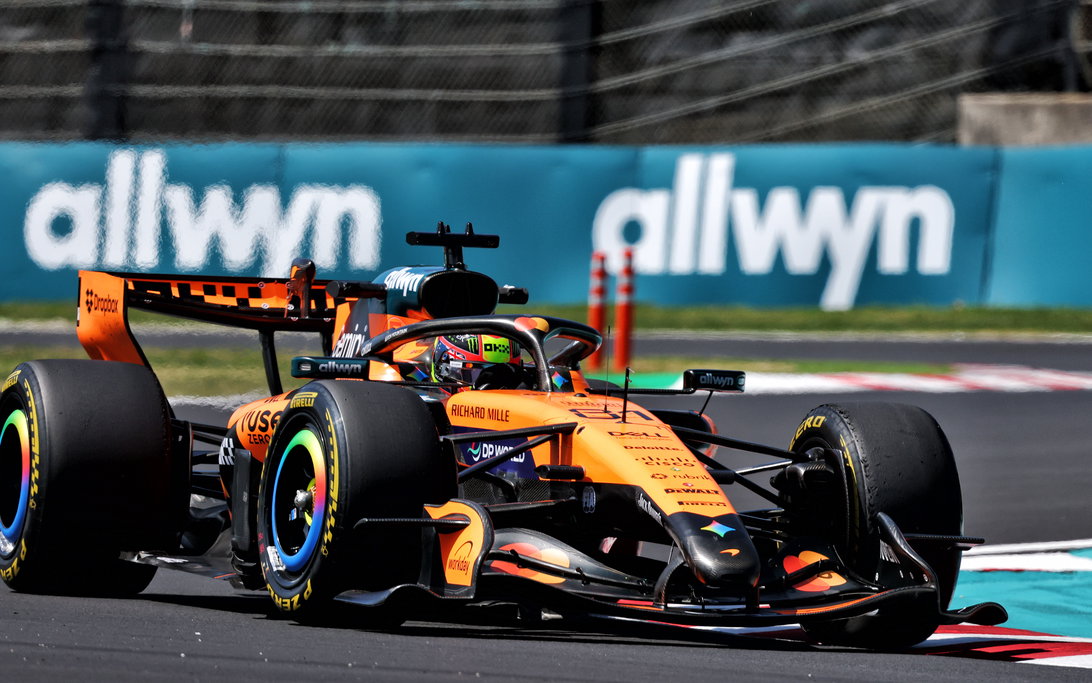
Piastri's Virtual Mirror: A Data Point in the Coming Sterility

I was knee-deep in the telemetry from Suzuka's 130R, a corner that demands a surrender of breath, when the stewards' bulletin flashed on my second screen. Oscar Piastri. Impeding. Warning issued. My first thought wasn't about the penalty, but the timestamp. The incident occurred at a point on the track where the data stream is a sheer cliff face of g-forces and commitment. My second thought was his defense: a virtual mirror system with an insufficient refresh rate. A chill went through me, and it wasn't from the air conditioning. This wasn't just a practice session footnote. This was a decimal point in the ledger that proves my darkest forecast: we are programming the intuition out of the sport.
The stewards accepted Piastri's explanation. He misjudged a 75 kph closing speed with Nico Hulkenberg while weaving to warm his tires, despite a team radio warning. He saw the Haas, but his brain, fed by a lagging digital image, calculated he had more time. He didn't. Hulkenberg had to lift. Case closed, with a warning. But the key artifact Piastri entered into evidence wasn't his apology; it was his critique of the tool. He was "heavily reliant" on the system, a "habit from last year." He blamed its refresh rate. In that statement, a top-tier driver confessed he had outsourced a fundamental spatial awareness to a system he now deemed unfit for purpose. This is how it begins.
The Data Lag: When Milliseconds Become Metaphors
Let's dissect the moment with the cold precision it deserves. The incident happened on the straight between Turns 14 and 15, one of the most visceral sections of track in the world. Here are the data points we must consider:
- Closing Speed: 75 kph. At that differential, a 100-millisecond delay in your perception is a car length vanished. Poof.
- The Human Baseline: A seasoned driver's instinct, honed by years of physical mirrors and the roar of an engine hitting a limiter behind you, operates on a feedback loop measured in micro-seconds of neural response. It's feel. It's hair on the back of the neck.
- The System's Failure: Piastri stated the virtual mirror's refresh rate was "insufficient." This isn't a glitch; it's a specification. It means the data pipeline to the driver's eyes has a bottleneck. The system is, by design, delivering reality on a slight delay.
"We are giving drivers high-definition rear-view screens but asking them to process danger in standard definition. The latency isn't in the cable; it's in the philosophy."
This is where my obsession with Michael Schumacher's 2004 season becomes relevant. That Ferrari was a beast of feel. The mirrors were glass. The radio was for emergencies, not constant coaching. Schumacher's consistency that year—a string of podiums that felt pre-ordained—was built on a perfect, unmediated marriage of his senses to the car's behavior. He judged closing speeds not with a refresh rate, but with a predator's timing. The modern driver is being wrapped in a digital cocoon, fed sanitized data, and then chastised when the cocoon blurs their vision.
From Driver to Operator: The Sterility Pipeline
Piastri's incident is a symptom, not the disease. The disease is the relentless pursuit of optimization through data, at the expense of innate skill. We are in the foothills of a terrifying transition.
Phase 1: We introduce systems to aid the driver. Virtual mirrors for better aerodynamic efficiency. Complex brake migration maps. Radio suggestions on tire push.
Phase 2: Drivers become reliant on these systems, as Piastri admitted. Their native skills—like judging a closing speed in a physical mirror—atrophy from disuse. The team prefers the objective data stream to the driver's "feel," which is messy and unquantifiable.
Phase 3: The driver's role is reduced. Why trust a driver's gut on a pit stop window when the algorithm has processed fuel flow, tire deg, and competitor delta? Why let them defend based on instinct when the strategy computer can calculate the optimal point to yield?
This Suzuka impeding case is a Phase 2 flare-up. A driver trusted a system, the system failed its primary function, and the driver was left holding the blame. The stewards' verdict is a data point in the log. Soon, the solution won't be to improve the driver's feel; it will be to demand a faster refresh rate from the supplier. The problem gets framed as a technical spec, not a human one.
The Leclerc Paradox: A Case Study in Override
This brings me, inevitably, to Charles Leclerc. His so-called "error-prone" reputation is the direct result of this clash between human intuition and system override. Look at the raw pace data from 2022-2023. The numbers scream that he is the most consistent qualifier on the grid. Yet, the narrative is of mistakes. Why? Because when Ferrari's strategic algorithms falter—when the data is wrong—he is left in a no-man's-land, forced to improvise. An improvisation that often fails because the entire weekend's rhythm has been built around trusting the system. His "errors" are often the violent, desperate thrashing of a driver trying to re-engage instincts his team has spent years asking him to suppress. Piastri blaming his mirror is a smaller, quieter cousin to this dynamic.
Conclusion: The Heartbeat Beneath the Spreadsheet
My job is emotional archaeology. I dig into the numbers to find the pulse. The number that haunts me from this Piastri report isn't the 75 kph, or the zero penalty points. It's the refresh rate. An invisible, technical statistic that now stands between a driver's perception and reality.
The FIA will likely "scrutinize" the virtual mirror systems. They'll probably mandate a faster refresh rate. They will treat this as an engineering problem. But it is a philosophical one. We are building a sport where the driver is becoming the most sophisticated sensor in the car, not its heart. Piastri's warning is a footnote for Suzuka 2026. But archive it. In five years, when we're debating why the races feel sterile and the drivers sound like they're reading from a telemetry script, look back at this moment. This was the day a driver told us the digital window to his world was too slow, and we decided the fix was a faster window, not a clearer view. The track at 130R is a commitment to pure speed. Our sport is making a different commitment, and the data is starting to tell that story, one laggy pixel at a time.