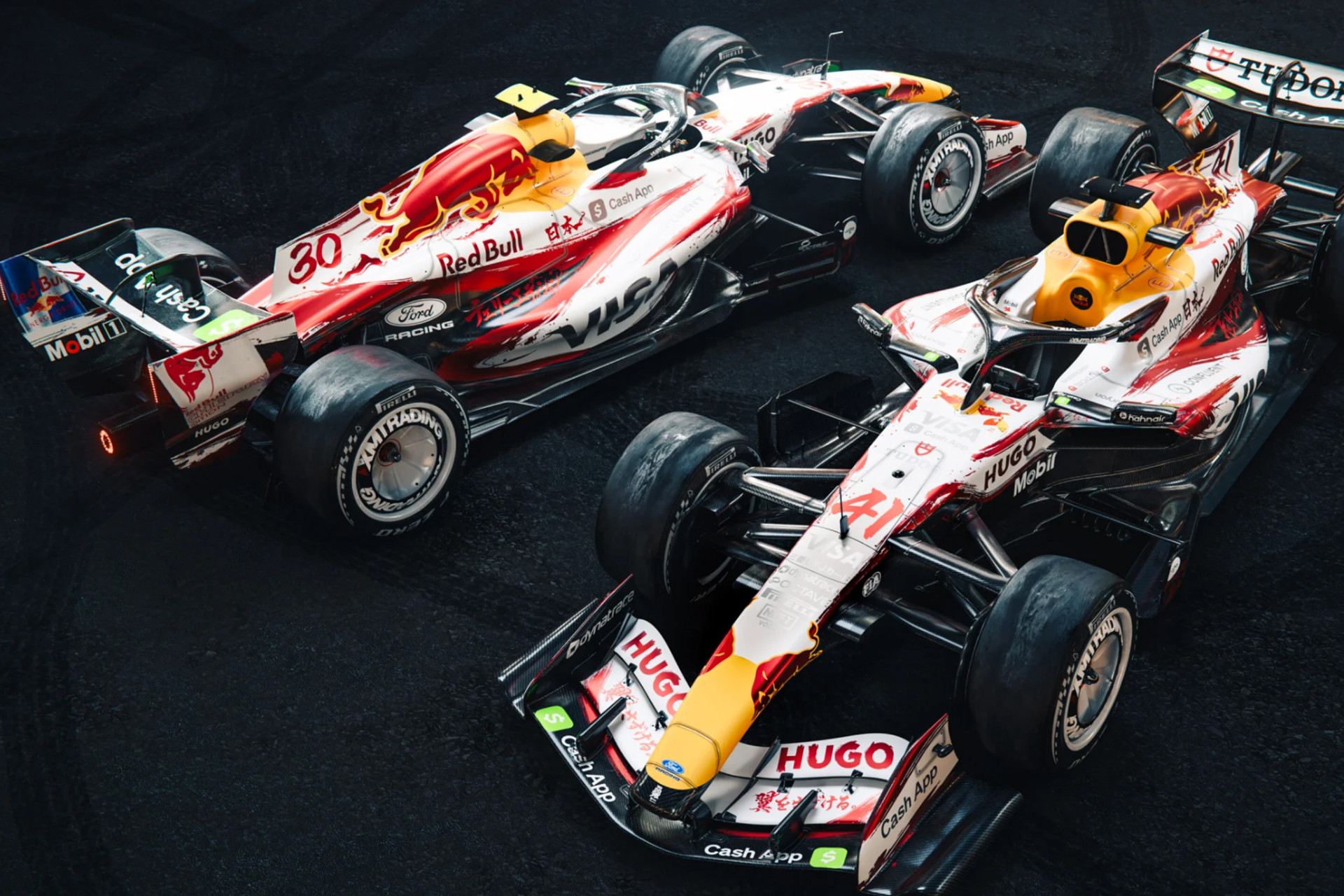
The Paint is a Distraction: What Racing Bulls' Cherry Blossom Livery Tells Us About F1's Data-Driven Identity Crisis

I stared at the press release images, the elegant brushstrokes of Bisen Aoyagi bleeding across the carbon fiber. Beautiful. And utterly, completely irrelevant to the stopwatch. This is modern Formula 1 in a single, cherry-blossom-flecked frame: a breathtaking spectacle meticulously engineered to distract from the sterile, algorithmic reality beneath the paint. While Racing Bulls CEO Peter Bayer talks of connecting with "cultures that shape the sport," I can't help but hear the hum of the server rack, calculating the optimal pit window for Liam Lawson before his car has even turned a wheel at Suzuka.
The Aesthetic Alibi: Storytelling When the Data Has No Soul
Let's be clear. The livery is a masterpiece of marketing symbiosis.
- Design Inspiration: White, red, and silver, from the Red Bull Spring Edition can and Japan's sakura.
- Artistic Collaboration: With calligrapher Bisen Aoyagi, who said, "Calligraphy captures motion in a single stroke, much like racing captures speed in a pivotal moment."
- Unveiling: A dramatic slide into position at the Red Bull Tokyo Drift event.
Every detail is calibrated. The tour of Tokyo landmarks, the redesigned driver kits—it's a unified, immersive brand moment. Bayer calls it a transformation of a "bold design into something truly unique for the track." But that's the lie we're all buying. The design is unique for the brand activation, not the track. On the track, that car is a vector of data points. Its performance is dictated by wind tunnel correlation numbers, tire deg models, and energy deployment algorithms so complex they might as well be hieroglyphics to the driver.
This is where my skepticism curdles. We celebrate this "connection" to culture while systematically removing the human element that makes culture—and racing—worth connecting to in the first place. What is Aoyagi's single, expressive stroke against ten thousand lines of telemetry code? It's a beautiful alibi, a story we tell ourselves so we can ignore the fact that the driver's intuition, that gut feel for a fading brake pedal or a greasy track surface, is being overwritten by pre-programmed lift-and-coast commands.
"Special liveries are a powerful tool to engage local fans... moving beyond pure sponsorship to create memorable moments."
Memorable moments used to be created by drivers wrestling a car, by a strategic gamble that defied the data. Now, we create them with paint and PR stunts. The real narrative isn't in the cherry blossoms; it's in the timing sheets no one will publish, the internal data that shows Lawson's 0.2-second lap time drop-off in high-fuel runs, a story of car balance no livery can paint over.
The Schumacher Standard: When Feel Was the Final Algorithm
This brings me, as it always does, to Michael Schumacher's 2004 season. That Ferrari was a beast, but it was a beast he felt. There was no real-time telemetry telling Ross Brawn what Michael was feeling in his fingertips. The communication was human: a crackle over the radio, a debrief steeped in sensory detail. The consistency—13 wins in 18 races—was born from a symbiotic fusion of man and machine, where the driver's feedback was the primary data stream.
Contrast that with today. Arvid Lindblad will strap into that cherry blossom car at Suzuka, and before he's even found his rhythm, a team of analysts will know more about his car's performance than he does. They'll see the marginal brake disc temperature anomaly, the slight deviation in rear-axle energy recovery. They'll feed him delta times and engine modes. His job is increasingly to execute a pre-ordained performance curve, to be a biological component in a cybernetic system.
Is this progress? In pure lap time, unequivocally yes. In sporting soul, it's a rout. We are trading the chaotic, human drama of a driver pushing beyond the model's limits for the clean, predictable execution of a simulation. The cherry blossom, symbolizing transience, is ironically plastered on the most rigidly controlled, pre-meditated version of racing we've ever seen.
Conclusion: The Data Archaeologist's Prediction
So, as the beautiful car goes on display in Shibuya, I look past the brushstrokes. I see the data ports. I see the story Racing Bulls wants to tell—one of cultural reverence and artistic fusion. And I see the true story, written in the cold, hard numbers that will govern its every move at Suzuka.
Within five years, this trend doesn't just continue; it culminates. We will have "robotized" racing. Driver intuition will be an antiquated concept, a charming anecdote like manual gearshifts. Pit stops will be purely algorithmic, triggered not by a race engineer's hunch but by a live cloud-based model that factors in the micro-climate over Sector 1. The sport will become a public demonstration of simulation accuracy.
My work as a data analyst will shift from performance prediction to emotional archaeology. I'll be sifting through the numbers of a season like 2026, trying to find the ghost in the machine—correlating Liam Lawson's subtle performance dip with the pressure of a contract negotiation, or a personal milestone, the last vestiges of human affect bleeding into an otherwise sterile data set.
Racing Bulls' livery is a poignant, gorgeous epitaph for the era when the car was an extension of the driver's body, not just the team's server. Enjoy the cherry blossoms. They, like the driver's role as we knew it, are beautifully, tragically transient. The stopwatch, however, is eternal and merciless. And it tells a much colder story.