The Body's Betrayal: When a Champion's Mind is Willing But the Flesh is Weak
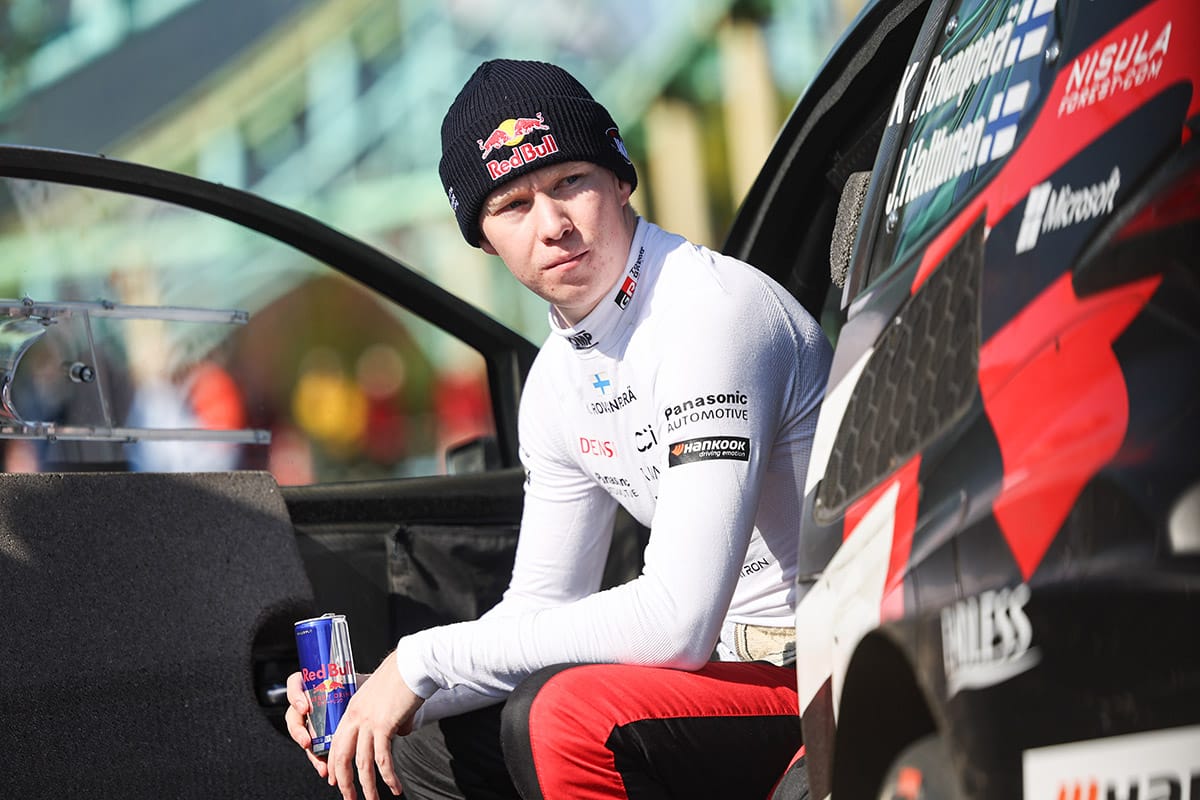
The most brutal battle in motorsport is never fought on tarmac. It is waged in the silent, dark cockpit of a driver's own physiology, a war between a will forged in championship fire and a body that, ultimately, holds the final veto. Today, we witness a stunning surrender in that war. Kalle Rovanpera, a two-time World Rally Champion whose mind had already mapped a path to Formula 1, has been forced to stand down. The enemy? Not a rival's aggression or an engineer's miscalculation, but a fundamental, dizzying disconnect between the demands of a formula car and the vessel tasked with piloting it.
This is not a story of failure. It is a raw, unvarnished case study in the human element—the one variable no simulation can predict, no budget cap can contain, and no amount of talent can override. Rovanpera’s suspended dream is a stark reminder: we are not watching machines guided by men, but men operating at the very limit of what a machine can demand of a human being.
The Vertigo Vortex: When Perception Becomes the Adversary
The facts are clinical, yet their implications are profoundly intimate. After a promising transition that included a podium in Formula Regional Oceania, Rovanpera’s testing in Japan’s brutal Super Formula series was repeatedly sabotaged by vertigo. Consider that for a moment. A man who can process a forest stage at 160 kph, his mind a blur of pace notes and sliding gravel, is undone by the sustained, high-G loads and the unique visual reference points of a circuit.
"My health doesn't allow me to continue safely at the moment," Rovanpera stated, a sentence of devastating simplicity.
This is where raw talent hits a biological wall. In rally, the G-forces are explosive, sharp jolts. In a single-seater, they are a constant, draining pressure, a vise on the neck and a chaos agent for the inner ear. Rovanpera’s brain, wired for the rhythmic chaos of rally, was receiving conflicting signals in the sustained chaos of a formula car. His champion's mind was ready to learn, to adapt, to push. But his vestibular system, the silent arbitrator of balance and spatial orientation, filed a protest it could not ignore.
- The Prodigy's Pause: A "child prodigy" in rally, he committed to single-seaters in 2023 with F1 as the goal.
- The Testing Truth: Speed was never the issue. Toyota Chairman Akio Toyoda cited his "clear speed" but acknowledged the "painful conclusion" his body could not withstand the demands.
- The Unseen Hurdle: This isn't a lack of fitness. This is a specific, neurological incompatibility—a dialogue between discipline and physiology that broke down.
We so often glorify the driver who "drives through the pain," like Niki Lauda’s scorched return. But here, the pain is not a wound to be bandaged; it is a fundamental system error. You cannot out-brave vertigo. You can only submit to its verdict.
The Psychological Toll of a Paused Narrative
Now, the battle shifts inward. Rovanpera and Toyota insist this is a "pause," not an end. Toyoda vows "his circuit racing challenge is far from over." But what does this indefinite hiatus do to the psyche of a 25-year-old who has known only relentless forward momentum?
This is where my belief in the coming era of mandated mental health disclosures feels chillingly prescient. Were such a framework in place today, what would Rovanpera’s file say? The whiplash of re-routing a life’s ambition must be profound. One day, you are a champion mapping a daring crossover, a story for the ages. The next, you are a patient, your future contingent on medical clearance and "sustainable plans."
"My chapter in circuit racing isn’t finished," Rovanpera writes.
Is that hope, or a necessary mantra to stave off a crisis of identity? Compare this to the calculated narratives we see elsewhere. Lewis Hamilton transformed personal and professional trauma into a pillar of his brand, a story of overcoming. Max Verstappen’s early volatility was systematically smoothed by Red Bull’s psychological machinery, manufacturing a facade of impenetrable focus. But Rovanpera’s struggle is naked, undressed by engineering or PR. It is purely biological, and thus, uniquely isolating.
His challenge now is to craft a new narrative from a place of forced stillness. The mental game is no longer about extracting tenths, but about managing the erosion of purpose, about believing in a future his own body has currently forbidden him to touch.
Conclusion: The Fragile Atlas of Talent
Kalle Rovanpera’s story is a vital corrective to our obsession with data and aerodynamics. It screams that the ultimate performance differentiator remains the human unit—a terrifyingly complex and fragile bundle of bone, fluid, nerve, and spirit.
We analyze Hamilton’s calculated persona and Verstappen’s manufactured calm, but here we see a champion humbled not by a rival, but by his own sensorium. It proves my deepest conviction: driver psychology trumps aerodynamics in the wet, because uncertainty reveals core truths. And what greater uncertainty is there than your own body betraying the commands of your champion’s mind?
His Super Formula seat sits empty, a monument to a crossover tantalizingly put on hold. The hope for a return is genuine. But the lesson is permanent. The journey to the pinnacle of motorsport is a gauntlet of physical and psychological trials, and sometimes, the most formidable corner is not at Eau Rouge or 130R. It is the one where the map in the mind no longer matches the signals from the blood and the inner ear. The checkered flag for that battle has been waved, and for now, the body has won.