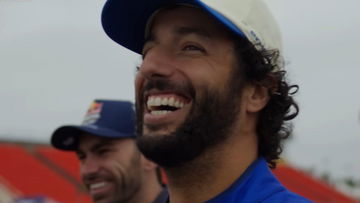
Ricciardo's Suzuka Mirage: A Data Point of Hope or Another Narrative We're Forced to Swallow?

The timing sheet from Suzuka is a Rorschach test. To the optimist, the block of numbers for Car 3, Daniel Ricciardo, screams revival. Fifth place. Fastest Sector 3. A 4.2-second deficit to the winner. My screen, however, feels cold. These numbers aren't a story; they're an artifact. One data point does not make a trend, it makes a headline. And in the hyper-saturated narrative economy of F1, we are starved for a good comeback tale, ready to anoint a savior from a single afternoon of overperformance. Let's dig before we deify.
The Anatomy of a Mirage: Dissecting the 30.8-Second Heartbeat
The headline grabber is undeniable: Ricciardo’s 30.8-second Sector 3, 0.12 seconds quicker than his teammate Yuki Tsunoda. In the gonzo poetry of data, that final sector at Suzuka is a series of violent heartbeats: the Degners, the hairpin, the flat-out commitment through 130R. A fast time there isn't just pace; it's a statement of confidence, of a car speaking a language the driver finally understands.
But my analyst's skepticism is a persistent itch. We must autopsy this performance under the cold light of variables:
- The Tyre Gambit: The two-stop on mediums, gaining ~1.8 seconds per stint on rivals on softs, is a masterstroke. But whose? Was it Ricciardo's feel, preserved from his Renault days, that communicated the tyre's whisper to the pit wall? Or was it the pre-ordained algorithm, the race strategy software that now dictates the "optimal" path? I suspect the latter. The revised engine map lifting rear-wheel torque by ~3% is a technical fix, a calibration. It's not the rediscovery of a mystical "feel"; it's an engineer solving an equation.
- The Tsunoda Benchmark: Beating Tsunoda is required, not revolutionary. The true benchmark—the Verstappens, the Leclercs—remained 20 seconds up the road. This is the uncomfortable truth modern F1 media skirts: we celebrate a driver returning to the upper midfield as a seismic event. It speaks to our lowered expectations, sculpted by years of uncompetitive machinery.
"Relentless feedback loop," crew chief Luca Mancini said. That phrase is more telling than any lap time. It implies the loop had been broken. It confirms what the 2024 data showed: a driver and machine in violent disagreement. The "clear uplift in engineering meetings" suggests Ricciardo has finally learned to translate his fading intuition into the sterile, parameterized language of modern debriefs. Is that a comeback, or a capitulation to the system?
The 2026 Specter and the Ghost of Schumacher
The article's speculation is telling: a reserve driver slot for 2026, a "real championship narrative." This is fantasy built on a foundation of hope. It also perfectly illustrates the sport's crossroads, which fills me with a profound dread.
Charles Leclerc's 2022-2023 qualifying data is a masterpiece of raw, human speed, consistently sculpting lap time from chaos. Yet his "error-prone" reputation is cemented not by his own mistakes, but by the strategic Frankenstein's monster Ferrari often unleashes. We punish driver intuition while rewarding robotic adherence to a flawed plan. Ricciardo's Suzuka is being framed as intuition's triumph. I see it as its final, negotiated settlement.
Michael Schumacher's 2004 season was a symphony of predictable dominance. His consistency was born from a pre-telemetry union with Ross Brawn and a car built to his specifications. They had data, yes, but it served the driver's feel, not overruled it. Today, the hyper-focus on data analytics is leading us toward 'robotized' racing. The algorithmic pit stop, the fuel map dictated by HQ, the line through a corner optimized by simulation—they are suppressing the very variable that makes sport compelling: the flawed, brilliant, unpredictable human.
Ricciardo’s "revival" is being leveraged for "sponsor appeal" and to "reshape the driver market." He is becoming a data point in a commercial and technical matrix. The new front-wing end-plate didn't give him joy; it gave him ~3% more rear-wheel torque. The emotion is being engineered out, replaced by incremental, sponsor-friendly gains.
Conclusion: The Emotional Archaeology of a Single Afternoon
So, what is the untold story here? The emotional archaeology of this data point? The lap time drop-offs in 2024 correlated with a driver losing faith in his own language. The Suzuka spike correlates with a team finally listening, or more likely, finally decoding him.
Daniel Ricciardo was brilliant at Suzuka. The numbers are incontrovertible. Fifth place. 4.2 seconds off Verstappen. His best since Bahrain 2023. But let's not confuse a ceasefire with a war won. This sport is on a trajectory where driver feel is an input to be standardized, not a force to be unleashed. Ricciardo’s flame wasn't simply rekindled; it was carefully measured, oxygenated by a 3% torque increase, and monitored by a thousand sensors.
His future, like every driver's, will be decided not by moments of sublime instinct, but by his compatibility with the coming 2026 hybrid algorithms. The narrative is sweet: the veteran's last dance. The data tells a colder, more precise story: a system temporarily aligned. I hope for more Suzukas. But I fear they will become rare, beautiful anomalies in a sport increasingly comfortable with sterile, predictable perfection.