Steiner's Pragmatism on Antonelli: A Symptom of F1's Lost Connection to Mechanical Grit
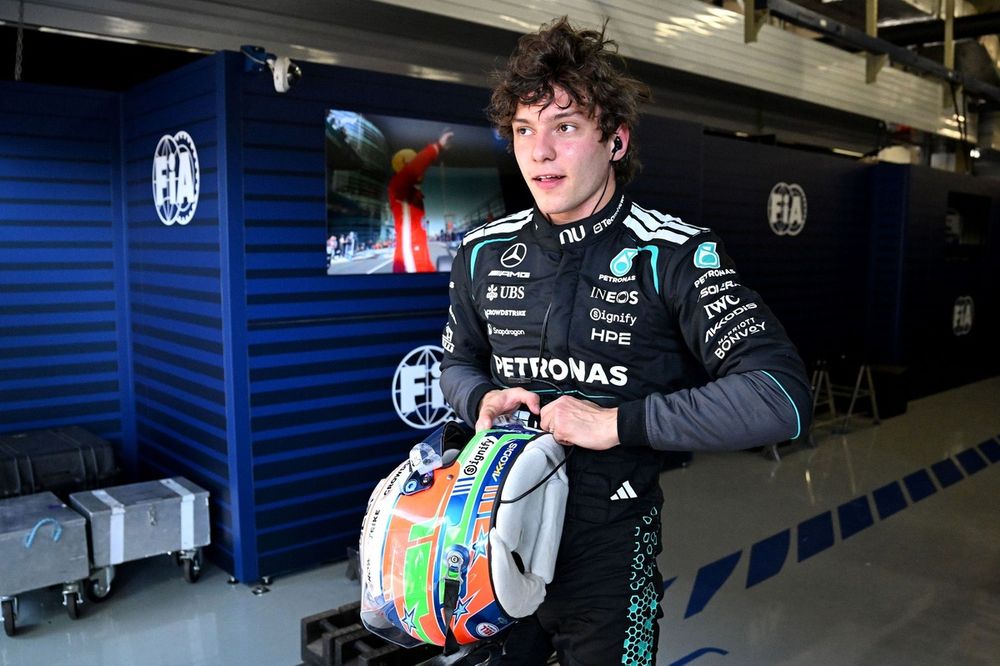
The champagne in Shanghai had barely dried before the hype machine, that great, bellowing beast of modern Formula 1, began to churn. Kimi Antonelli, the 19-year-old Mercedes rookie, had his breakthrough win. Cue the predictable, breathless speculation: Is he a 2026 title contender? Former Haas principal Guenther Steiner, ever the blunt instrument, promptly poured a bucket of ice water on the idea. He’s right, of course. But his reasoning—focusing on the experience gap to George Russell—only scratches the surface of a far more profound truth we’re all ignoring. This isn’t just about a teenager’s composure; it’s about a sport that has systematically engineered the driver’s raw, mechanical feel out of the equation, making veteran savvy less about car whispering and more about managing a suite of digital presets.
Steiner’s dismissal isn’t cynicism; it’s the logical conclusion of an era where the aerodynamic map is king, and the driver is increasingly its servant. Antonelli’s win, as Steiner noted on The Red Flags Podcast, came in "atypical circumstances" with Russell hamstrung by technical issues. One opportunistic victory does not a champion make. But the deeper question is: what does make a champion in this era? We’re told it’s about "managing complexity," but I argue we’ve confused complexity for sophistication.
The Ghost in the Machine: Why Experience Now Means Managing Code, Not Feel
Steiner highlighted the core dynamic: beating George Russell, a top-tier talent embedded within Mercedes for years, "remains very difficult" for Antonelli under normal conditions. This is the standard narrative. The rookie learns from the veteran. But what, precisely, is he learning?
"I don't think he can do it this year," Steiner stated, advising Antonelli to treat 2026 as a "foundation year."
This is sage advice. Yet, the foundation being built is for a fundamentally different kind of racing than what defined legends of the past. Russell’s experience edge isn’t in wrestling a twitchy monster of a car on mechanical grip alone, like Senna in the rain or Schumacher on worn tires. It’s in understanding the labyrinthine interactions between:
- Porpoising-triggered floor stiffness adjustments
- Energy recovery deployment zones
- The precise millimeter of ride height that unlocks the floor’s vortex seals
This is engineering management, not pure driving. The driver’s sensory feedback loop—the seat-of-the-pants connection to the contact patch—is filtered through layers of algorithm and aerodynamic dependency. Antonelli’s task isn't to out-drive Russell in the classical sense; it’s to out-optimize him within the digital and aerodynamic envelope the team provides. This is why Verstappen’s dominance feels so sterile. His brilliance is undeniable, but it is amplified to superhuman levels by a car—the Red Bull—with an aerodynamic platform of such forgiving, dominant efficiency that it masks what would be critical flaws in a car with a weaker concept. The chassis and aero do the heavy lifting, making the driver’s role one of flawless execution rather than desperate invention.
The Coming Storm: Active Aero and the Final Nail in the Driver’s Coffin
This brings me to my central, uncomfortable prediction. If you think the driver’s role is diluted now, just wait. Within five years, by 2028, AI-controlled active aerodynamics will render discussions like “experience gap” almost quaint. DRS will be obsolete, replaced by surfaces that morph in real-time, not by driver command, but by machine learning algorithms processing data from the car ahead.
Imagine China 2026 versus China 2028. Antonelli 2026 capitalizes on Russell’s misfortune with a cool head, a testament to human nerve. Antonelli 2028 might be told by his engineer, "The car AI is initiating Chase Mode 3, just hold the wheel." The chaos will be incredible—overtaking might become constant—but it will be manufactured chaos. The 1990s Williams FW14B, with its pioneering active suspension, was a mechanical marvel that still required a genius like Mansell or Patrese to extract its limit. The coming active-aero cars will be computational marvels that extract their own limit, with the driver as a biological component in the feedback loop.
This is the context for Steiner’s tempered perspective. He’s looking at the 2026 season as a battle of human development. I’m looking at it as one of the last seasons where that development, in its traditional form, even matters. Antonelli’s "bright future" that Steiner alludes to will be fought on a battlefield being radically re-terraformed.
Conclusion: Celebrating the Wrong Victory
So, let us praise Kimi Antonelli for a drive well-executed. Let us agree with Guenther Steiner that a title challenge this year is a fantasy. But let’s not mistake the real lesson. His win was a triumph of modern F1: capitalize on a rival’s technical misfortune, don’t make errors, manage the systems. It was not a display of overwhelming, car-taming skill born of mechanical sympathy. That art is fading.
The pressure on Antonelli isn't just to match Russell’s experience. It’s to master a discipline that is becoming less about driving and more about systems arbitration. My advice to the young Italian? Enjoy these last few years where the human element still flickers. Learn everything you can from George. Because the storm of AI-driven aero is coming, and when it hits, the very concept of a "driver’s championship" will need a complete redefinition. The title may still go to the best competitor, but the essence of what they are competing in will have changed forever. Steiner sees a rookie needing time. I see a talented young man racing at the end of an era.